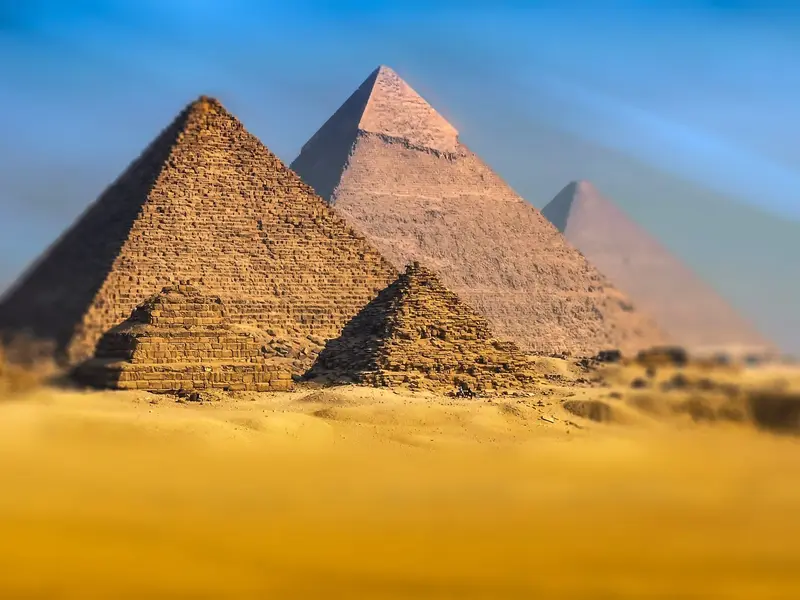
A new theory about the Great Pyramid of Giza is raising eyebrows by suggesting that its architecture may contain a mathematical system linked to the Moon, stars and planetary cycles. Independent researcher Sefy Levy argues that the pyramid’s exterior dimensions were not simply engineering choices but may have been deliberately arranged to encode astronomical and mathematical information.
The claim comes from a paper titled “The Pyramid as Memory Hypothesis,” published by Levy on SSRN in August 2026 and revised in September. The paper is not peer-reviewed, and its conclusions have not been independently established by mainstream Egyptologists.
What is the alleged mathematical code?
Levy examined the Great Pyramid’s principal exterior measurements, including its base, height and slope, and applied fractions associated with ancient Egyptian mathematical practices.
He then compared the resulting numbers with astronomical and mathematical values.
One of his examples produces 27.5, which he connects with the roughly 27.55-day interval between successive lunar perigees, when the Moon reaches its closest point to Earth.
Another calculation produces 70, which Levy links to the approximate period during which Sirius becomes invisible because of the Sun’s glare. He also proposes possible numerical connections with the cycles of planets, including Jupiter, Saturn, Venus and Mars, as well as constants such as pi and the golden ratio.
These are the central pieces of evidence behind his suggestion that the pyramid could have functioned as a kind of permanent mathematical and astronomical record.
How did the researcher test whether the patterns were accidental?
This is where Levy’s analysis becomes more statistical.
He compared the Great Pyramid’s measurements against 100,000 computer-generated pyramid models with different dimensions. According to reports describing the study, about 2.4 percent of those models produced comparable numerical patterns.
Levy interprets that result as evidence that the Great Pyramid’s combination of measurements may be unusual enough to suggest intentional design.
But a low percentage by itself does not demonstrate that ancient Egyptians deliberately encoded astronomical cycles.
Statistical significance depends heavily on how the models were generated, what counts as a “match,” how many possible comparisons were tested and whether the analysis was designed before the patterns were identified. Those questions are particularly important in research involving many mathematical combinations.
What does the actual paper say?
The SSRN version gives a more complicated picture than the simplified “hidden code” headline suggests.
Levy says he tested the pyramid using six exterior dimensions derived from a base of 440 royal cubits and a seked of 5½. He reports 10 astronomical or calendrical targets reached within a specified tolerance, while four were missed. He also says some potential targets were excluded because reaching them would require mathematical operations prohibited by his stated rules.
The paper describes several statistical controls, including comparisons involving Egyptian unit fractions, Babylonian sexagesimal mathematics and decimal systems.
Levy also says his analysis code and raw output have been made available for replication.
That makes the research testable, but testability is not the same as independent confirmation.
Did ancient Egyptians know about pi and the golden ratio?
The Great Pyramid’s dimensions have long generated debate over whether its builders incorporated mathematical constants into its design.
Its reconstructed dimensions are commonly given as about 280 royal cubits in height and 440 cubits along each side of the base. The resulting proportions produce values that can be expressed in ways resembling pi and, depending on the geometric formulation, the golden ratio.
But there is a major difference between saying that a modern calculation produces a familiar mathematical constant and proving that ancient architects intended that constant to be encoded.
Researchers have debated this question for decades. A 2014 study in Nexus Network Journal noted competing explanations for the pyramid’s proportions, including practical Egyptian construction methods and interpretations involving pi and the golden ratio.
What was the Great Pyramid actually built for?
The conventional archaeological interpretation identifies the Great Pyramid as the monument of Pharaoh Khufu, built during Egypt’s Fourth Dynasty around 4,500 years ago.
It is widely understood as a royal funerary monument, although questions remain about precisely how its internal spaces and religious symbolism were used.
The fact that no royal mummy was found inside the Great Pyramid is sometimes presented as evidence against the tomb interpretation. But the absence of a surviving burial does not, by itself, establish that the structure had a completely different purpose.
NASA educational material likewise describes the Great Pyramid of Khufu as a tomb monument and notes its precise orientation and unusual geometry as long-standing subjects of scientific study.
What does Levy think the pyramid represented?
Levy proposes a much broader interpretation.
Rather than viewing the Great Pyramid primarily as a tomb, he argues that it may have been designed as “memory” made into architecture, preserving mathematical, astronomical and cosmological knowledge in its physical proportions.
His paper also connects the monument with the ancient Egyptian concept of Benben, the primordial mound associated with creation in Heliopolitan mythology. The theory extends into a much larger hypothesis concerning the Green Sahara and the origins of Egyptian sacred traditions.
Those ideas form part of a series of papers Levy has published in 2026, but they remain his hypotheses rather than established archaeological conclusions.
Could the Moon really be encoded in the pyramid?
The proposed lunar connection is intriguing, but it requires caution.
The Moon’s anomalistic month, the interval between successive perigees, is about 27.55 days. Levy’s reported 27.5 result is numerically close to that value.
The challenge is determining whether that proximity is meaningful or coincidental.
Ancient structures contain many measurements, ratios and geometric relationships. Once researchers search across numerous astronomical periods and mathematical constants, some close numerical matches can emerge naturally.
Establishing intentionality therefore requires more than finding a handful of matching numbers. It requires demonstrating that the numerical system was available to the builders, that the construction dimensions uniquely support the proposed interpretation and that alternative explanations are less convincing.
What does the “2.4 percent” result prove?
It does not prove that the pyramid contains a deliberate astronomical code.
At most, under Levy’s stated modeling rules, the Great Pyramid produced the specified combination of patterns less frequently than most of the simulated alternatives.
Whether that difference establishes intentional design depends on the details of the statistical experiment and independent replication.
This is why the study’s status matters. The paper is hosted on SSRN, which allows researchers to circulate manuscripts, but publication there is not equivalent to passing through conventional peer review.
Why is the theory attracting attention?
The Great Pyramid has always been fertile ground for mathematical speculation because its dimensions are extraordinarily precise.
Its builders created a structure with four nearly cardinally aligned sides, a highly regular square base and carefully calculated slopes. Ancient Egyptian mathematics also demonstrably included sophisticated practical techniques for surveying, construction and fractions.
That combination makes it reasonable to investigate whether the pyramid’s geometry reflected astronomical knowledge.
What remains unresolved is how far that knowledge went and whether specific modern mathematical relationships were intentionally embedded in the monument.
For now, Levy’s work adds another hypothesis to that long-running debate, not a final answer.