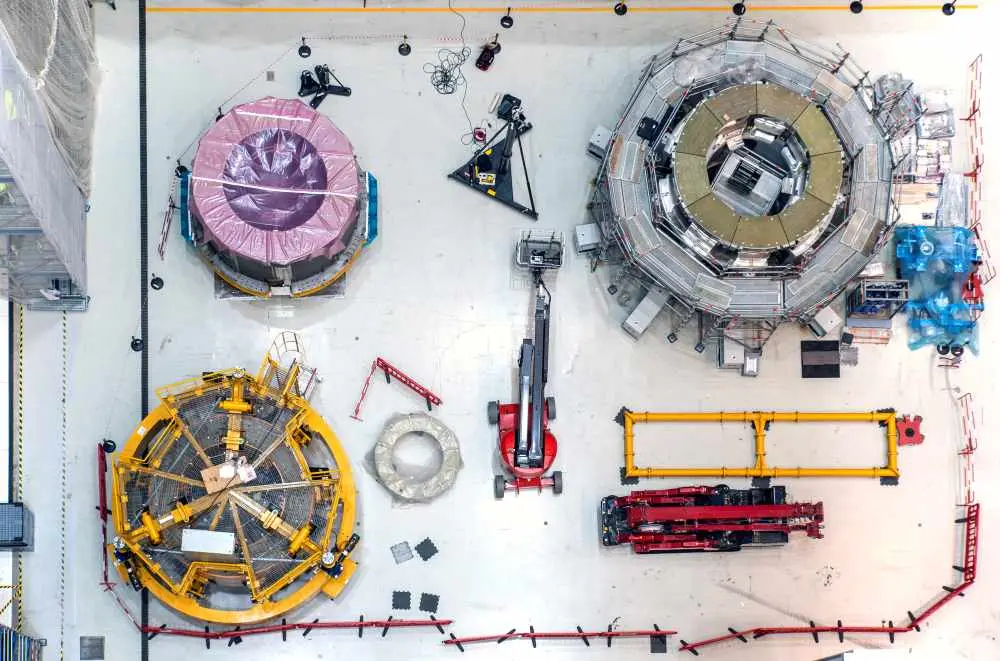
The world’s largest nuclear fusion experiment has crossed another major milestone.
ITER, the massive international fusion project under construction in Cadarache, has received the final components needed to assemble the central solenoid — the enormous superconducting magnet often described as the “heartbeat” of the reactor.
The delivery marks a significant step forward for a project that has spent decades trying to recreate the same energy process that powers the Sun.
If successful, ITER could help prove that nuclear fusion can become a viable source of nearly limitless clean energy. But the project also faces growing skepticism over its timeline, soaring costs, and competition from faster-moving private fusion companies.
What Is ITER?
ITER, short for International Thermonuclear Experimental Reactor, is the largest fusion energy experiment ever attempted.
The project is backed by a coalition including:
- United States
- China
- European Union
- India
- Japan
- South Korea
- Russia
The goal is ambitious: demonstrate that fusion can generate far more energy than it consumes.
Unlike traditional nuclear fission reactors, which split atoms apart, fusion combines light atomic nuclei at extremely high temperatures to release enormous amounts of energy.
That process powers stars, including the Sun.
Scientists have spent decades trying to make it work reliably on Earth.
Why the Central Solenoid Matters
The newly completed central solenoid is one of the most important parts of the ITER reactor.
Developed in the United States at Oak Ridge National Laboratory, the magnet is designed to help control and stabilize the superheated plasma inside ITER’s tokamak reactor.
The scale is staggering
According to project details:
- The solenoid stands 18 meters (59 feet) tall
- It measures 4.25 meters (14 feet) wide
- It consists of six separate modules
- Each module weighs more than 122 tonnes
- Every module contains roughly 6 kilometres of superconducting cable
The system uses niobium-tin superconductors capable of carrying immense electrical currents without resistance when cooled to extremely low temperatures.
A strong visual addition here would be a scale graphic comparing the central solenoid to a multi-story building or rocket booster.
What does the solenoid actually do?
The central solenoid acts somewhat like the engine of the tokamak.
Its job is to:
- Generate a massive magnetic field
- Induce electric current inside the plasma
- Help keep the plasma stable
- Sustain fusion conditions inside the reactor chamber
Without magnetic confinement, the plasma would instantly escape and destroy the reactor walls.
That is because fusion plasma reaches temperatures hotter than the core of the Sun — over 150 million degrees Celsius.
What Is a Tokamak?
At the center of ITER sits a giant machine known as a tokamak.
A tokamak is a doughnut-shaped fusion reactor that uses magnetic fields to contain plasma.
Why plasma containment is so difficult
Fusion requires atomic nuclei to collide and merge. But because nuclei naturally repel one another, scientists must create:
- Extremely high temperatures
- Intense pressure
- Stable confinement conditions
ITER attempts to solve this using giant superconducting magnets that suspend plasma away from physical surfaces.
The full magnetic system reportedly weighs around 3,000 tonnes and interacts with nine vacuum vessel sectors surrounding the plasma chamber.
A useful infographic here could illustrate:
- How a tokamak works
- The role of superconducting magnets
- How plasma circulates inside the reactor
Why Nuclear Fusion Is Called the “Holy Grail” of Energy
Fusion has long been viewed as one of science’s most promising clean energy technologies.
That is because fusion could theoretically provide:
- Massive amounts of energy
- No greenhouse gas emissions during operation
- Minimal long-lived radioactive waste
- Fuel sourced from abundant materials like hydrogen isotopes
Fusion vs. fission
Traditional nuclear plants use fission, which splits heavy atoms such as uranium.
Fusion works differently by combining light atoms, usually hydrogen isotopes like deuterium and tritium.
Supporters argue fusion could eventually overcome many criticisms directed at fossil fuels and current nuclear systems.
Unlike coal or gas plants, fusion would not emit carbon dioxide during operation.
Unlike fission reactors, fusion carries far lower risks of runaway chain reactions or large-scale meltdowns.
Why ITER Has Faced So Many Delays
Despite its scientific promise, ITER has become almost as famous for its delays and cost overruns as for its engineering achievements.
The project has taken decades
The core magnetic system alone required:
- 15 years of development
- Multi-country coordination
- Two-year testing cycles per module
- Precision manufacturing on a massive scale
Construction on ITER began nearly two decades ago, but the reactor is still years away from producing its first plasma.
Current estimates place project costs at roughly €22 billion.
Why fusion is so hard
Fusion remains one of the most technically difficult scientific challenges ever attempted.
Researchers must simultaneously manage:
- Extreme heat
- Superconducting systems
- Magnetic confinement stability
- Plasma turbulence
- Material durability
- Gigantic energy requirements
Even tiny instabilities can disrupt plasma confinement within milliseconds.
That complexity helps explain why commercial fusion has repeatedly remained “decades away” despite enormous scientific progress.
Private Fusion Companies Are Increasing the Pressure
While ITER remains the flagship international fusion project, the competitive landscape is changing rapidly.
Over the past several years, private fusion startups have attracted billions in investment funding.
Why smaller companies may move faster
Private fusion firms often benefit from:
- Faster decision-making
- Smaller reactor concepts
- Less bureaucracy
- New magnet technologies
- Venture capital funding models
Some startups claim they could achieve commercial fusion milestones before ITER becomes fully operational.
That has sparked debate inside the scientific community about whether giant international megaprojects remain the best path toward viable fusion energy.
Why ITER Still Matters
Despite the criticism, many physicists argue that ITER remains indispensable.
Its scale allows researchers to study plasma behaviour under conditions impossible to replicate in smaller experiments.
ITER is not designed to produce electricity for consumers. Instead, it aims to prove that sustained net-energy fusion is scientifically and technically achievable at an industrial scale.
If ITER succeeds, it could lay the foundation for future commercial fusion plants around the world.
Even critics acknowledge the project is likely to generate valuable scientific data regardless of whether it meets every original timeline target.
The Bigger Picture for Clean Energy
Fusion remains one of the most closely watched technologies in global energy research.
Countries are investing heavily because fusion could eventually help address:
- Climate change
- Energy security
- Rising electricity demand
- Industrial decarbonization
But major questions remain unresolved:
- Can fusion become commercially affordable?
- Can reactors operate continuously?
- Will materials survive decades of extreme conditions?
- Can construction costs be reduced dramatically?
ITER’s latest milestone does not answer those questions yet.
But it does move humanity one step closer to finding out.