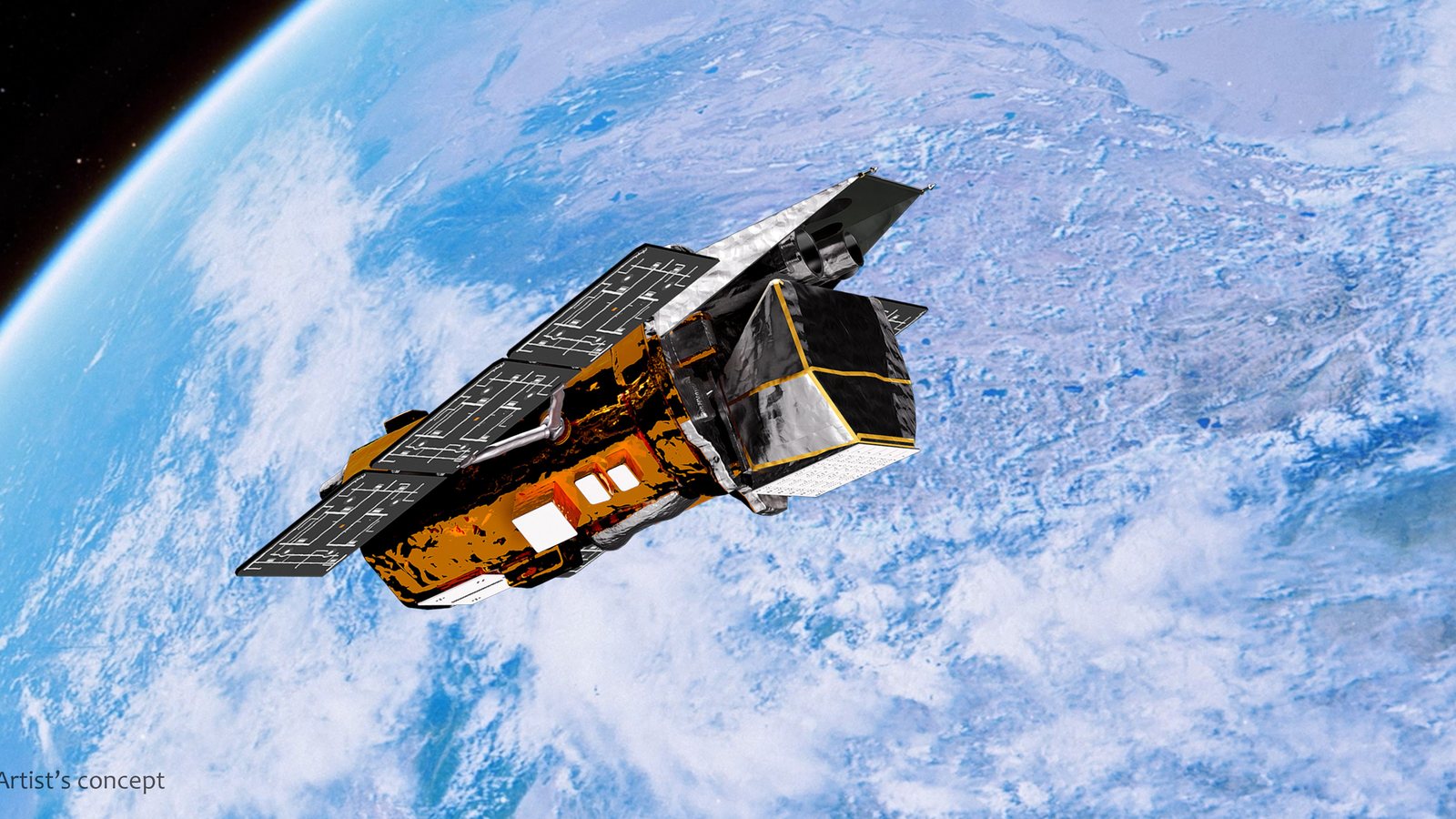
NASA’s Swift telescope will fall back to Earth within weeks in an uncontrolled reentry, after nearly 22 years of chasing cosmic explosions. Swift sank to 171 miles (275 kilometers) on Oct. 20 and slipped into safe mode, NASA said on Oct. 23. Its team then shut it down for good.
Most of the spacecraft should burn up. But NASA expects “some components” to survive and reach the ground, while calling the risk of harm to anyone unlikely.
The fall also closes out a $30 million bet that a private robot could rescue it. Katalyst Space’s LINK spacecraft never got closer than about 7.5 miles to Swift. NASA is losing its fastest-reacting telescope with no replacement waiting.
Where Swift can come down, and where it can’t
Swift’s orbit tilts about 20.5 degrees from the equator, the latest public tracking data on CelesTrak show. Its ground track never reaches farther north or south than that. So it “could reenter anywhere in any latitude from 21 North to 21 South,” Ewan Wright told Space.com. He is a junior fellow at the University of British Columbia’s Outer Space Institute.
That rules out the continental US entirely, since Key West sits near 24.5 degrees north. Honolulu, at about 21.3 degrees, sits just outside the band. But Hawaii’s Big Island, Puerto Rico, the US Virgin Islands, Guam and American Samoa all lie under Swift’s path.
Most of that band is open ocean. “The most likely outcome is that any surviving debris will land in the sea, but there is a chance it could impact a built-up area and cause a casualty,” Wright said.
The timing is still loose. We ran the numbers on the Oct. 26 tracking data, which put Swift at a mean altitude of about 160 miles (257 kilometers).
That is roughly 11 miles lower than six days earlier, and the drop speeds up as the air gets thicker. No agency has published a reentry date or location yet.
What NASA says about debris that survives
Swift has no engine to steer itself down, so nobody can aim it at an empty ocean. Earlier this month, an 11-foot object tied to a Chinese rocket stage turned up in a Minnesota cornfield.
“Yes, Swift will have an uncontrolled reentry,” NASA spokesperson Alise Fisher told Space.com in August. NASA expects most of it to burn up, she said, “but some components are expected to survive reentry. The risk of harm coming to anyone on Earth is unlikely.”
The observatory weighs about 3,200 pounds (1,452 kilograms), CNN reported. Darren McKnight of the tracking company LeoLabs told Space.com that parts of its X-ray and optical telescopes might survive. He named optical lenses and titanium tanks as likely candidates, and said he had seen “no public reporting on the survivability analysis.”
LeoLabs, which also tracked a Russian satellite shadowing a US-operated radar satellite this month, gave CNN its own estimate. “The probability of debris causing significant property damage or physical harm to anyone is very small,” the company said. Most surviving debris falls “into the ocean or on land that’s uninhabited,” it added.
Why the $30 million rescue never reached Swift
NASA picked Katalyst, a Flagstaff, Arizona, startup, in September 2025. The $30 million award went through the Small Business Innovation Research program, a route NASA said let it move faster. The plan was for LINK to meet Swift, grab it with robotic arms and push it higher. Swift was never built to be serviced, and it has no grapple fixtures.
LINK launched July 3 on a Northrop Grumman Pegasus XL rocket dropped from a jet near Kwajalein Atoll. About a week in, a power switch for a reaction wheel failed. Katalyst’s Kieran Wilson described the failures to a National Academies committee, SpacePolicyOnline reported.
Reaction wheels are the spinning motors that keep a spacecraft pointed. By late July, two of LINK’s three wheels were out and it was tumbling, Katalyst said in an update.
Engineers slowed the spin from about 9 degrees per second to about 1.5, NASA said on Aug. 6. That recovery burned through the fuel LINK needed for the capture. “LINK no longer had sufficient fuel to safely execute the planned capture and orbit-raising phase of the mission,” Katalyst told CNN.
On Aug. 19, NASA called off the boost. “This is not the outcome we were working toward,” said NASA Administrator Jared Isaacman, who is also reworking the Artemis moon plan. He added that it “does not change why this mission was worth attempting.”
LINK still deployed its arms, fired its thrusters and photographed Swift from 7.5 to 9 miles away. It reentered on Sept. 25, Katalyst said.
Katalyst CEO Ghonhee Lee blamed the clock. “I think if we had had 12 months even, just three more months, it would have made a tremendous difference,” he told CNN in August, as quoted by Space.com.
How the sun pulled Swift down early
Every satellite in low orbit loses height to drag from the thin upper atmosphere. When the sun is most active, it heats and puffs up that atmosphere, so drag climbs. In October 2024, NASA and NOAA announced that the sun had reached the peak phase of its 11-year cycle. Swift began sinking faster than planned.
The Penn State team that flies Swift fought back with pointing tricks. From December 2025, it swapped science targets for sky positions that cut drag. By February it had paused normal science altogether, according to NASA. That held Swift above 185 miles (300 kilometers), which NASA calls the point of no return, for several months.
Once the rescue was off, the team switched the telescopes back on in late August. That raised drag again, and Swift dropped from about 200 miles in late September to 171 miles by Oct. 20.
What Swift found in 22 years
Swift launched on Nov. 20, 2004, on a two-year mission. Its job was to catch gamma-ray bursts, flashes that can fade in seconds. It would then swing its own telescopes onto them, typically within about a minute.
It observed more than 2,000 of those bursts and more than 1,400 supernovas, NASA said, and its data fed about 7,000 scientific papers. In May 2005 it caught the afterglow of a burst lasting just 0.03 seconds, the first time anyone had seen one from a short burst. That helped show short bursts likely come from colliding neutron stars.
“Swift delivered an incredible, lasting return on investment for the nation, designed for a two-year primary mission but productive for more than 10 times as long,” said Shawn Domagal-Goldman, who leads NASA’s astrophysics division. Its roughly 12-terabyte archive stays public, and NASA says it will lean on existing telescopes to cover the gap.
NASA says it will share more as reentry approaches, “following established interagency procedures for such notifications.” Its next Swift blog post should carry the first official reentry window.