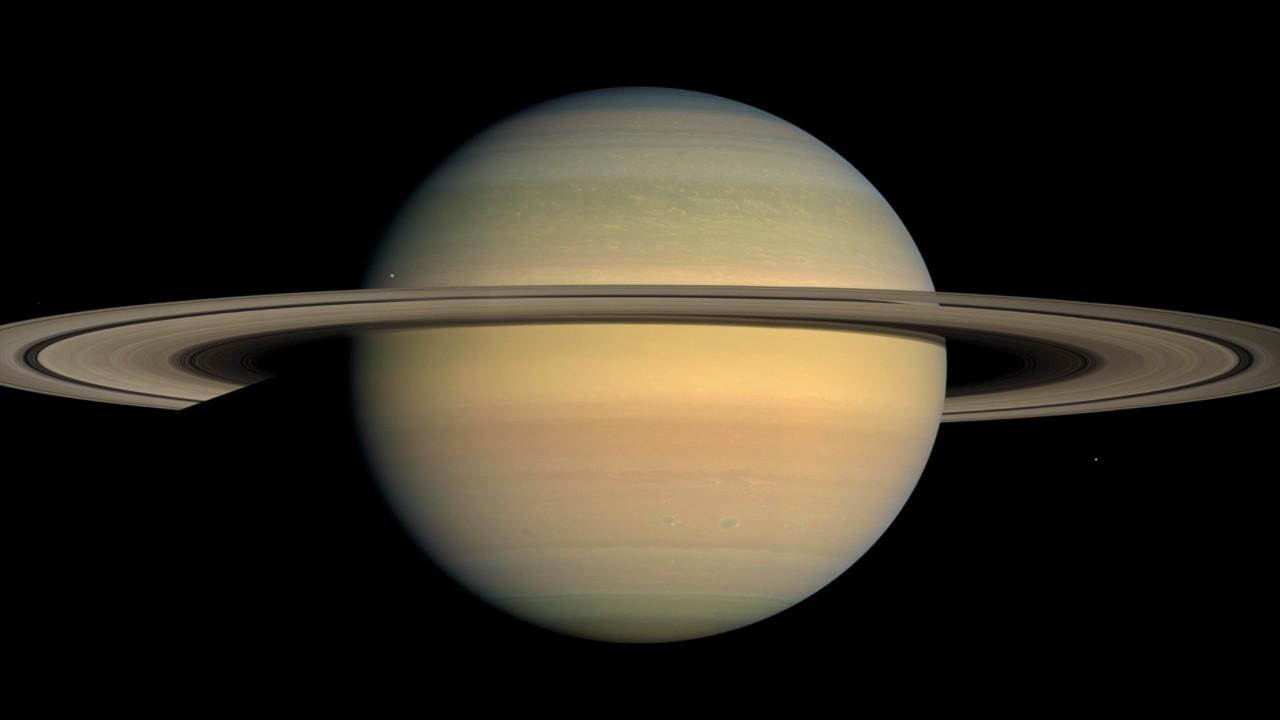
Saturn, the huge planet famous for its rings, will soon lose its glory. According to NASA, the gas planet’s famed intergalactic hoops will soon vanish—thankfully, they will not cease to exist; we will simply be unable to see them. Saturn’s rings will be obscured from our perspective due to its tilting inside its orbital axis. Essentially, as the planet circles the sun again, it will tilt, and the familiar face with the famed rings will disappear from view.
Saturn makes the journey around the sun in about 30 Earth years. Throughout this journey, based on the planet’s tilt, its rings are more or less visible, according to NASA. “For nearly half of Saturn’s orbit, the sun shines on the south side of the rings. For the other half, it shines on the north side,” notes a NASA transcript as quoted by USA Today.
As per NASA estimates, the rings will disappear around March 2025
Stargazers should try to enjoy the view while they can. As per NASA estimates, the rings will disappear in about 18 months, around March 2025. Currently, Saturn’s tilt is angled downwards at nine degrees, and in 2024, this will decrease to a barely visible 3.7 degrees. Finally, in March 2025, it will hit zero degrees, which as per Earth.com will be akin to seeing “a sheet of paper edge-on when it’s positioned at the far end of a soccer field.”
But don’t worry; the rings will be back soon. Saturn’s angle of tilt will be 27 degrees again by 2032, providing the best glimpse of its rings. They fade into obscurity every few years, but researchers believe they may finally vanish. This, however, will not happen in our lifetimes. It will actually take a couple hundred million years.
Saturn contains seven different rings consisting of ice, rocky debris, and dust. According to NASA, these are the leftovers of comets, asteroids, and moons that were pushed apart by the planet’s enormous gravitational attraction. These celestial hoops extend some 70,000 to 140,000 kilometres — the equivalent of the width of 30 Earths. Yet, in most places they are very thin — only 90 metres.