
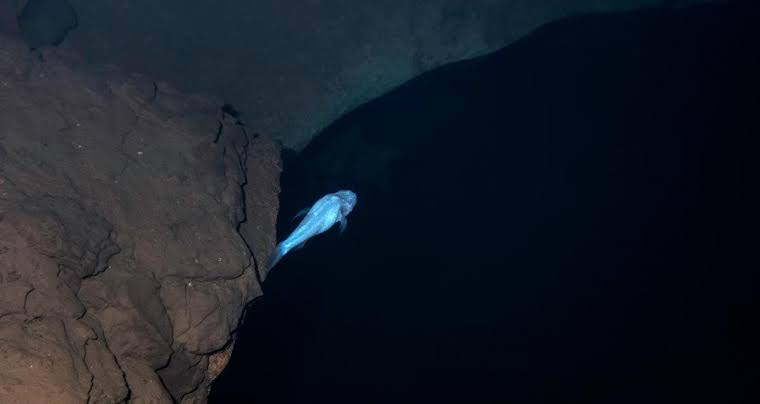
A mysterious new species of eyeless cavefish has been discovered beneath one of the United States’ most unexpected locations: NASA’s Redstone Arsenal in Alabama. Named Demogorgonichthys arcanus—a nod to the mythological demogorgon and the Latin word arcanus, meaning “secret”—the newly identified fish has already earned the nickname “demon cavefish.”
The discovery surprised researchers not only because the fish represents a previously unknown species, but also because it was found in Bobcat Cave, a cave system that scientists have monitored for decades. Despite regular surveys over the past 30 years, the elusive fish had never been recorded until now, raising new questions about how much remains hidden beneath seemingly well-studied environments.
What is the demon cavefish?
The demon cavefish (Demogorgonichthys arcanus) is a newly identified freshwater cavefish that has adapted to life in complete darkness.
Like many cave-dwelling species, it has:
- No functional eyes
- No visible pigmentation
- Adaptations suited to underground aquatic habitats
Researchers from the University of Alabama in Huntsville (UAH), Auburn University, and Mississippi State University identified the species during biological surveys in Bobcat Cave, located beneath Redstone Arsenal, a military installation that also serves as a major center for NASA’s rocket development activities.
The finding highlights how even heavily studied cave systems can still harbor previously unknown species.
Why is the discovery significant?
The discovery stands out for two reasons.
First, Bobcat Cave has been surveyed four times a year for roughly three decades, yet no one had documented this fish before.
Second, the newly discovered species shares its habitat with another eyeless fish—the southern cavefish (Typhlichthys subterraneus)—but the two species are not closely related.
Instead, scientists say they independently evolved similar traits after adapting to life underground, making this a striking example of convergent evolution.
As lead researcher Matthew Niemiller explained, both species lost their eyes and body pigmentation separately over millions of years despite living in the same cave pools.
How can two unrelated fish evolve the same features?
Convergent evolution occurs when unrelated organisms develop similar characteristics because they face similar environmental pressures.
In the case of the demon cavefish and the southern cavefish:
- Both inhabit permanently dark underground waters.
- Eyes offer little advantage where there is no light.
- Maintaining vision requires energy, so natural selection favors individuals that redirect resources to other senses.
Over millions of years, both species independently evolved into eyeless, pale cavefish despite originating from different evolutionary lineages.
Their similarities are the result of adaptation—not shared ancestry.
Why hadn’t scientists seen the demon cavefish before?
Researchers believe the answer lies beneath the cave itself.
Unlike the southern cavefish, the demon cavefish appears to spend much of its life deeper within the underground aquifer, beyond the areas typically accessible during routine cave surveys.
Genetic analysis provided an important clue.
Scientists found that the new species lacks part of the rhodopsin gene, which plays a role in light sensitivity. This difference may explain why it occupies darker, deeper waters than its cave-dwelling neighbor.
According to Auburn University researcher Jonathan Armbruster, the fish may have recently moved upward from deeper sections of the aquifer, making it visible during surveys for the first time.
However, he also noted that it is equally possible the species has always been present but simply escaped detection.
Why does the location matter?
Bobcat Cave lies beneath Redstone Arsenal, a federally protected area known primarily for aerospace and defense research.
While the installation is famous for rocket development and NASA operations, the restricted land above has also helped shield the underground ecosystem from urban development and habitat destruction.
The cave supports numerous endemic subterranean species, meaning many organisms found there occur nowhere else on Earth.
Researchers say continued protection of the surrounding land will be essential for preserving these fragile ecosystems and for uncovering additional undiscovered species.
What does the discovery reveal about biodiversity?
The finding serves as a reminder that scientists have not yet documented all of Earth’s biodiversity—even in places that have been studied extensively.
Modern technologies such as genetic sequencing continue to reveal hidden species that were previously mistaken for known animals or simply overlooked because of their rarity or inaccessible habitats.
Discoveries like the demon cavefish also improve scientists’ understanding of:
- Evolution in extreme environments
- Cave ecosystem biodiversity
- Genetic adaptations to life without sunlight
- Conservation priorities for subterranean habitats
Could there be more undiscovered species?
Researchers believe the answer is yes.
Bobcat Cave already hosts a variety of unique underground organisms, and scientists suspect additional undiscovered species may still inhabit deeper sections of the aquifer.
As Niemiller noted, the discovery demonstrates that biological inventories remain incomplete, even in locations that have been explored repeatedly for decades.
Future surveys, combined with advances in DNA analysis and cave exploration, may uncover even more hidden life beneath the surface.
The bottom line
The discovery of Demogorgonichthys arcanus, or the “demon cavefish,” underscores how much remains unknown about Earth’s underground ecosystems. Found beneath Alabama’s Redstone Arsenal after decades of monitoring, the eyeless fish highlights the remarkable adaptations of cave-dwelling species and the power of convergent evolution.
Its existence also reinforces the importance of conserving protected habitats, as even well-studied environments can still hold extraordinary scientific surprises waiting to be discovered.