
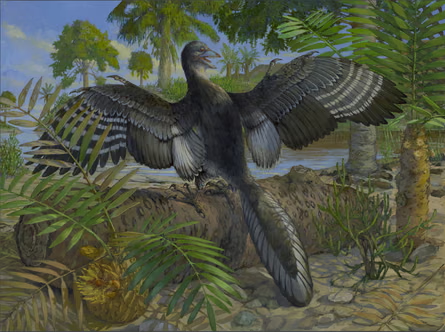
For more than 150 million years, the question of how the earliest birds got off the ground has puzzled scientists. A new study offers a surprisingly grounded answer: Archaeopteryx may have taken flight through a series of powerful jumps before its wings took over.
The research, titled “Hop, hop and away: On the take-off of Archaeopteryx using a multiple leaping mechanism,” examines how the prehistoric animal could have achieved the speed needed for sustained flight. Researchers modeled its biomechanics using takeoff movements observed in living birds.
Their conclusion is striking but still a scientific hypothesis, not a direct observation: a roughly 400-gram Archaeopteryx may have needed two or three leg-powered leaps to reach a sustainable flight speed of about 7 meters per second, or 16 mph.
What was Archaeopteryx?
Archaeopteryx lived about 150 million years ago during the Late Jurassic period and has long been an important fossil in the study of bird evolution.
It had several features associated with modern birds, including feathers and wings. But it also retained a collection of dinosaur-like characteristics.
These included:
- A long bony tail
- Teeth rather than a modern bird-like beak
- Clawed fingers on its forelimbs
- A body plan quite different from that of modern flying birds
That combination makes Archaeopteryx particularly useful for scientists investigating how powered flight evolved.
It is important, however, not to describe it as definitively “the first bird” or the direct ancestor of all modern birds. It is better understood as an early bird-like dinosaur close to the evolutionary transition that produced modern birds.
How could Archaeopteryx take off?
Modern birds can generate enormous force during takeoff. Many species use their legs to launch themselves, while their wings rapidly begin producing lift and thrust.
Archaeopteryx appears to have faced a mechanical limitation.
Unlike modern birds, it did not have a keeled sternum, the prominent breastbone that provides an attachment point for the powerful chest muscles used in flight. Researchers also argue that its shoulder anatomy restricted the range of motion available for powerful wing strokes.
That raises a basic question: if Archaeopteryx could not simply flap its wings and launch itself into the air, where did the initial acceleration come from?
The new study points toward its hindlimbs.
Why its legs may have been the key to flight
The researchers studied the takeoff mechanics of modern birds, including species such as crows, magpies, gulls and finches.
They then used biomechanical modeling to estimate what Archaeopteryx’s legs could have achieved.
The results suggest that the animal’s hindlimbs could have generated most of the initial force required to accelerate its body.
The wings would then have become increasingly important once the animal had reached the necessary speed.
In other words, flight may not have begun with a spectacular wingbeat. It may have started with the legs doing the heavy lifting.
Consider it as a sequence:
- Archaeopteryx pushes off with its legs.
- It lands and immediately performs another powerful leap.
- It builds additional horizontal and vertical velocity.
- Its wings begin contributing more significantly.
- Once sufficient speed is reached, sustained flight becomes possible.
The study proposes two possible versions of this sequence: three consecutive bipedal leaps followed by sustained flapping, or two leaps with a downward wing flap between them.
How fast did Archaeopteryx need to go?
The researchers estimated that a mid-sized Archaeopteryx weighing around 400 grams could reach a sustainable flight speed of approximately 7 meters per second.
That is roughly 16 mph.
The modeling suggests that two or three leaps could have provided enough acceleration to reach that threshold.
The important point is that the researchers are not claiming Archaeopteryx literally performed this exact sequence every time it flew. Fossils cannot preserve a prehistoric takeoff in motion.
Instead, the team used biomechanics, anatomy and observations of living birds to reconstruct a plausible method.
That distinction matters because evolutionary biomechanics often deals with questions for which there is no direct fossil evidence.
Did birds really evolve flight through jumping?
The study adds weight to a broader idea that powered flight may have developed through incremental stages rather than appearing as a fully formed ability.
Living birds provide an interesting clue.
Some birds still use multiple hops or jumps when taking off, particularly when they are not under immediate pressure to escape. Crows, magpies and gulls, for example, can use multiple movements to build speed rather than relying on one explosive launch.
That behavior does not prove Archaeopteryx used exactly the same technique.
But it gives scientists a living example of a mechanism that could potentially explain how early bird-like animals transitioned from ground movement to powered flight.
What makes the Archaeopteryx discovery important?
The significance of the study goes beyond one prehistoric animal.
The evolution of flight is one of the major transitions in vertebrate history. Moving from running or jumping on the ground to sustained powered flight requires major changes in anatomy, muscles, balance and energy use.
Archaeopteryx sits close to this evolutionary story because it combines feathers and wings with several characteristics associated with non-avian dinosaurs.
The new research suggests that its anatomy may not have been an obstacle to flight in the way scientists once assumed. Instead, its legs could have provided a solution to the limitations of its wings.
That makes the transition look less like a sudden leap from “dinosaur” to “bird” and more like a series of functional steps.
What does the study tell us about the evolution of bird flight?
The proposed mechanism fits into a larger scientific debate over how powered flight evolved.
One possibility is that early feathered dinosaurs first developed useful feathers for purposes other than flight, such as insulation, display or balance. Over generations, changes to their bodies and behavior could have made those structures increasingly useful for aerial movement.
Another question concerns how the first animals capable of powered flight actually left the ground.
The new modeling supports a ground-up mechanism in which the hindlimbs generated the initial acceleration and the wings progressively took over.
A 2022 University of Southampton doctoral thesis by lead researcher Erik Meilak had already modeled Archaeopteryx’s leaping ability and concluded that successive leaps could potentially have brought it to the minimum speed needed for sustained flight. The new work builds on that biomechanical approach.
Why Archaeopteryx could not simply fly like a modern bird
Modern birds have a highly specialized flight system.
Their skeletons, muscles, wings and shoulder joints work together to generate powerful and controlled strokes.
Archaeopteryx occupied an earlier point in that evolutionary story. Its lack of a keeled sternum and more limited shoulder movement would have restricted its ability to generate the kind of high-amplitude wing strokes associated with modern birds.
This is why the legs become so important in the new explanation.
Rather than asking whether Archaeopteryx had modern bird-style flight muscles, researchers asked what its existing anatomy could actually accomplish.
That shift in perspective produces a more nuanced picture: early flight may have worked differently from the highly refined system seen in birds today.
Is the new theory proven?
No.
The study provides a biomechanical model for how Archaeopteryx could have taken off. It does not prove that every Archaeopteryx used two or three leaps before flying.
The animal lived roughly 150 million years ago, so scientists cannot directly observe its behavior. Researchers must reconstruct possible movements from fossil anatomy, physics and comparisons with living animals.
That means the strongest way to describe the finding is that Archaeopteryx could plausibly have used repeated leaps to reach flight speed.
It is evidence for a possible evolutionary mechanism, not a video replay from the Jurassic.
What does this mean for the story of birds?
The research adds another piece to a much larger evolutionary puzzle.
Bird flight did not necessarily begin with an animal suddenly developing the ability to soar. It may have emerged through small changes that gradually altered how an animal moved, jumped and used its feathers.
For Archaeopteryx, the crucial step may have been surprisingly simple: jump again.
The study’s “hop, hop and away” scenario offers a compelling model for how a dinosaur-like animal with wings that were not yet built like those of modern birds could nevertheless have become airborne.
The broader lesson is that evolutionary innovations often emerge by modifying systems that already perform another job. In this case, legs built for terrestrial movement may have helped provide the launch mechanism for a new form of locomotion.