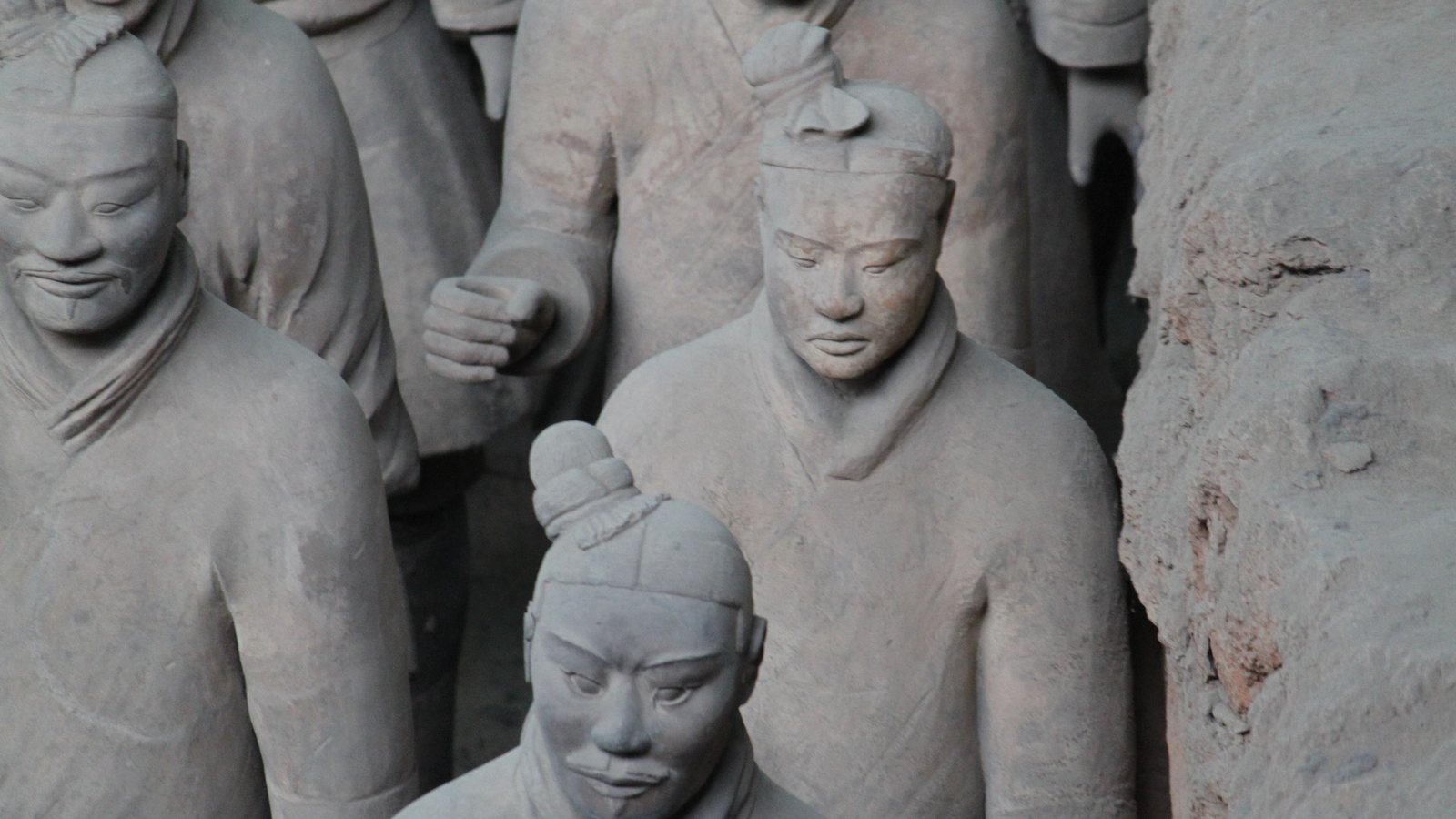
Fingerprints pressed into the clay of China’s Terracotta Army suggest that women and children helped make it, not only adult men. A study in the Journal of Cultural Heritage estimates that of 79 prints found on 36 warriors, about 45% came from adult men, 33% from adult women and 22% from children under 15.
Those are shares of fingerprints, not a headcount of workers. Still, the paper is the most systematic attempt so far to put numbers on who handled the clay for the life-size army buried near the tomb of Qin Shi Huang, China’s first emperor, more than 2,200 years ago.
Xiaoxi Li, an archaeologist at the Emperor Qinshihuang’s Mausoleum Site Museum, led the study with seven co-authors. It appears in the journal’s November 2026 issue and was freely available online by Oct. 13.
ScienceAlert reported it on Oct. 17, followed by HeritageDaily and Phys.org. We found no university or museum press release.
Prints from one unit of Pit 1
Farmers digging a well found the army in 1974, about 1.5 kilometers from the emperor’s burial mound. Estimates put it at roughly 8,000 warriors, 130 chariots with 520 horses, and 150 more cavalry horses. Much of the UNESCO-listed necropolis is still unexcavated.
Li’s team worked on a much smaller slice. All 36 warriors came from a single excavation unit, T23, in Pit 1, the largest of the army’s pits. Each figure carried between one and five usable prints, left in the wet clay before firing.
The researchers started with 91 prints and dropped 12 that looked like overlapping prints from more than one person. Of the 79 left, 73 were surface impressions left while workers molded, shaped and assembled the figures. The other six were relief impressions, found only on pieces of armor.
How ridge spacing gives an age and sex
The method rests on mean ridge breadth, the average distance between the raised lines of a fingerprint. Ridges spread apart as hands grow through childhood. In adults, women’s ridges are on average slightly narrower than men’s.
No one can sort a single print with confidence, because the ranges overlap. A teenage boy and an adult woman can leave very similar prints. So the team did not label prints one by one. It used a Bayesian mixture model, a statistical method that estimates how much each group contributed to a whole set of prints, with the uncertainty attached.
Archaeologists have been refining this approach on ancient pottery. A 2023 paper in MethodsX by Andrew Burchill, Akiva Sanders and Thomas Morgan set out a Bayesian mixture model for inferring potters’ ages and sexes from ridge density.
Li’s team corrected for clay shrinkage during drying and firing, and for population differences in fingerprint size. They set the child cutoff at 15 because surviving Qin legal texts tie responsibility to age. In the paper, they describe the result as “the first quantitative biological evidence for a diverse workforce including women and children,” as ScienceAlert quotes it.
Earlier hints of young hands
The finding builds on earlier, smaller observations from the same site. In 2022, the Shaanxi provincial government reported that researchers found three prints on the abdomen of warrior No. 28. Their features were “highly similar to teenagers.”
In July 2025, the Global Times described more than 100 prints taken from the inner surfaces of over 40 restored warriors. That preliminary analysis found that most came from adult men and a small number from minors. It did not mention women, and no peer-reviewed version has appeared.
Written records point the same way. Inscriptions on Qin lacquerware refer to adult women, girls and boys working in state-run workshops, according to the paper’s summary in HeritageDaily.
ScienceAlert’s report also points to bamboo legal manuscripts known as the Yuelu Academy Qin slips, which describe apprenticeships that took one to two years. The researchers suggest younger apprentices may have done simpler jobs, such as attaching armor details.
This fits what earlier studies of inscriptions and clay chemistry found: the warriors came from an organized system of workshops, not from lone sculptors. Fingerprints add the people. They show who touched the clay, if not who designed the figures.
Why the percentages are softer than they look
The authors and early coverage are clear that 22% of prints does not mean 22% of workers. One person could leave several prints and a skilled artisan might leave none. An apprentice handling joins and armor plates could leave far more than a master shaping faces.
The bigger caveat is the reference data. The model compares the ancient prints with a modern European dataset, since no reference set of Qin-era prints exists. According to HeritageDaily’s account of the paper, that choice could overestimate the shares of women and children. The MethodsX authors made a similar warning in 2023, noting that ridge density varies between populations and that malnutrition in the past could shift it.
That matters for how the story has traveled. The South China Morning Post headlined it as the army “may have been mainly built by women and children.” The study does not support that. Adult men were the largest single group, and the sample is one unit of one pit.
The sounder reading is narrower and still new. In the sampled part of Pit 1, people of both sexes and different ages handled the clay. That challenges the assumption, still common in popular accounts, that the army was an all-male project.
BreezyScroll has covered other ancient-China research built on physical traces. One example is how a bowl of millet may have eased a migrant crisis. Archaeology headlines can also outrun the evidence, as with the retracted “underground city” study beneath Egypt’s pyramids.
A larger print archive is the next test
The data for the obvious next step already exists. The 100-plus prints described in 2025 come from more than 40 restored warriors. Running the same model on them would show whether the T23 mix holds elsewhere.
The other fix is a better benchmark. A reference set of East Asian fingerprints would replace the modern European data. That benchmark limits this estimate most, and changing it could move the shares of women and children up or down.