• About BreezyScroll
  • Privacy & Policy
  • Contact Us
Thursday, June 4, 2026
BreezyScroll
  • Home
  • Breezy Stories
  • Technology
  • Gaming
  • Entertainment
  • Lifestyle
  • World
  • Money
  • Sports
  • Breezy Explainer
No Result
View All Result
  • Home
  • Breezy Stories
  • Technology
  • Gaming
  • Entertainment
  • Lifestyle
  • World
  • Money
  • Sports
  • Breezy Explainer
No Result
View All Result
BreezyScroll
No Result
View All Result

Home  /  Science  /  The world’s biggest bacterium found in Caribbean mangrove swamp, visible to the naked eye

The world’s biggest bacterium found in Caribbean mangrove swamp, visible to the naked eye

by KS Arpitha
June 24, 2022
in Science
Reading Time: 3 mins read
World's biggest bacterium found in Caribbean mangrove swamp

Scientists have discovered the world’s largest bacteria in a mangrove swamp in the Caribbean. While most bacteria are only seen through the microscope, this one is visible to the naked eye.

Scientists identify the largest bacteria ever

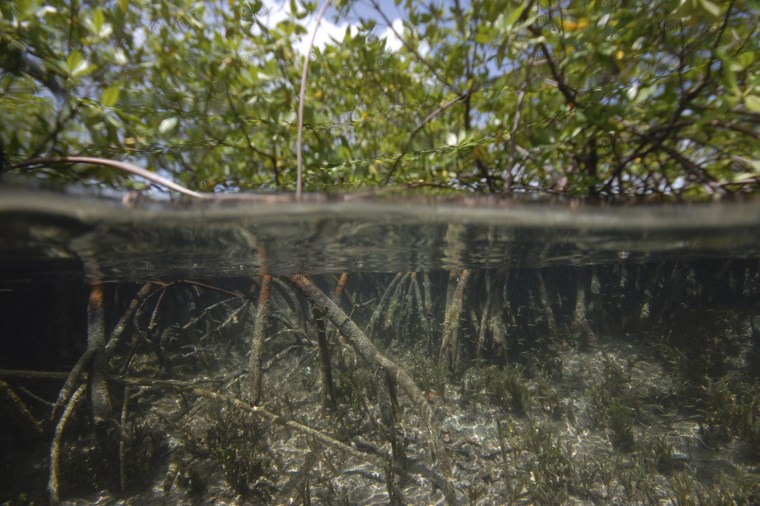
Scientists discovered the largest bacterium known to man in a shallow mangrove swamp in the Caribbean. The discovery is redefining the possibilities of one of the ancient life forms on the planet. Called Thiomargarita magnifica, the bacteria is noteworthy for both its size and internal architecture.

The thin white filament, approximately the size of a human eyelash, is “by far the largest bacterium known to date,” said Jean-Marie Volland, a marine biologist at the Lawrence Berkeley National Laboratory and co-author of a paper announcing the discovery Thursday in the journal Science.

A normal bacterial species measures 1-5 micrometers long. This species averages 10,000 micrometers (four-tenths of an inch/1 cm) long, with some Thiomargarita magnifica twice that length. The largest known bacterium until now had a maximum length of around 750 micrometers.

“It is thousands of times larger than regular-sized bacteria. Discovering this bacterium is like encountering a human being as tall as Mount Everest,” stated Volland.

“It is orders of magnitude bigger than what we thought was the maximum possible size for a single bacterium. They are about the same size and shape of an eyelash,” added Volland.  

More on the bacterium and its inner mechanics

It was first spotted in the sulfur-rich sea water in a Guadeloupe swamp in 2009 by co-author  Oliver Gros. Gros is a microbiologist from the Université des Antilles. However, since then, they identified it in several locations across Guadeloupe. Guadeloupe is a French archipelago in the Caribbean.

But he didn’t immediately know it was a bacterium because of its surprisingly large size — these bacteria, on average, reach a length of a third of an inch (0.9 centimeters). Only later did genetic analysis reveals the organism to be a single bacterial cell.

“In 2009, I found long white filaments attached to a sunken leaf of a mangrove tree. I found such filaments intriguing. I brought them back to the lab to analyze them. Big surprise for me to have so huge a bacterium living in the mangroves of Guadeloupe,” stated Gros.
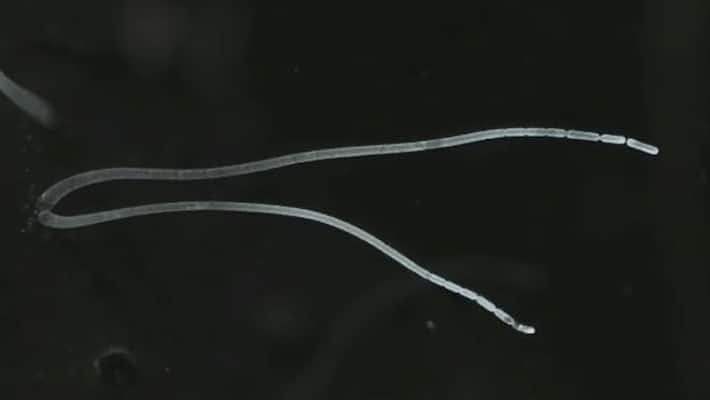
The world's biggest bacterium found in Caribbean mangrove swamp, visible to the naked eye

Scientists have not yet been able to grow it in a lab culture, but the researchers’ say the cell has a structure that’s unusual for bacteria. One key difference: It has a large central compartment, or vacuole, that allows some cell functions to happen in that controlled environment instead of throughout the cell.

“The acquisition of this large central vacuole definitely helps a cell to bypass physical limitations… on how big a cell can be,” said Manuel Campos, a biologist at the French National Center for Scientific Research, who was not involved in the study.

Mapping its genome also reveals that it has lost essential genes for cell division and has more than the usual number of copies of genes responsible for cell elongation.

“This may explain, in part, why the cell grows into such an elongated filament. The genome is also very big and contains three times the average number of genes that are usually found in bacteria. Half of those genes, we have no idea what are they for,” added Volland.


Tags: bactaria
ShareTweetShareSend

Recent Articles

WWDC 2026: What to Expect From Apple’s Biggest Software Event of the Year

WWDC 2026: What to Expect From Apple’s Biggest Software Event of the Year

June 4, 2026
US Wildlife Officials Urge Residents to Kill Invasive Tegu Lizards Spreading Across Southern States

US Wildlife Officials Urge Residents to Kill Invasive Tegu Lizards Spreading Across Southern States

June 4, 2026
Monako Glass: Chinese Smart Glasses Can Run Claude Code and Codex

Monako Glass: Chinese Smart Glasses Can Run Claude Code and Codex

June 4, 2026
Prince Harry Reportedly Not Invited to Peter Phillips’s Wedding Amid Royal Rift

Prince Harry Reportedly Not Invited to Peter Phillips’s Wedding Amid Royal Rift

June 4, 2026
BreezyScroll Logo

BreezyScroll is a global content platform that provides a unique experience of enhancing the knowledge quotient for its audience by providing the latest news and updates from various categories such as politics, sports, entertainment, technology, and more.
The platform aims to provide a concise and easy-to-read format for its users. BreezyScroll covers news stories from around the world, majorly the United States. The platform was launched in 2021 and has become one of the fastest-growing content companies in the US.

Follow Us

Browse by Category

  • Africa
  • Alaska
  • Animals
  • Asia
  • Athletics
  • Australia
  • Auto
  • Basketball
  • Bollywood
  • Brand
  • Breezy Explainer
  • Breezy Feature
  • Breezy Soul
  • Business
  • Canada
  • Chess
  • China
  • Coronavirus
  • Cricket
  • DIY
  • Education
  • Entertainment
  • Environment
  • EPL
  • Europe
  • Exclusive Interview
  • Exclusive Review
  • Football
  • Gaming
  • Health
  • Hollywood
  • India
  • International
  • K Pop
  • Law
  • Lifestyle
  • Middle East
  • Money
  • NFL
  • North America
  • OTT
  • Paris Olympics
  • Pets
  • Press Releases
  • Russia
  • Science
  • South America
  • Space
  • Sports
  • Startup
  • Technology
  • Tennis
  • Tennis
  • The Achievers
  • The US
  • Travel
  • UK
  • UK
  • Uncategorized
  • World
  • WWE

Trending Topics

AI Apple Australia Biden California Canada ChatGPT China Climate Change Coronavirus COVID-19 Donald Trump Elon Musk Featured Florida Google IPL Iran Japan Joe Biden Mars Meta Moon NASA NBA Netflix New York North Korea Ohio OpenAI Putin Russia Russia-Ukraine crisis South Korea Taliban Tesla Texas TikTok Trump Twitter UFO UK Ukraine USA Virat Kohli

No Result
View All Result
  • About BreezyScroll
  • Privacy & Policy
  • Contact Us

© 2024 · BreezyScroll.com

No Result
View All Result
  • Home
  • Breezy Stories
  • Technology
  • Gaming
  • Entertainment
  • Lifestyle
  • World
  • Money
  • Sports
  • Breezy Explainer

© 2024 · BreezyScroll.com

Go to mobile version