
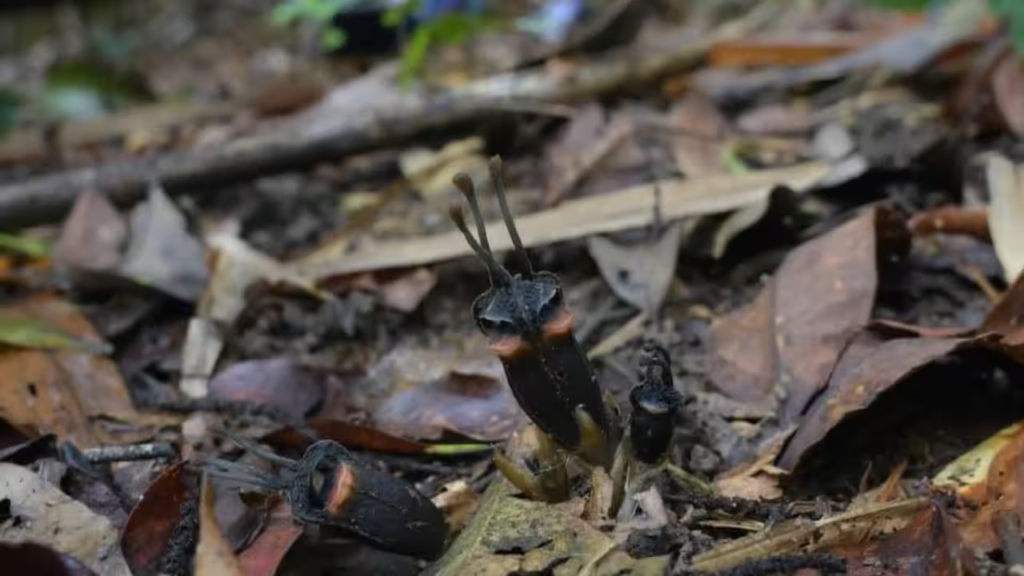
Deep beneath the leaf litter of a Thai forest, scientists have discovered a tiny flower that appears to have abandoned one of the most fundamental rules of plant life.
The newly described species, Thismia daemona, has no leaves, no green parts, and no chlorophyll. That means it cannot make its own food through photosynthesis, the process that powers most plants.
Instead, this strange plant gets its nutrients through underground fungi and spends most of its life hidden from view.
Its appearance is just as unusual. With a dark flower, horn-like structures, and reddish-orange features near its base, researchers say it resembles a tiny creature from a nightmare, inspiring the species name daemona, derived from the idea of a devil-like appearance. The species was formally described in the journal PhytoKeys in August 2026.
What is Thismia daemona?
Thismia daemona belongs to Thismia, a genus of unusual plants commonly nicknamed “fairy lanterns.”
Unlike ordinary flowering plants, members of this genus are fully mycoheterotrophic. They do not photosynthesize and instead obtain nutrients through associations with fungi in the soil.
Scientists say Thismia species are notoriously difficult to spot because most of the plant remains underground or concealed beneath leaf litter. They typically become visible only during the brief period when they flower.
That makes discovering a new species particularly difficult. Researchers may be searching an area where the plant has been present for years without realizing it.
Why can this plant survive without sunlight?
The plant has effectively outsourced its food supply.
Most plants use chlorophyll to capture energy from sunlight and convert carbon dioxide and water into sugars through photosynthesis. Thismia daemona cannot do that because it lacks chlorophyll.
Instead, it relies on fungi beneath the forest floor.
The relationship is part of a process known as mycoheterotrophy, in which the plant obtains organic nutrients through fungal connections. This allows it to survive in the deep shade of forest environments where photosynthetic plants would struggle to capture enough sunlight.
So this is not a plant that has somehow learned to “eat” sunlight differently. It has evolved a completely different way of obtaining the resources it needs.
Where was the ‘devil flower’ discovered?
Researchers found Thismia daemona in Thong Pha Phum National Park in Kanchanaburi Province, western Thailand.
The species was discovered during botanical surveys carried out by researchers from Chulalongkorn University and Prince of Songkla University.
What surprised the team was not only the plant itself but also where it was growing.
The species was found in a lower montane evergreen forest at an elevation of approximately 950 to 970 meters above sea level.
Why was the habitat surprising?
Thismia species are often associated with humid, shaded tropical forests, but the newly discovered population was found in a seasonal montane environment.
The researchers described the site as a lower montane forest with small bamboo, where the plant grows among layers of fallen leaves.
That discovery expands scientists’ understanding of where these highly specialized plants can survive.
It also suggests that potentially suitable habitats for rare Thismia species may be more widespread than previously recognized, particularly in underexplored mountainous areas.
Why does Thismia daemona look like a tiny monster?
The appearance of the flower is what gave the species its dramatic name.
The flower is predominantly blackish, with reddish-orange, fleshy outer structures. Its inner petals form a dome-like structure called a mitre, from which three slender, club-shaped appendages extend.
The overall arrangement gives the flower a distinctly horned appearance.
The researchers chose the name daemona because of this unusual, devil-like appearance. It is a scientific naming decision based on morphology, not evidence that the plant has any supernatural qualities.
What makes the flower scientifically unusual?
Its appearance is only part of the story.
The researchers used both morphological examination and molecular phylogenetic analysis to establish that the plant represents a previously unknown species.
DNA analysis placed it within Thismia section Geomitra, a group distinguished by features including coralliform roots and a distinctive arrangement of the floral structures.
The newly discovered species was found to be most closely related to Thismia betung-kerihunensis, a species previously known from Borneo.
That genetic relationship helps scientists understand how these unusual plants evolved and spread across Southeast Asia.
Does the discovery change the known range of the group?
Yes.
Before the discovery of Thismia daemona, the section Geomitra was known from parts of the Thai-Malay Peninsula, Borneo and Sumatra.
Finding a member of the group in western Thailand pushes its documented range farther north.
That may sound like a small geographic detail, but distribution records are important to biologists because they reveal where specialized species evolved, how populations became separated and which habitats might contain undiscovered relatives.
The researchers say the finding also highlights how much remains to be learned about Thailand’s montane forests.
Why is the new species already considered critically endangered?
The plant may be new to science, but researchers are already worried about its survival.
Thismia daemona is currently known from a single population, with fewer than 50 individuals documented. The known population occupies an area of less than 0.05 square kilometers, according to the researchers.
The population is inside a protected national park, but the site is also visited regularly by tourists.
Because the plant depends on a highly specific underground environment involving fungi, even small changes to the forest floor could have consequences.
The researchers have therefore provisionally assessed the species as Critically Endangered under the IUCN Red List criteria.
Why could tourism threaten such a tiny plant?
For most visitors, walking across leaf litter may seem harmless.
For a plant that lives almost entirely beneath that layer, it can be anything but harmless.
Trampling can disturb the soil, compact the ground and damage the microscopic habitat around the plant and its fungal partners. Changes to vegetation, drainage or the forest floor could also affect a species that has such specialized nutritional requirements.
This is one reason researchers say protecting the species requires protecting its entire microhabitat, not simply the flowers themselves.
Could the devil flower help scientists understand forests better?
Potentially.
Rare mycoheterotrophic plants can act as indicators of complex ecological relationships beneath the forest floor.
Although a flowering Thismia plant may look isolated, its survival depends on a network of interactions involving fungi and the surrounding forest ecosystem.
Studying such plants can therefore reveal ecological connections that are easy to miss when scientists focus only on large, visible organisms.
The discovery also reinforces the idea that tropical forests may still contain species that remain scientifically undocumented.
What does the discovery tell us about plant evolution?
Thismia daemona demonstrates that plants do not all need leaves, sunlight and chlorophyll to survive.
Evolution has produced remarkably different strategies for obtaining energy and nutrients. Some plants capture sunlight, while others have developed relationships with fungi that allow them to exploit resources indirectly.
The result can look almost alien, but it is a perfectly natural biological adaptation.
In this case, abandoning photosynthesis appears to have allowed the plant to specialize in a dark, nutrient-rich world beneath the forest floor.
Is Thismia daemona really a ‘demon flower’?
Only in the nickname.
Its scientific name is Thismia daemona, and the “devil flower” description comes from the unusual shape and color of its bloom.
There is nothing supernatural about it.
What is genuinely extraordinary is its biology: a leafless, chlorophyll-free flowering plant that survives through fungi and remains almost completely hidden until it reproduces.
That is strange enough without adding any mythology.
Why does this tiny flower matter?
The discovery is a reminder that even well-studied regions can contain species that scientists have never formally described.
It also comes with a warning.
Thismia daemona is known from only one small population, and its highly specialized lifestyle makes it vulnerable to disturbance. Protecting the species means preserving the forest floor, the surrounding vegetation and the underground fungal relationships on which it depends.
For now, the “devil flower” is doing what it has apparently done for generations: staying almost invisible.
Scientists have simply managed to catch it in the act.