

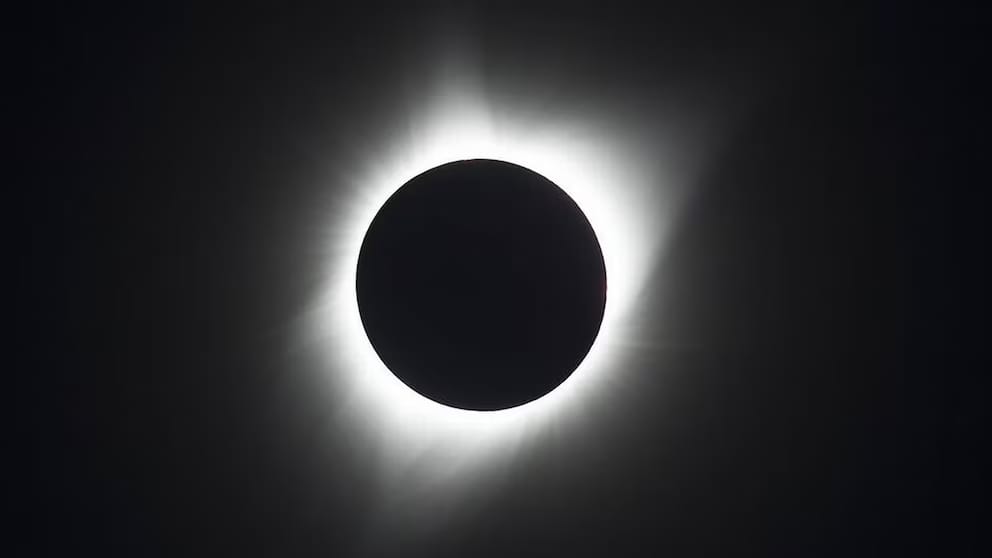
When a rare, total solar eclipse sweeps across North America on Monday, scientists will be able to collect crucial data on everything from the sun’s atmosphere to unusual animal behaviors.
It comes as the sun approaches the peak of its 11-year solar cycle, preparing for a dazzling display: the corona will light spectacularly from the moon’s silhouette along the path of totality, which runs from Mexico to Canada via the United States.
Total solar eclipses provide “incredible scientific opportunities,” NASA Deputy Administrator Pam Melroy stated at a press briefing this week.
The United States Space Agency is preparing for the eclipse, with plans to launch “sounding rockets” to research the impact on the Earth’s upper atmosphere.
Here’s what researchers hope to learn from the total solar eclipse:
1. Sun’s atmosphere
When the Moon passes exactly in front of the Sun and blocks it, the elusive outermost edge of the Sun’s atmosphere, known as the corona, will be visible “in a very special way,” Melroy explained.
“Things are happening with the corona that we don’t fully understand,” she added.
The heat in the corona increases with distance from the sun’s surface, a counterintuitive phenomenon that scientists are still trying to understand and explain.
Solar flares, which are quick explosions of energy that emit radiation into space, and solar prominences, massive plasma formations that loop out from the sun’s surface, both occur in the corona.
During an eclipse, the bottommost part of the corona — where much of this activity occurs — is more clearly visible than when specialized instruments are used to block the central part of the sun, providing an excellent opportunity for study, according to Shannon Schmoll, director of Michigan State University’s Abrams Planetarium.
Researchers are particularly excited because the sun is nearing the peak of its 11-year cycle.
“The chance we’re going to see something amazing is very high,” Melroy said. Melroy said in a statement.
2. Earth’s atmosphere
The total eclipse will also allow scientists to examine changes in the ionosphere, a region of the Earth’s upper atmosphere that influences radio signals used for communication and navigation.
“Disturbances in this layer can cause issues with GPS and communications,” said Kelly Korreck, NASA headquarters’ eclipse program manager.
NASA’s three sounding rockets will be launched from Virginia before, during, and immediately following the eclipse to assess these changes.
The significant fall in sunlight due to the eclipse, which is quicker and more localized than a typical sunset, could allow researchers to understand more about how light impacts the ionosphere and better predict potential disruptive events.
3. Unusual animal behavior
During eclipses, animals exhibit unusual behavior, such as giraffes running around, roosters crowing, and crickets chirping.
Aside from a drop in sunshine – temperatures, and wind, conditions to which animals are sensitive, can also decrease dramatically during an eclipse.
Andrew Farnsworth, an ornithology researcher at Cornell University, studies how eclipses influence birds by employing weather monitoring radar to detect birds in flight.
During the previous total solar eclipse viewable from the United States in August 2017, scientists noticed a “decline in the number of animals flying around,” Farnsworth told reporters.
4. Human behavior
“Eclipses have a special power. They move people to feel a kind of reverence for the beauty of our universe,” NASA Administrator Bill Nelson told reporters.
In 2017, researchers studied this ‘sense of awe’ using data from roughly three million Twitter users (now X).
According to Paul Piff, a psychology professor at the University of California, Irvine, those in the so-called “path of totality,” in which the Moon completely blocks out the Sun, used the pronoun “we” (rather than “I”) and expressed care about other people.
“What we’re finding is that experiences that bring about awe… seem to attune people and connect us to one another, to connect us to entities that are larger than ourselves,” Piff added.
5. Citizen scientific projects
Approximately 40 citizen scientific projects are planned around the eclipse, ranging from using a phone app to detect temperature and cloud cover to capturing noises during the event.
“We encourage you to help NASA observe the sights and sounds around you,” he stated.


