
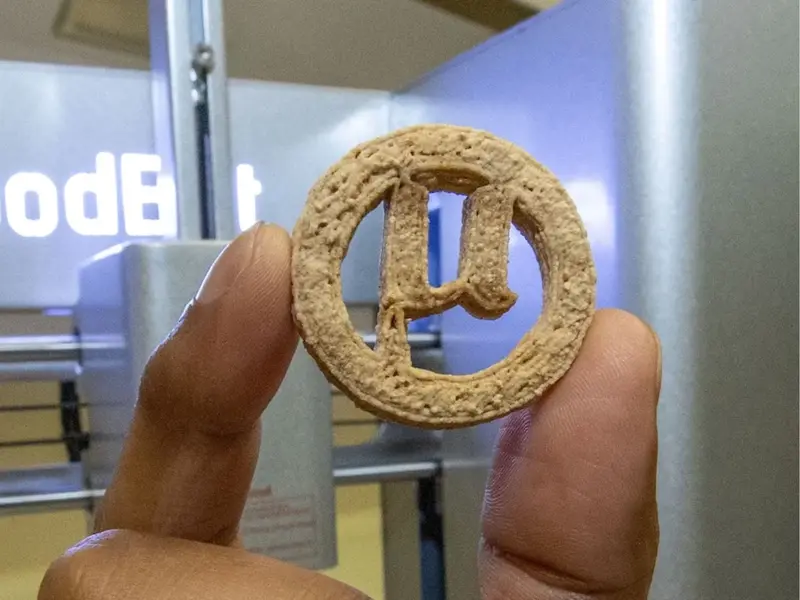
What if your next cookie were made from discarded plastic bottles instead of conventional ingredients? Researchers at Southern Illinois University Carbondale are working on a futuristic food concept that does exactly that — at least in the laboratory. The team has developed a 3D-printed cookie made using material derived from plastic waste, with specially engineered yeast helping turn the plastic into ingredients that can be incorporated into food.
The project is being supported by NASA’s Deep Space Food Challenge, giving the unusual experiment a potential use far beyond Earth.
The idea is not to feed people with plastic in its original form. Instead, researchers are attempting to break down certain plastics chemically and biologically, convert their components into useful food ingredients and then use a 3D printer to create a finished product.
The resulting cookie has been named “µBites,” after the Greek letter mu.
There is, however, one important catch: researchers have not yet eaten the cookies themselves because they are waiting for approval from the university.
What are the plastic cookie made from?
The project focuses on polyethylene terephthalate, better known as PET.
PET is one of the most widely used plastics in the world. It is commonly found in:
- Water bottles
- Food packaging
- Polyester-based textiles
- Other everyday consumer products
Rather than putting intact plastic into a food mixture, the researchers first break the material down into smaller chemical components.
Those components can then be processed by specially engineered microorganisms.
The objective is to transform material that would normally be treated as waste into compounds that can eventually become part of a food product.
How did scientists turn plastic into food?
The process involves several stages, with genetically engineered yeast playing a central role.
First, PET plastic is broken down using a process called oxidative hydrothermal dissolution.
This breaks the polymer into smaller molecules that are easier for microorganisms to process.
The researchers then use yeast that has been genetically modified with CRISPR technology.
The engineered yeast is designed to consume components derived from PET along with material from agricultural waste such as plant stalks.
According to the research team, the microorganisms can convert these inputs into substances including proteins, fats, acids and compounds that contribute to flavor.
Those ingredients are then combined with additional components such as fiber, starch and sweetener.
The final mixture is fed into a 3D printer, which produces the cookie in a desired shape.
Why use 3D printing?
The 3D printer is not necessarily what makes the food edible.
Its main advantage is that it allows researchers to precisely control the shape and composition of the food.
That could become particularly useful for space missions.
Instead of shipping large quantities of conventional food from Earth, astronauts could potentially use locally available materials and biological processes to produce customized food products.
A 3D printer could also adjust the texture, size and nutritional composition of individual portions.
For a long-duration mission, that flexibility could be valuable.
Why are the cookie called µBites?
The cookies are reportedly printed in the shape of the Greek letter µ, pronounced “mu.”
That inspired the name “µBites.”
The design is more than a novelty, however.
3D printing allows food to be produced in almost any shape, meaning future versions could potentially be customized for specific nutritional or psychological needs.
That could matter in environments such as spacecraft, where food variety and morale can become important during missions lasting months or even years.
Have scientists actually tasted the cookie?
Not yet.
This is one of the most important details about the project.
Although the researchers believe the cookies are safe and could taste good, they have not yet officially sampled them.
The team is waiting for approval from Southern Illinois University Carbondale before tasting the finished product.
Lead researcher Lahiru Jayakody told New Scientist that the cookies had what he described as a pleasant and appealing aroma and that he expected them to taste good.
But until researchers actually complete testing and tasting, claims about the cookie’s flavor or safety remain preliminary.
Is the cookie really made from plastic?
Yes, but the description needs some clarification.
The finished cookie is not simply compressed plastic shaped into a biscuit.
Instead, the research process chemically breaks down PET and then uses engineered microorganisms to transform the resulting material into other compounds.
Those compounds are incorporated into a food formulation.
So the concept is closer to converting waste-derived molecules into ingredients than simply “eating plastic.”
That distinction is important because the chemical structure of a finished food product is very different from the original polymer used to produce it.
Could humans safely eat the cookies?
That remains to be established.
Before a plastic-derived food could become a real commercial product, researchers would need extensive testing.
They would need to establish that the conversion process removes harmful compounds and that the resulting ingredients are safe for human consumption.
Researchers would also need to determine whether contaminants from waste plastic could survive the process.
Food safety testing would have to examine issues such as toxicity, allergens, chemical residues, nutritional value and long-term exposure.
The fact that a biological system can break down plastic does not automatically mean the resulting material is suitable for human food.
Why is NASA interested in this technology?
Space missions create unusual problems when it comes to food.
Sending food from Earth requires storage space, adds mass to a spacecraft and creates logistical challenges.
Those problems become much more significant during missions lasting months or years.
A journey to Mars, for example, would require astronauts to remain far from Earth for an extended period.
NASA is therefore interested in technologies that could make food production more sustainable and reduce dependence on supplies launched from Earth.
The Deep Space Food Challenge was created to encourage exactly this kind of innovation.
The goal is to explore technologies capable of producing nutritious food using fewer resources during deep-space missions.
Could astronauts really eat plastic-derived food on Mars?
That is a possibility the research is exploring, but it is far from an established plan.
A future spacecraft could potentially carry systems capable of recycling waste materials and converting them into useful resources.
In principle, those systems might eventually transform discarded materials into food-related ingredients.
For astronauts, such technology could help create a more circular life-support system.
Instead of treating every waste material as something that must be stored or discarded, a spacecraft could potentially extract useful chemicals and reuse them.
That concept could become increasingly important on extremely long missions.
Could this solve the global plastic pollution problem?
Probably not.
The sheer scale of plastic waste makes that unrealistic.
The world produces hundreds of millions of tons of plastic waste every year.
Turning a small portion of that material into food using an expensive laboratory-based process would not come close to eliminating the global waste stream.
Jason Hallett of Imperial College London told New Scientist that the scale of plastic production makes it impossible for cookies to become a complete solution to the plastic-waste crisis.
That is an important reality check.
The technology may demonstrate an interesting form of recycling, but it should not be presented as a single answer to global plastic pollution.
Why is the process currently so expensive?
Another obstacle is cost.
According to reporting cited in the source material, producing a kilogram of the cookies would currently cost around $60.
That is far more expensive than ordinary food production.
The economics would therefore make little sense for conventional food markets.
The equation could look different in space.
When sending materials into orbit costs enormous amounts of money, the value of recycling something already aboard a spacecraft can become much higher.
A process that is economically impractical on Earth could potentially make sense on a spacecraft where every kilogram matters.
Could plastic recycling become a food source?
In theory, researchers are exploring a broader concept than cookies.
The underlying approach involves converting waste materials into useful biological building blocks.
Those could potentially be used to produce different food products rather than one specific type of baked item.
The technology could eventually involve multiple microorganisms and different waste streams.
Agricultural waste could also provide raw materials.
That opens the possibility of creating food systems that depend less on conventional agricultural inputs.
But much more research would be needed before that becomes practical.
What role does CRISPR play?
CRISPR is the genetic-engineering technology used to modify the yeast.
In this project, researchers are using genetic modification to alter how the microorganisms process chemical compounds derived from PET and agricultural materials.
The goal is essentially to give the yeast a new metabolic capability.
Instead of relying on naturally occurring strains, researchers can redesign microorganisms to perform specific tasks.
That is what makes the plastic-to-food concept possible in the first place.
Without microorganisms capable of processing the broken-down plastic components, turning the material into useful biological ingredients would be much harder.
Why combine plastic with agricultural waste?
The researchers are not relying solely on plastic.
The system also incorporates material from agricultural waste, including plant stalks.
That gives the process another potential advantage.
Agricultural waste is already produced in enormous quantities, and much of it contains carbon-rich material that could potentially be converted into useful compounds.
Combining multiple waste streams could make the process more versatile.
It also aligns with the broader goal of developing systems that can produce food from materials that would otherwise have little immediate value.
Could astronauts manufacture their own food?
That is one of the larger ideas behind research like this.
On a long-duration mission, astronauts would ideally have access to systems that recycle water, air, nutrients and waste.
Food production could eventually become part of that closed-loop system.
Instead of carrying every meal from Earth, future spacecraft could potentially produce portions of their food using biological and chemical recycling technologies.
The challenge is making those systems reliable, lightweight, energy-efficient and completely safe.
A spacecraft cannot afford a biological process that suddenly fails halfway to Mars.
What are the biggest challenges?
Several major obstacles remain.
Food safety
Researchers must prove that the final product is safe for humans to eat.
Cost
At roughly $60 per kilogram under current estimates, production is far too expensive for normal food markets.
Scale
Even if the technology works, it would process only a tiny fraction of the world’s enormous plastic waste stream.
Energy requirements
Breaking down plastic and converting it biologically requires energy and specialized equipment.
Reliability
A system designed for space would need to work consistently for months or years with minimal maintenance.
Regulatory approval
Before commercial food production becomes possible, authorities would have to assess the safety of the resulting ingredients and manufacturing process.
Why is this still important if it cannot solve plastic pollution?
Because technological breakthroughs do not always need to solve an entire global problem to be useful.
The researchers are demonstrating that waste polymers can potentially be converted into biologically useful material.
That could eventually have applications beyond cookies.
The same underlying principles could be used for producing other chemicals, materials or nutritional components.
The most important achievement may therefore be the biological conversion process rather than the cookie itself.
The bigger picture
A cookie made from plastic sounds like a science-fiction idea.
But the Southern Illinois University Carbondale project is based on a real combination of chemical processing, genetic engineering and 3D printing.
Researchers are breaking down PET, using engineered yeast to process the resulting compounds and combining them with other ingredients before printing the final food product.
The project is particularly interesting because it targets one of the central challenges of long-duration spaceflight: how to produce useful resources without continually receiving supplies from Earth.
That does not mean astronauts are about to start eating recycled water bottles.
The cookies have not yet even been tasted by the researchers, and significant questions surrounding safety, cost and scalability remain unanswered.
Nor is this likely to become a solution to Earth’s plastic pollution problem.
But in the controlled environment of a future spacecraft, where every kilogram of cargo matters, turning waste into food could eventually become far more valuable than it sounds.
For now, the biggest question is not whether people would eat a plastic cookie.
It is whether scientists can prove that the strange-looking µBite is safe, nutritious and practical enough to make its journey from a university laboratory to outer space.