NASA’s Artemis II mission made history by carrying four astronauts farther from Earth than any human crew had travelled before. But during the spacecraft’s journey around the Moon, commander Reid Wiseman experienced a tense moment when a distance reading continued rising beyond the figure he had expected to be the mission’s maximum.
Speaking at the Starmus Festival in Tenerife, Spain, on October 17, Wiseman recalled watching the onboard display as the spacecraft passed behind the Moon. Mission control had given the crew an expected maximum distance of 219,667 nautical miles, according to his account.
He expected the number to begin falling once the spacecraft passed its farthest point. Instead, it rose to 219,668 and then 219,669.
“That was the moment that I felt real fear,” Wiseman recalled, explaining that he briefly worried the crew might not make it back to Earth.
The episode was a moment of genuine anxiety during an otherwise carefully planned mission. It did not mean the spacecraft had lost its course, but it revealed how even a brief uncertainty can feel when astronauts are hundreds of thousands of miles from home.
Why did the Artemis II distance reading keep rising?
Wiseman said he had been watching the spacecraft’s distance display during the lunar flyby. The crew had been told to expect a maximum reading of 219,667 nautical miles before the spacecraft began its return journey.
When the display reached that number, he expected the next reading to be lower. Instead, it continued increasing over the following minutes.
Wiseman recalled seeing 219,668 and then 219,669, prompting fears that the mission might have travelled farther than anticipated.
He said the crew waited anxiously for about three minutes before the number finally began to fall. The change reassured them that the spacecraft had passed its farthest point and was heading back towards Earth.
The episode did not establish that Artemis II had suffered a navigation failure. The spacecraft was following a planned trajectory around the Moon, using lunar gravity to help carry it back towards Earth.
How far did Artemis II travel from Earth?
NASA’s Artemis II crew set a new human spaceflight distance record on April 6, 2026, during the mission’s lunar flyby.
NASA reported that the Orion spacecraft reached approximately 252,756 statute miles, or about 406,773 kilometres, from Earth. The milestone surpassed the previous record held by the Apollo 13 crew, who reached approximately 248,655 miles from Earth in 1970.
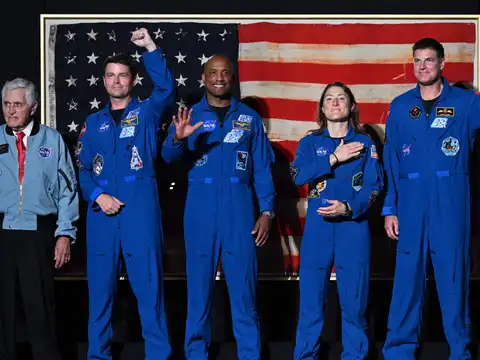
The four Artemis II astronauts were commander Reid Wiseman, pilot Victor Glover, mission specialist Christina Koch and Canadian Space Agency astronaut Jeremy Hansen.
Their mission involved flying around the Moon without landing on its surface. The journey tested the Orion spacecraft and its systems while allowing the astronauts to observe the lunar far side from a distance and angle unavailable to most previous human explorers.
The record-breaking flight marked an important step in NASA’s broader Artemis programme, which aims to return astronauts to the lunar surface and support future missions deeper into space.
What happens when astronauts pass behind the Moon?
During the lunar flyby, Orion travelled behind the Moon from Earth’s perspective. The Moon temporarily blocked radio signals between the spacecraft and ground controllers, producing a planned communications blackout lasting approximately 40 minutes.
During this period, mission control could not communicate directly with the astronauts. The crew continued following the mission plan while the spacecraft passed behind the Moon and moved towards the return leg.
The communications blackout was expected and did not itself indicate a problem. However, being temporarily out of contact with Earth adds another layer of pressure to an already demanding mission.
The Moon’s gravity also played a crucial role in the journey. Orion followed a trajectory designed to swing around the lunar far side and return towards Earth without requiring a large propulsion manoeuvre to begin the entire journey home.
The spacecraft’s planned flight path, rather than the distance display alone, determined the mission’s route.
Jeremy Hansen reflects on accepting the risks of spaceflight
Canadian astronaut Jeremy Hansen also discussed the mission’s risks at the Starmus Festival.
Hansen said the crew had discussed the possibility of a serious problem shortly before launch, including what they might do if they realised they could not return to Earth.
He explained that the astronauts had considered the emotional challenge of facing an uncertain future while remaining alive in space.
Hansen said the crew had reached a sense of acceptance about the risks, not because they believed themselves invulnerable, but because they were prepared to do their best whatever happened.
His comments highlighted a less visible part of astronaut preparation: learning to manage uncertainty while remaining focused on the mission.
Spaceflight requires extensive training for technical emergencies, but astronauts must also prepare psychologically for isolation, communication delays and the possibility that a situation could develop beyond their control.
Artemis II astronauts share their experience at Starmus
Wiseman, Glover and Hansen attended the Starmus VIII science festival in the Canary Islands, which ran from October 17 to 22. Christina Koch was also recognised as part of the Artemis II crew, although she was not present at the ceremony.
The astronauts received the Stephen Hawking Medal for Science Communication in recognition of their efforts to make space exploration accessible to the public.
Their appearances followed a mission that captured global attention through live communications, images of the Moon and reflections on seeing Earth from deep space.
For Wiseman, the experience of watching the distance display rise beyond its expected maximum offered a reminder that spaceflight combines precise engineering with moments that remain deeply human.
The Artemis II mission completed its planned lunar flyby and established a new distance record. Wiseman’s brief anxiety did not signal that the crew was lost, but it revealed how intense it is to wait for a critical sign that the journey home is proceeding as expected.