
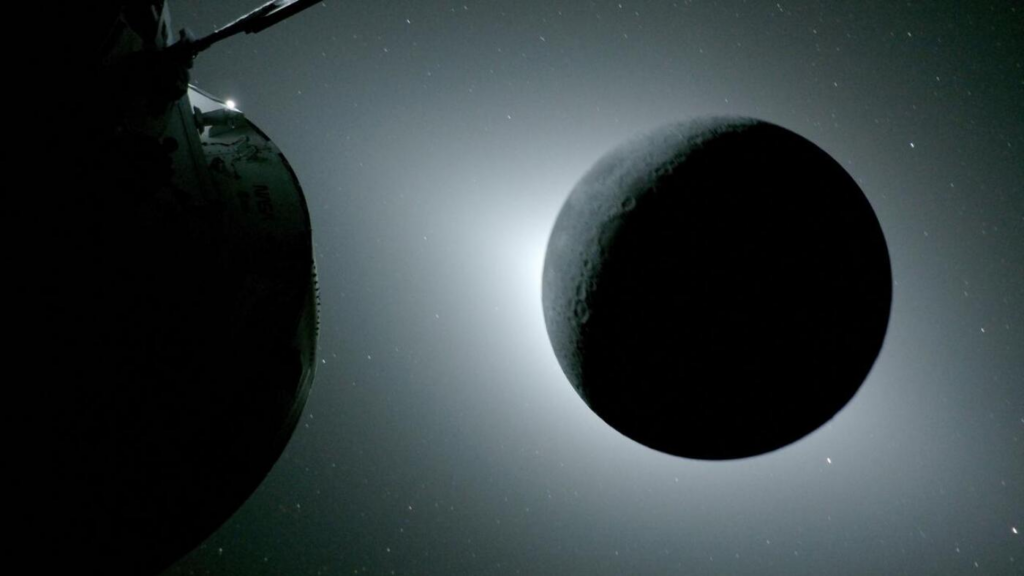
For astronauts aboard Artemis II, the most powerful moment wasn’t a technical milestone or a mission checkpoint. It was silence and absence.
As their spacecraft slipped behind the Moon, Earth vanished from view. Communication dropped. And for 31 minutes, the crew was completely cut off from home.
Mission commander Reid Wiseman later described it simply: a moment that still gives him chills.
What is the Artemis II “Earthset” moment?
The term “Earthset” mirrors the familiar idea of a sunset. But instead of the Sun dipping below the horizon, it was Earth disappearing behind the Moon.
From inside the Orion spacecraft, the astronauts watched:
- The blue curve of Earth slowly shrinks
- The thin glow of its atmosphere fades
- The Moon’s surface rises and blocks their view
And then, suddenly, nothing.
No Earth. No signal. Just deep space.
Why is this moment so significant
Space missions are often measured in kilometers, fuel efficiency, and data. But moments like this reshape how astronauts understand their place in the universe.
A rare human experience
- Only a handful of astronauts in history have seen Earth disappear
- It happens only when flying behind the Moon
- It combines visual isolation with total communication blackout
For 31 minutes, the Artemis II crew was beyond reach. No messages, no updates, and no safety net.
That combination makes the moment uniquely intense.
The 31 minutes of silence: what really happens?
When Orion passed behind the Moon:
- Radio signals were blocked by the Moon’s mass
- Mission control lost all contact
- The crew operated entirely on pre-planned systems
This is expected, but that does not make it easy.
Why the blackout matters
- It tests crew autonomy
- It reinforces the risks of deep-space travel
- It creates a psychological shift from connected to completely alone
For astronauts used to constant communication, that silence can feel enormous.
How astronauts described the experience
Wiseman’s reaction captures both awe and unease.
He described watching Earth fade as
- “Unbelievable”
- “Humbling”
- Physically overwhelming, even in retrospect
At one point, the crew paused their work.
They shared cookies, reflected on where they were, and took in the moment before returning to mission tasks.
It was a brief human pause in an otherwise tightly scheduled operation.
Earthset vs Earthrise: Why the comparison matters
The Artemis II images are already being compared to one of the most famous space photographs ever taken during Apollo 8.
The legacy of Earthrise
- Captured by William Anders in 1968
- Showed Earth rising above the Moon’s horizon
- Became a defining image of environmental awareness
What makes Earthset different
- It was planned, not accidental
- It captures loss of view, not emergence
- It emphasizes distance and separation, not beauty alone
If Earthrise made humanity feel connected, Earthset makes it feel small.
How far Artemis II actually traveled
The mission pushed human spaceflight deeper than any crewed mission in decades.
- Orion traveled about 7,500 kilometers beyond the Moon’s far side
- The crew became the farthest humans from Earth in modern history
This distance is not just symbolic. It represents a return to deep space exploration after more than 50 years.
Who were the astronauts on Artemis II?
The crew included:
- Reid Wiseman (commander)
- Christina Koch
- Victor Glover
- Jeremy Hansen
Together, they conducted experiments, documented the mission, and experienced moments no human had encountered in decades.
Why Artemis II matters for future Moon missions
This mission is not an endpoint. It is a rehearsal.
NASA is using Artemis II to prepare for:
- Human landings on the Moon (targeted around 2028)
- Long-term lunar missions
- Future deep space exploration, including Mars
The emotional and psychological lessons from Earthset are just as important as the technical ones.
The psychology of seeing Earth disappear
Astronauts often report a phenomenon called the “overview effect,” where seeing Earth from space changes their perspective.
Earthset adds a different dimension.
What makes it unique
- It is not about seeing Earth
- It is about losing sight of it
That shift can trigger:
- A sense of isolation
- A deeper appreciation of Earth’s fragility
- A heightened awareness of human vulnerability in space
It is not just awe. It is confrontation with distance.
Why this moment resonates on Earth
Back on Earth, the idea of losing sight of our planet is almost unimaginable.
That is why this story connects.
It turns space exploration from abstract science into something deeply human:
- What does it feel like to be completely cut off?
- How do you process that in real time?
- What does “home” mean when you cannot see it?
These are questions that go beyond spaceflight.
TL;DR
- Artemis II astronauts experienced “Earthset” as their spacecraft went behind the Moon
- Earth disappeared from view and communication was cut off for 31 minutes
- The moment was described as emotional, humbling, and intense
- It is being compared to Apollo 8’s iconic Earthrise image
- The mission marks a major step toward future human landings on the Moon