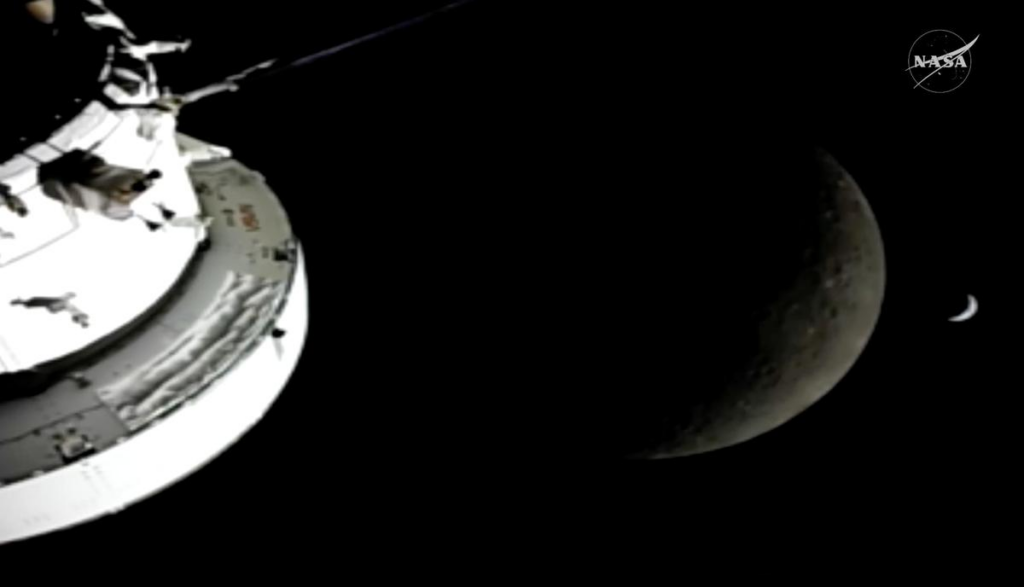
Astronauts aboard Artemis II have experienced something no human has ever seen before: a total solar eclipse from deep space, near the Moon.
The moment wasn’t just visually stunning. It marked a milestone in human spaceflight, combining a rare celestial alignment with a record-breaking distance from Earth. For a brief period, the crew also lost contact with Earth, adding an extra layer of intensity to an already historic event.
What did Artemis II astronauts see during the solar eclipse?
As NASA confirmed, the Orion spacecraft entered a phase where the Sun, Moon, and spacecraft aligned perfectly, triggering a total solar eclipse.
What made it unique:
- The astronauts were positioned thousands of miles above the Moon
- They saw the Sun disappear behind the Moon’s darkened surface
- The eclipse lasted nearly an hour—far longer than most Earth-based eclipses
Unlike observers on Earth, who see the Moon block the Sun from below, the Artemis II crew witnessed the event from a deep-space vantage point, creating a dramatically different perspective.
Earthshine: a rare visual
Pilot Victor Glover described a phenomenon known as Earthshine:
“Seconds after the sun set behind the moon, you can see Earthshine.”
This occurs when sunlight reflects off Earth and faintly illuminates the dark side of the Moon—a subtle glow that’s rarely visible this clearly.
Why did NASA lose contact with Artemis II?
Before and during the eclipse, communication between the spacecraft and Mission Control was interrupted for about 40 minutes.
The reason:
- The Moon physically blocked radio signals between the spacecraft and Earth
- This created a communication blackout, a known and expected phenomenon during certain lunar maneuvers
Why it matters
This wasn’t a malfunction—it was part of mission planning.
However, it highlights a key challenge of deep-space missions:
- Astronauts must operate independently during blackouts
- Real-time guidance from Earth is temporarily unavailable
- Systems and training must account for autonomy under pressure
How far did Artemis II travel—and why is it historic?
The mission didn’t just deliver stunning visuals—it also broke records.
Record-breaking distance
- Artemis II reached 252,752 miles from Earth
- It surpassed Apollo 13’s record of 248,655 miles
- That’s a difference of roughly 4,100 miles
This makes Artemis II the farthest humans have ever travelled from Earth.
Why this matters
Distance isn’t just symbolic. It tests:
- Spacecraft durability
- Life-support systems
- Human endurance in deep space
Each milestone builds confidence for future missions, including potential crewed journeys to Mars.
Who are the astronauts on Artemis II?
The mission features a diverse, experienced crew:
- Reid Wiseman – Commander
- Victor Glover – Pilot
- Christina Koch – Mission Specialist
- Jeremy Hansen – Mission Specialist (Canadian Space Agency)
Why this crew matters
- Glover is among the first Black astronauts to participate in a lunar mission
- Koch previously set records for long-duration spaceflight
- Hansen represents international collaboration in deep-space exploration
Their observations and data will shape how future missions are designed and executed.
What did astronauts see on the Moon’s far side?
Beyond the eclipse, Artemis II delivered another historic first: close-up views of the Moon’s far side.
Key highlights:
- The crew flew 4,000–6,000 miles above the lunar surface
- They observed regions never directly seen by Apollo astronauts
- They captured images of previously shadowed terrain
Astronaut Jeremy Hansen described the view as:
“It is blowing my mind what you can see with the naked eye from the Moon right now.”
Why the far side matters
The Moon’s far side:
- Has a different geological composition
- Contains fewer maria (dark plains)
- Offers clues about the Moon’s formation
How does Artemis II compare to Apollo missions?
Artemis II is often compared to Apollo-era missions—but it represents a significant leap forward.
Key differences:
Technology
- Artemis uses modern navigation, computing, and safety systems
- Apollo relied on analogue-era technology
Mission goals
- Apollo focused on landing and return
- Artemis aims for sustained lunar presence
Perspective
- Artemis provides longer-duration deep-space observation
- Offers new data on human performance beyond low Earth orbit
While Apollo 13 was a critical test of survival and resilience, Artemis II is a planned step toward long-term exploration.
Why this mission matters for the future of space exploration
Artemis II is more than a single mission—it’s part of a larger strategy.
NASA’s long-term goals:
- Return humans to the Moon
- Establish a sustainable lunar presence
- Use the Moon as a launch point for Mars missions
What this mission proves:
- Humans can safely travel farther into space than before
- Spacecraft systems perform under extreme conditions
- Crews can operate during communication blackouts
These are essential building blocks for deep-space exploration.
TL;DR
- Artemis II astronauts witnessed a rare solar eclipse near the Moon.
- The crew experienced a 40-minute communication blackout as the Moon blocked signals.
- The mission broke the distance record set by Apollo 13.
- Astronauts observed the Moon’s far side like never before.
- The mission is a key step toward future lunar and Mars exploration.