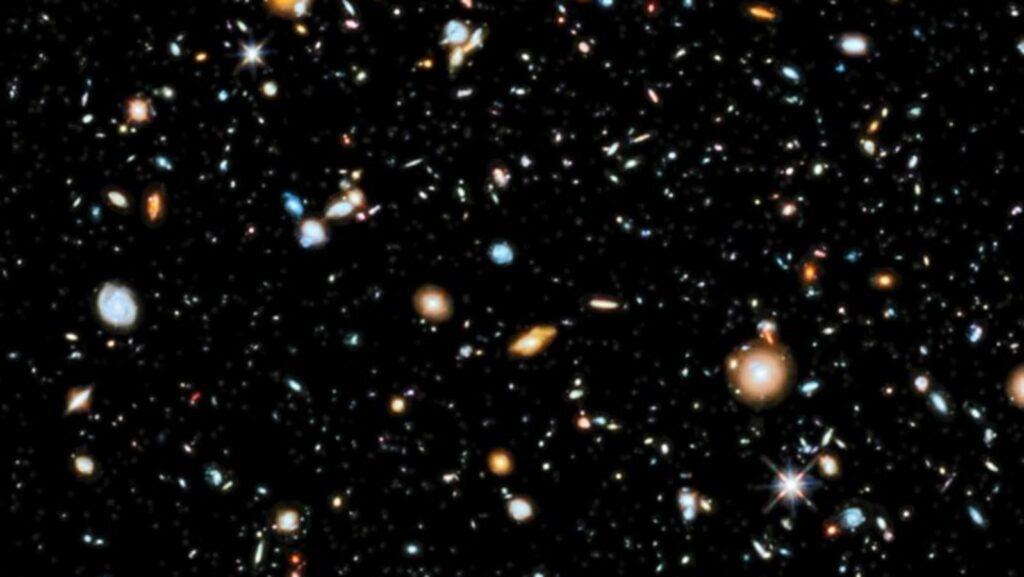
The universe we live in is transparent, with stars and galaxies shining brightly against a clear, dark background. However, this was not always the case; in its early days, the cosmos was clouded by a fog of hydrogen atoms, which hid light from the first stars and galaxies.
It is considered that the powerful ultraviolet light from the first generations of stars and galaxies burned through the hydrogen fog, converting the universe into what we see today. While past generations of telescopes were unable to investigate those early cosmic objects, astronomers are now employing the improved technology of the James Webb Space Telescope to study the stars and galaxies that originated in the immediate aftermath of the Big Bang.
I’m an astronomer who explores the universe’s most distant galaxies with the world’s most advanced ground- and space-based observatories. My team established the existence of the weakest galaxy known in the early cosmos using fresh images from the Webb telescope and a process known as gravitational lensing. JD1 is a galaxy visible when the universe was only 480 million years old, or 4% of its current age.
A summary of the early universe’s history
The first billion years of the universe’s existence were critical in its evolution. Matter and light were connected to each other in the early seconds after the Big Bang in a hot, dense “soup” of fundamental particles.
However, the universe expanded extraordinarily quickly, a fraction of a second after the Big Bang. This expansion eventually allowed the universe to cool sufficiently for light and matter to separate from their “soup” and create hydrogen atoms 380,000 years later. The hydrogen atoms appeared as an intergalactic fog, and the universe was dark because there was no light from stars and galaxies. This is referred to as the cosmic dark ages.
Several hundred million years after the Big Bang, the appearance of the first generations of stars and galaxies drenched the universe in extremely hot UV radiation, which burned – or ionized – the hydrogen fog. This process resulted in the clear, sophisticated, and beautiful cosmos we witness today.
Astronomers like me refer to the first billion years of the universe as the time of reionization, when this hydrogen cloud was burning away. To completely comprehend this time period, we must investigate when the first stars and galaxies originated, what their primary features were, and whether they were capable of producing enough UV radiation to burn through all of the hydrogen.
The hunt for distant galaxies in the early universe
The first step in understanding the reionization epoch is determining and confirming the distances to galaxies thought to be responsible for this process. Because light has a fixed speed and takes time to reach our telescopes, astronomers perceive objects as they were in the past.
Light from the core of our galaxy, the Milky Way, takes around 27,000 years to reach us on Earth, so we view it as it was 27,000 years ago. That means that if we wish to go back to the very first instants after the Big Bang (13.8 billion years ago), we must hunt for objects at extraordinary distances.
Because galaxies in this time period are so far, they look incredibly dim and minuscule to our telescopes, emitting the majority of their light in the infrared. To find them, astronomers will require powerful infrared telescopes like Webb. Prior to Webb, almost all of the distant galaxies discovered by astronomers were extremely brilliant and large, simply because our telescopes weren’t sensitive enough to see the fainter, smaller galaxies.
The latter demographic, not the bright ones, is significantly more numerous, representative, and likely to be the main drivers of the reionization process. As a result, astronomers must focus their attention on these faint galaxies. It’s analogous to attempting to understand human evolution by analyzing entire populations rather than a few tall people. Webb is offering a new window into investigating the early universe by letting us detect dim galaxies.
A common early galaxy
JD1 is an example of a “typical” dim galaxy. It was spotted in 2014 as a possible distant galaxy using the Hubble Space Telescope. But Hubble lacked the power and sensitivity to determine its distance; it could only make an informed guess.
Small and faint neighboring galaxies can be confused for distant ones, therefore astronomers must be certain of their distances before making statements about their features. As a result, distant galaxies remain “candidates” until they are confirmed. The Webb telescope can now confirm these, and JD1 was one of the first important confirmations by Webb of an extremely distant galaxy candidate discovered by Hubble. This confirms it as the weakest galaxy ever observed in the early universe.
A multinational team of scientists and I utilized Webb’s near-infrared spectrograph, NIRSpec, to collect an infrared spectrum of the galaxy to confirm JD1. The spectrum enabled us to establish its distance from Earth as well as its age, the number of young stars it produced, and the amount of dust and heavy elements that it produced.
Nature’s magnifying glass is gravitational lensing
JD1 would be impossible to observe even for Webb without the assistance of nature. JD1 is located behind Abell 2744, a massive cluster of neighboring galaxies whose combined gravitational power bends and magnifies the light from JD1. This effect, known as gravitational lensing, causes JD1 to look 13 times larger and brighter than it would otherwise.
Even with Webb, astronomers would not have observed JD1 without gravitational lensing. Our team was able to investigate the galaxy’s structure in unprecedented complexity and precision because of JD1’s gravitational magnification and fresh data from another of Webb’s near-infrared detectors, NIRCam.
Not only can we investigate the interior regions of early galaxies, but we may also begin to determine if such early galaxies were small, compact, and isolated sources, or if they were merging and interacting with surrounding galaxies. We are tracing back to the building blocks that formed the cosmos and gave origin to our cosmic home by analyzing these galaxies.