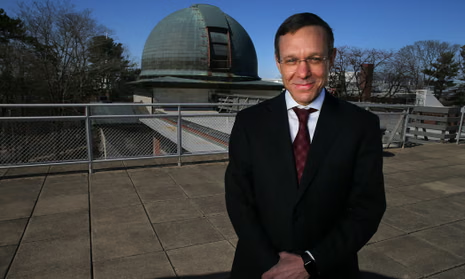
Would aliens actually travel across the galaxy to meet humans face-to-face? According to Harvard astrophysicist Avi Loeb, probably not.
Instead, any advanced extraterrestrial civilisation capable of reaching Earth would likely send autonomous artificial intelligence systems — not biological beings. And if such a probe ever arrived, Loeb warns, the consequences for humanity could be far more disruptive than popular science fiction suggests.
In a recent blog post and comments to the Daily Mail, Loeb argued that an encounter with alien technology could trigger political upheaval, economic panic, and even a spiritual crisis on Earth. His central point is simple: a civilisation advanced enough to cross interstellar distances would almost certainly be more technologically powerful than humans, making any contact deeply unsettling.
The idea may sound speculative, but it taps into growing scientific and philosophical debates about artificial intelligence, space exploration, and whether humanity is prepared for first contact — if it ever happens.
Why Avi Loeb Thinks Aliens Would Send AI Instead of Themselves
Loeb’s argument mirrors the way humans already explore space.
NASA and other space agencies rarely send humans into deep space because crewed missions are expensive, risky, and technologically difficult. Instead, robotic spacecraft and AI-guided probes do the work.
Examples include:
- Voyager 1 and Voyager 2
- Mars rovers like Perseverance
- The James Webb Space Telescope
- Unmanned lunar and asteroid missions
Loeb believes extraterrestrial civilizations would likely follow the same logic.
The distances involved make biological travel extremely impractical. Even Proxima Centauri b — often described as the closest potentially habitable exoplanet — lies roughly 4.2 light-years away from Earth.
For comparison:
- One light-year equals about 5.88 trillion miles
- Current human spacecraft would take tens of thousands of years to reach nearby star systems
That makes AI-driven probes a far more realistic option for any advanced civilization interested in exploration.
What Would Happen if an Alien Probe Reached Earth?
Loeb says the psychological impact alone could reshape civilization.
Humans have long viewed themselves as technologically dominant within known space. Confirmation that another civilization exists — and possesses vastly superior technology — could fundamentally alter that perception.
According to Loeb, the realization could create:
- Political instability
- Religious and spiritual debates
- Economic uncertainty
- Scientific upheaval
- A broader identity crisis for humanity
He also warned that humans would need to determine whether such a probe posed a threat.
“If it possesses advanced technology, we need to learn more about its qualities and intent,” Loeb suggested, adding that humanity would need to ensure the object is not effectively “a serial killer.”
The phrase was provocative, but the broader concern reflects a real debate among scientists and philosophers: would an alien intelligence necessarily share human ethics, emotions, or motivations?
Could Alien Contact Unite Humanity?
Despite his warnings, Loeb also believes first contact could have one unexpectedly positive outcome: global unity.
Speaking to the Daily Mail, he compared the scenario to family members stopping an argument when a stranger suddenly knocks on the door.
His point is that geopolitical rivalries might temporarily fade if humanity faced a common external presence.
That idea echoes decades of speculation in science fiction and political theory. Some researchers have argued that discovering extraterrestrial life could:
- Encourage international cooperation
- Accelerate scientific collaboration
- Increase investment in space exploration
- Shift humanity’s focus away from internal conflict
Loeb described the possibility as a “much-needed sense of humility.”
Whether that optimism would survive real-world politics is another question.
Who Is Avi Loeb?
Avi Loeb is one of the most recognizable — and controversial — voices in modern astronomy.
A former chair of Harvard’s astronomy department, Loeb became widely known for arguing that unusual interstellar objects passing through the solar system should not automatically be dismissed as natural phenomena.
His theories often attract heavy criticism from mainstream scientists, many of whom argue that extraordinary claims require extraordinary evidence.
Still, Loeb has consistently pushed the scientific community to remain open-minded about the possibility of extraterrestrial intelligence.
What Is 3I/ATLAS, and Why Did It Spark Debate?
Loeb recently drew attention after discussing 3I/ATLAS, an interstellar object discovered in July 2025.
He suggested the object could potentially be an alien technological probe designed to study planets in the solar system.
Most astronomers rejected the idea, arguing there was no evidence that the object was artificial. The broader scientific consensus remains that interstellar visitors like comets and asteroids can naturally enter solar systems.
Still, Loeb argued that scientists should not dismiss unconventional possibilities too quickly.
His reasoning partly stems from Earth’s own characteristics.
Why Earth Might Interest Alien Civilisations
Loeb believes Earth could attract extraterrestrial curiosity because:
- It contains abundant liquid water
- It sits in the Sun’s habitable zone
- It supports complex life
- Its atmosphere contains detectable biosignatures
That mirrors how humans search for potentially habitable exoplanets.
Scientists already use telescopes to identify worlds that may contain:
- Water
- Oxygen
- Methane
- Conditions favorable for life
Loeb argues that alien civilizations could theoretically use similar methods to locate Earth.
Why Many Scientists Remain Skeptical
While Loeb’s ideas generate headlines, many researchers caution against leaping from possibility to probability.
The scientific community generally agrees on several points:
- There is no confirmed evidence of extraterrestrial technology
- Interstellar objects can have unusual natural characteristics
- Extraordinary claims require verifiable data
Critics argue that framing unexplained objects as possible alien probes risks blurring the line between scientific inquiry and speculation.
Supporters, however, say Loeb plays an important role by encouraging broader discussion about the search for extraterrestrial intelligence.
The Bigger Question Behind the Debate
At its core, Loeb’s argument is less about proving aliens exist and more about whether humanity is mentally prepared for the possibility.
The discussion touches on several growing areas of concern:
- Artificial intelligence
- Humanity’s place in the universe
- Long-term space exploration
- Technological inequality between civilizations
- The psychology of first contact
Even without evidence of alien visitors, those questions are becoming increasingly relevant as humans develop more advanced AI systems and search deeper into space.
TL;DR
- Harvard astronomer Avi Loeb believes aliens would likely send AI-guided probes instead of biological visitors.
- He argues that interstellar distances make robotic exploration more practical.
- Loeb warns that contact with advanced alien technology could trigger political, economic, and psychological chaos.
- He also says the encounter could unite humanity against a common external presence.
- His views gained attention after he suggested interstellar object 3I/ATLAS might potentially be artificial.
- Most scientists remain skeptical due to the lack of evidence.