The sharpest public image yet of China’s secretive spaceplane appeared this week in a Pentagon intelligence report. A commercial Maxar satellite took the photo from orbit in 2024. The Defense Intelligence Agency published it in its new assessment of threats in space, released Oct. 26.
The China spaceplane is an uncrewed, reusable craft. Beijing has flown it four times since 2020 while saying almost nothing about it.
It looks strikingly like the U.S. Space Force’s X-37B. The new picture shows what the craft looks like in orbit, but not what it was doing there.
Where the image came from
The photo appears in Challenges to Security in Space 2026, DIA’s 130-page unclassified report. This is the third edition, with information current as of July 2026, according to the agency’s press release.
The caption calls it a “PRC Spaceplane captured by Maxar,” credited to Maxar Technologies with a 2024 date. It says spaceplanes “can launch into orbit to place objects in space or even test them and return to earth.”
Maxar, now called Vantor, later told The War Zone that its WorldView-3 satellite took the image on May 28, 2024. It was shot from just under 56 miles away.
The image isn’t brand new. A much lower-resolution version appeared in 2024, The War Zone reported.
Space Force Col. John Patrick, then head of U.S. Space Forces-Korea, showed it during a presentation at the Open Space Forum in South Korea. The DIA report has now put a sharper copy on the public record.
What the photo shows, and what it doesn’t
The image shows the craft from below, with its wings, tail and solar arrays visible. Vantor’s description goes further.
It told The War Zone that “a separate satellite” sits docked to the craft’s aft section. It added that the payload bay doors are “visibly open.”
That detail matters, because other coverage, including The Aviationist, described the rear object as a service module. If Vantor is right, the photo may show the spaceplane working with another spacecraft. That fits what the DIA says about its missions.
The May 2024 date also places the image inside the third mission, which ran from December 2023 to September 2024. That was the flight on which, the DIA says, the spaceplane “released and interacted with an object.”
What the photo can’t show is purpose. Neither the DIA nor Vantor has said what the docked object was, or what the payload bay carried.
What the DIA says China’s spaceplane has done
The report says China “has two primary spaceplane models,” the Shenlong and the Tengyun. It doesn’t say which one appears in the photo. Shenlong is the name commonly used for the vehicle China has flown so far.
The DIA lays out a short record. The first prototype went to orbit in 2020 and stayed two days. The second mission, launched in August 2022, spent 276 days in space.
In November 2022, the spaceplane “appeared to maneuver with a companion satellite” about one kilometer away, the report says. At one point the two came within 100 meters of each other. The report says they “possibly rendezvoused” before the spaceplane let the satellite go again.
The third mission, launched in December 2023, lasted 268 days. We covered reports of that release in May 2024.
China launched a fourth mission on Feb. 7, 2026. As of late October, no one had reported the craft back on Earth.
Tracking by astronomer Jonathan McDowell showed it “executed a rerendezvous with the subsat on Sep 10 and a recapture on Sep 13,” The Aviationist reported. China’s state news agency Xinhua has said the flights provide “technical support for the peaceful use of space.”
How it compares with America’s X-37B
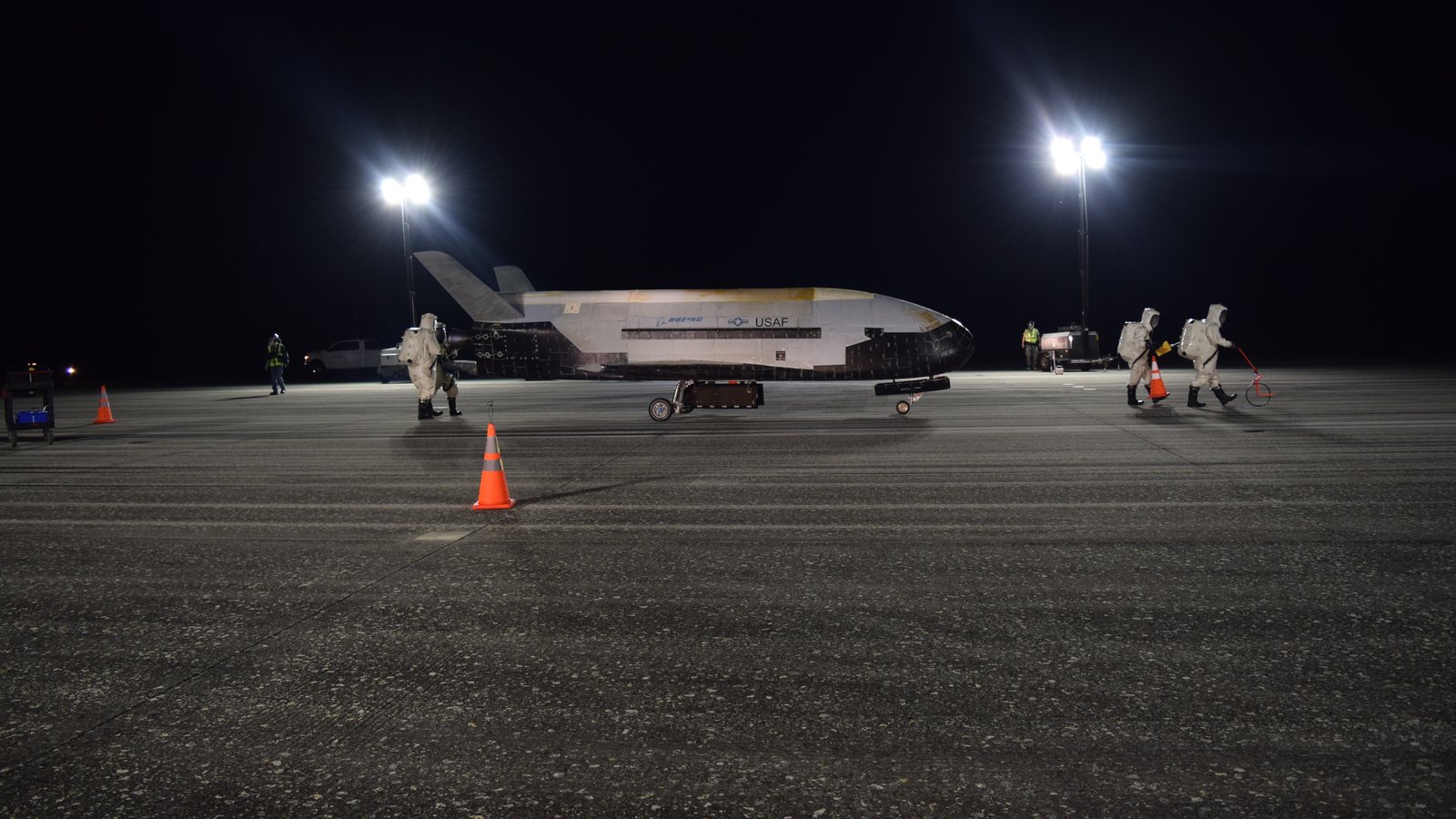
The resemblance to the X-37B is close. According to The War Zone, both have small wings, twin vertical tails, upward-opening payload bay doors and a tail extension with solar panels. The Chinese design’s wings have a much longer chord, meaning they run deeper from front to back.
The U.S. craft has a longer track record. It has spent more than 4,200 days in space since its first launch in April 2010. That’s according to Boeing, which builds it.
Its eighth mission launched on Aug. 22, 2025, according to The War Zone.
That mission also flies with a service module, Boeing said. Its announced experiments include laser links between satellites. It also carries what Boeing calls “the highest performing quantum inertial sensor ever tested in space,” meant to help with positioning where GPS is unavailable.
The Space Force released its own first image of the X-37B in orbit in February 2025. Both programs now have a public picture, and both keep most of their missions secret.
Why U.S. intelligence is watching
The DIA puts spaceplanes in a section on reusable technology. It says they “feature enhanced maneuverability, making them more suitable for certain missions than traditional satellites.”
That ability is what makes the program hard to read. A craft that can approach, hold near and recapture another object could test satellite servicing, inspection or something more military. The report doesn’t say which, and nothing in the public record shows the Chinese spaceplane carrying a weapon.
The wider report is more direct about China’s goals. It says China “has developed and will continue to advance weapons for use against satellites in orbit.” Their aim, the report says, is to “disrupt, damage, and destroy other nations’ space capabilities.” It names ground-based anti-satellite missiles among them.
The report also covers Russia, Iran and North Korea, and the growing problem of debris in orbit.
For the spaceplane, the next public clue will be its landing. The War Zone points to a remote airbase in northwestern China, with a 16,400-foot runway, as the likely site. Beijing has confirmed past landings only after the fact.