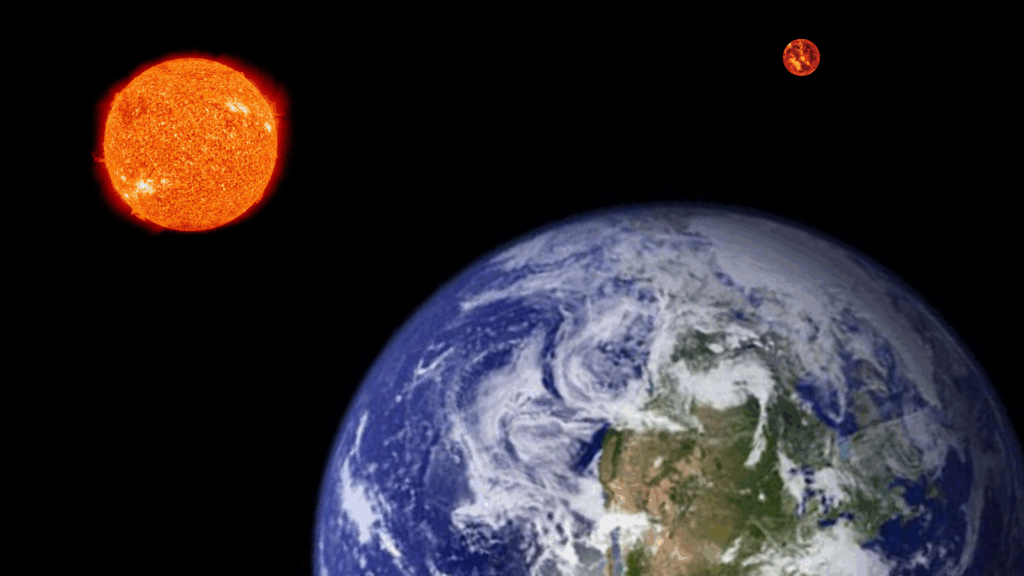
Scientists have long suspected that distant cosmic events can influence Earth in surprising ways. A new study adds a dramatic twist to that idea: a passing star may have jolted the Oort Cloud about 2.5 million years ago, sending a barrage of comets hurtling toward early Earth. These icy visitors, researchers suggest, could have helped reshape the planet’s climate at a pivotal moment in human evolution.
The study, soon to appear in Nature, focuses on a star called HD 7977 and its ancient flyby. Though the star never came close to Earth, its gravitational nudge may have been powerful enough to disturb billions of frozen bodies at the solar system’s edge. The resulting comet shower, researchers argue, could explain climatic shifts during the Pliocene-Pleistocene transition, an era when early humans were gaining a foothold on the planet.
This article explains the science behind the hypothesis, the role of the Oort Cloud, and why this event matters for understanding Earth’s past—and possibly its future.
What exactly is the Oort Cloud?
The Oort Cloud is a theoretical shell of icy objects that surrounds the solar system at extreme distances. Astronomers believe it marks the boundary between our solar system and interstellar space.
Key features of the Oort Cloud
• It likely begins around 2,000 astronomical units (AU) from the Sun and may extend out to nearly 100,000 AU.
• One AU is the distance between Earth and the Sun.
• Dutch astronomer Jan Oort first proposed its existence in 1950 to explain long-period comets.
• No telescope has directly observed it because it is too far, too dark, and too sparsely populated to detect.
The Oort Cloud is thought to be divided into two major regions:
• The inner Oort Cloud (IOC)
• The outer Oort Cloud (OOC)
Long-period comets that suddenly appear in the night sky often originate from these regions, nudged by gravitational forces such as passing stars or galactic tides.
How could a passing star disturb the Oort Cloud?
About 2.5 million years ago, the star HD 7977 is believed to have skimmed past the outer boundary of the solar system. While it wasn’t anywhere near Earth, even a distant flyby can produce measurable effects because the Oort Cloud’s objects are only loosely bound to the Sun.
According to Avi Loeb and co-authors Zhuoya Cao and Morgan MacLeod, HD 7977’s gravity may have:
• Repopulated the inner Oort Cloud
• Altered long-term comet trajectories
• Increased the number of comets entering the inner solar system
The authors describe the flyby as a potential trigger for a major comet shower, one intense enough to send icy debris cascading toward Earth like celestial bullets.
Why does this event matter for Earth’s climate history?
The comet shower described by the team coincides with the Pliocene-Pleistocene transition—a period when Earth began cycling through repeated glacial and interglacial phases.
If correct, the hypothesis suggests:
• A spike in comet impacts could have introduced dust into the atmosphere
• This dust might have affected global temperatures
• The impacts could have contributed to environmental changes shaping early human habitats
For example, cooling trends and habitat shifts during this period may have forced early human species to adapt, migrate, or develop new survival behaviors. The proposed comet influx would not be the sole driver of climate change, but it could be part of a broader mosaic of natural forces.
What evidence supports the comet shower hypothesis?
The research team evaluated whether craters from around 2.5 million years ago could be linked to a sudden increase in impacts.
Their analysis suggests:
• Some craters typically attributed to asteroid strikes might instead be the result of comet impacts
• Cometary bombardment is considered more plausible for certain sites
• The timing of HD 7977’s flyby aligns with these geological signatures
However, the researchers are careful to stress that more evidence is needed. Geological studies, isotope analysis, and improved crater dating could help determine whether comet impacts were truly widespread during this transition.
This is a key place where external scientific citations would strengthen the article, ideally linking to research from Nature, NASA, or university-led space science labs.
Could such an event happen again?
Yes—but not anytime soon. Stellar flybys near the Oort Cloud occur periodically in cosmic time, but they’re rare on human timescales.
Astronomers track nearby stars to assess future close encounters. For example:
• The star Gliese 710 is expected to pass relatively close to the solar system in about 1.3 million years.
• Models predict it could disturb the Oort Cloud, but the long-term effects on Earth remain uncertain.
Understanding past flybys helps researchers evaluate potential future risks. It also sheds light on how cosmic forces shape not only planets but biology, climate, and even the trajectory of evolution.
What does this study change about how we view Earth’s past?
The idea that a distant star might have helped influence Earth’s climate underscores the interconnectedness of cosmic systems. It expands the conversation beyond familiar factors such as volcanic activity or orbital cycles.
If confirmed, the HD 7977 event would:
• Provide a new mechanism for climate change in Earth’s deep past
• Highlight the role of distant astronomical interactions in shaping terrestrial environments
• Offer insights into why early human evolution unfolded the way it did
The intersection between astrophysics, geology, and anthropology makes this hypothesis especially compelling.
TL;DR
A new study suggests that the star HD 7977 passed close enough to the Oort Cloud about 2.5 million years ago to disturb it, sending a surge of comets toward Earth. This comet shower may have influenced climate changes during the Pliocene-Pleistocene transition—a crucial era in early human evolution. While the evidence is promising, researchers stress that more geological verification is needed.