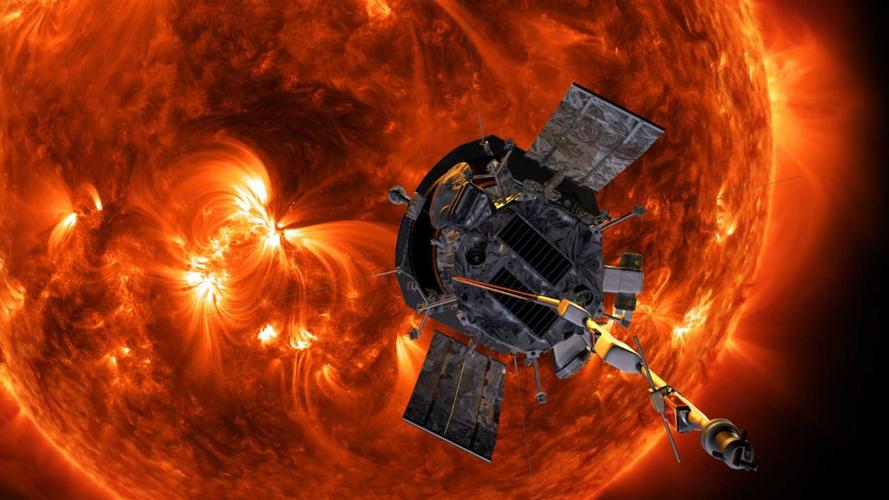
A solar expedition that has been spiraling closer to the sun in order to explore its secrets has made an important discovery. The Parker Solar Probe data has revealed the source of the solar wind, a stream of charged particles that flows from the sun’s corona, or hot outer atmosphere, toward Earth.
One of the primary goals of the mission, named after late astronomer Eugene Parker and launched in 2018, was to learn more about how wind arises near the sun and how it escapes the star’s gravity.
As the probe approached the sun at a distance of around 13 million miles (20.9 million kilometers), its instruments observed fine features in the solar wind that it generates near the photosphere, or the solar surface, and captured ephemeral details that disappear once the wind is blasted from the corona.
The spacecraft was specially constructed to fly within 4 million miles (6.4 million kilometers) of the solar surface, and it became the first mission to “touch” the sun in late 2021. A research report on the solar discoveries was published in the journal Nature on Wednesday.
Solar wind untangling
The solar wind is a continuous discharge of charged particles such as protons and electrons. The vast phenomena include a portion of the solar magnetic field and extend well beyond the corona, interacting with planets and the interstellar medium.
This wind comes in two varieties. The faster solar wind travels at a maximum speed of 497 miles per second (800 kilometers per second) from holes in the corona at the sun’s poles. The slower solar wind, located in the same plane of the solar system as Earth, flows at a calmer 249 miles per second (400 kilometers per second).
Normally, the rapid solar wind has no effect on Earth. However, the sun’s magnetic field flips at the solar cycle’s maximum, an 11-year period during which the sun’s activity gradually increases. Because of this flip, coronal holes emerge over the sun’s surface, releasing blasts of solar wind directly at Earth.
Understanding the source of solar wind can aid scientists in better forecasting space weather and solar storms that may harm Earth.
Although solar storms can produce magnificent auroras, they can also have an impact on satellites and the Earth’s electrical infrastructure.
“Winds carry lots of information from the sun to Earth, so understanding the mechanism behind the sun’s wind is important for practical reasons on Earth,” said study coauthor James Drake, distinguished professor of physics at the University of Maryland, College Park, in a statement. “That’s going to affect our ability to understand how the sun releases energy and drives geomagnetic storms, which are a threat to our communication networks.”
The data from the spacecraft indicated that coronal holes behave like showerheads, with jets appearing on the sun’s surface as bright spots, indicating where the magnetic field goes in and out of the photosphere.
Solar probe reveals magnetic reconnection as a source of fast solar wind
As magnetic fields pass each other in opposite directions within these solar surface funnels, they split and reunite, sending charged particles hurtling out of the sun.
“The photosphere is covered by convection cells, like in a boiling pot of water, and the larger scale convection flow is called supergranulation,” said lead study author Stuart D. Bale, a professor of physics at the University of California, Berkeley, in a statement.
“Where these supergranulation cells meet and go downward, they drag the magnetic field in their path into this downward kind of funnel. The magnetic field becomes very intensified there because it’s just jammed. It’s kind of a scoop of magnetic field going down into a drain. And the spatial separation of those little drains, those funnels, is what we’re seeing now with solar probe data.”
Parker Solar Probe observed very energetic particles traveling 10 to 100 times faster than the solar wind, leading researchers to assume that the fast solar wind is caused by magnetic field reconnection.
“The big conclusion is that it’s magnetic reconnection within these funnel structures that are providing the energy source of the fast solar wind,” Bale said. “It doesn’t just come from everywhere in a coronal hole, it’s substructured within coronal holes to these supergranulation cells. It comes from these little bundles of magnetic energy that are associated with convection flows. Our results, we think, are strong evidence that it’s reconnection that’s doing that.”
The sun’s cycle
Because the sun is scheduled to reach a solar maximum in July 2025, there have been more reports of solar flares and the northern and southern lights appearing in unexpected places. Parker Solar Probe and a companion mission, Solar Orbiter, are ideally positioned to see the sun’s tremendous, dynamic forces in action.
But scientists are grateful that Parker Solar Probe launched ahead of the sun’s increasing dramatics during the quieter solar minimum when chaotic activity didn’t have a chance of obscuring observations.
“There was some consternation at the beginning of the solar probe mission that we’re going to launch this thing right into the quietest, most dull part of the solar cycle,” Bale said. “But I think without that, we would never have understood this. It would have been just too messy. I think we’re lucky that we launched it in the solar minimum.”