
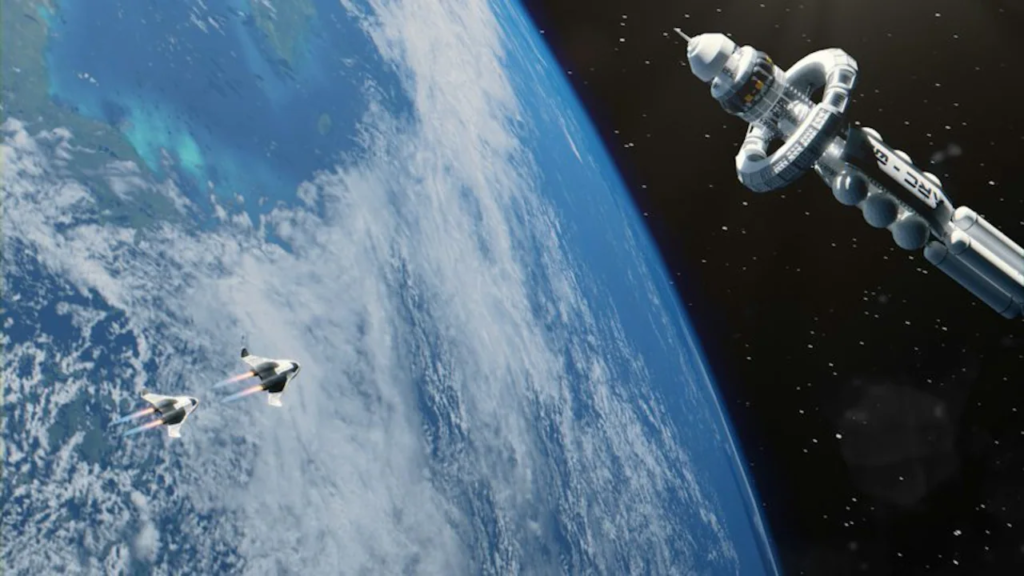
The United States has publicly acknowledged for the first time that it has “on-orbit space control weapons”, offering one of the clearest indications yet that Washington is preparing for a more openly contested military environment in space.
Air Force Secretary Troy Meink made the disclosure on September 14 at the Air & Space Forces Association’s 2026 Air, Space & Cyber Conference in National Harbor, Maryland. He said the Space Force has weapons in orbit capable of defending US forces against hostile action.
Meink did not reveal how many systems are deployed, where they are located or precisely what they can do. He also declined to say whether the weapons use kinetic or non-kinetic effects.
That uncertainty is important because “weapons in orbit” does not necessarily mean conventional missiles circling Earth.
What exactly did the US Space Force confirm?
Meink said the Space Force now has “on-orbit space control weapons” capable of defending the joint force against hostile adversary action.
He described space-control capabilities as involving both offensive and defensive missions and said the US needs to ensure it can continue operating freely in space.
When questioned about the announcement, Meink indicated that the wording had been carefully chosen. He refused to provide details about whether the systems had been tested or exactly how they operate.
That makes the disclosure significant while leaving much of the military technology behind it deliberately opaque.
Does this mean the US has missiles stationed in orbit?
Not necessarily.
The Pentagon has not identified the weapons as orbital missiles, nor has it said that the systems physically destroy other spacecraft.
A space-control weapon can have different effects. Some counterspace systems interfere with satellite communications or electronics without physically striking the target, while other concepts could involve more direct kinetic attacks.
For example, the US Space Force already operates the Meadowlands electromagnetic warfare system, a ground-based capability designed to disrupt adversary satellite communications. It was operationally accepted in June 2026. Because Meadowlands operates from the ground, however, it should not be confused with the newly acknowledged on-orbit systems.
The exact nature of the orbital weapons remains classified.
Why is the Pentagon talking more openly about space weapons?
The shift reflects a broader change in how Washington views space.
Military satellites underpin communications, navigation, intelligence gathering, missile warning and other operations on Earth. If an adversary can disrupt those systems, it can potentially degrade military forces without directly attacking troops or traditional weapons platforms.
US officials have increasingly described space as a contested military domain, particularly as China and Russia develop technologies intended to interfere with or attack satellites.
The White House has also formally emphasized counterspace threats. In December 2025, President Donald Trump said US policy should ensure the country can detect, characterize and counter the full range of threats to its space interests.
Why are China and Russia central to the US strategy?
Meink specifically identified China and Russia as major space threats.
Both countries have developed and demonstrated capabilities that US officials regard as potentially capable of attacking, disabling or interfering with satellites.
China has rapidly expanded its military space capabilities, including sophisticated satellite maneuvering and counterspace programs. Russia has also demonstrated anti-satellite capabilities and has repeatedly treated space as an important component of military competition.
The US believes it needs the ability not only to protect its own spacecraft but also to respond if an adversary attempts to disrupt American or allied satellites.
That logic underpins the broader concept of “space control”.
What is a space-control weapon?
In simple terms, a space-control weapon is a system intended to influence an adversary’s ability to use space.
That could involve disrupting communications, interfering with sensors, degrading satellite operations or, depending on the technology, physically damaging a spacecraft.
The distinction between offensive and defensive systems can also become blurry.
A capability designed to protect an American satellite could potentially do so by disabling an attacking or hostile spacecraft. The same technology can therefore have defensive and offensive applications depending on how it is employed.
Meink explicitly said the US capabilities could serve both purposes.
Is the US building space-based missile interceptors?
Separately, yes.
The Pentagon is developing space-based interceptors as part of the broader Golden Dome missile-defense architecture. Meink said the Space Force’s Space-Based Interceptor program had progressed rapidly and that an initial capability could potentially be fielded by 2028.
Those systems should not automatically be assumed to be the same weapons Meink referred to when he said the Space Force already has on-orbit space-control weapons.
The newly acknowledged capability is already in orbit. The space-based interceptor program remains a developing missile-defense effort.
What about “kinetic” and “non-kinetic” weapons?
The distinction is crucial in space warfare.
A kinetic weapon physically strikes or destroys its target. That can create a major secondary problem: orbital debris. A destroyed satellite can leave behind thousands of fragments capable of damaging other spacecraft.
A non-kinetic system can attempt to disable or degrade an adversary without physically smashing the satellite. Electronic warfare and jamming are examples of this broader category.
Meink said the US possesses space-control capabilities involving both kinetic and non-kinetic means, but he did not say which type is currently deployed in orbit.
Is having weapons in space legal?
The answer depends on what kind of weapon is being discussed.
The 1967 Outer Space Treaty prohibits countries from placing nuclear weapons or other weapons of mass destruction in orbit around Earth. It also bans such weapons on celestial bodies and prohibits military bases, weapons testing and military maneuvers on the Moon and other celestial bodies.
The treaty does not impose a blanket ban on every conventional military system in Earth orbit.
That distinction is why the existence of conventional orbital weapons is not automatically a violation of the treaty.
At the same time, the growing deployment of counterspace systems raises broader questions about escalation, debris and the risk of an arms race beyond Earth.
Could this trigger a new space arms race?
That is one of the major concerns surrounding the disclosure.
Experts quoted in recent reporting warned that ambiguity can cut both ways. Washington may hope that acknowledging a hidden capability deters adversaries by demonstrating that attacks on US satellites could face consequences.
But China and Russia could interpret the announcement as evidence that the US is moving further toward weaponizing orbit and use it to justify additional counterspace programs of their own.
China has already criticized the US announcement. Beijing called on Washington to stop what it described as an expansion of military capabilities in space and warned against a new arms race.
How does this fit into Trump’s space strategy?
The disclosure comes after the Trump administration put greater emphasis on military dominance in space.
A December 2025 executive order on American space superiority directed the government to strengthen the country’s ability to detect and counter threats to US space interests. It also tied space security to the development of the Golden Dome missile-defense system.
Trump has repeatedly described space as an increasingly important arena for military competition.
The latest announcement suggests that the administration’s approach is moving beyond long-term planning toward acknowledging that at least some space-control capabilities are already operational.
What has the US actually revealed?
Very little about the hardware itself.
The Pentagon has confirmed that the weapons are in orbit and that they are intended for space-control missions. It has not disclosed their number, orbital locations, launch dates or detailed effects.
That leaves an important question unanswered: what exactly is flying above Earth right now?
For the moment, only the broad category has been publicly acknowledged.
But that alone represents a notable shift. The United States has moved from discussing the need for counterspace capabilities to openly stating that weapons capable of conducting space-control missions are already deployed in orbit.
The next chapter of space warfare may therefore not begin with a dramatic satellite explosion.
It may begin with something much quieter: a signal that suddenly stops working, a sensor that no longer responds or a spacecraft that finds itself unable to operate as intended.