What makes this Martian rock so rare?
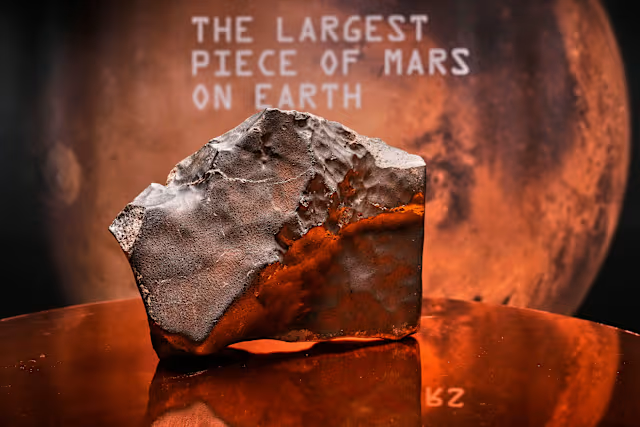
A one-of-a-kind space rock known as NWA 16788 is about to go under the hammer at Sotheby’s Natural History auction in New York, and it’s making headlines for good reason. Weighing in at 54 pounds (25 kilograms), this meteorite is the largest known piece of Mars ever found on Earth.
While more than 77,000 meteorites have been officially recognized, only about 400 have been confirmed to be of Martian origin. This particular rock, about the size of a small microwave, makes up nearly 7% of all known Martian material on Earth.
Estimated to sell for between $2 million and $4 million, NWA 16788 is expected to draw significant interest from collectors, institutions, and space history enthusiasts.
How did a piece of Mars end up on Earth?
According to Sotheby’s, this rare meteorite was blasted off the Martian surface millions of years ago, likely as a result of a massive asteroid impact. It then embarked on a 140-million-mile journey through space, eventually crash-landing in the Sahara Desert.
A meteorite hunter discovered it in Niger in November 2023, and a small fragment was later analyzed in a specialized lab. The testing confirmed that the rock’s chemical fingerprint matched samples obtained by NASA’s Viking probe, which landed on Mars in 1976.
What type of rock is it?
NWA 16788 has been classified as an olivine-microgabbroic shergottite — a type of volcanic rock that forms from the slow cooling of Martian magma. Its coarse-grained texture contains olivine and pyroxene minerals, making it particularly valuable to planetary scientists.
Its glassy outer surface indicates it endured extreme heating as it plummeted through Earth’s atmosphere, giving the meteorite both scientific and aesthetic appeal.
“This Martian meteorite is the largest piece of Mars we have ever found by a long shot,” said Cassandra Hatton, vice chairman for science and natural history at Sotheby’s. “It’s more than double the size of what we previously thought was the largest piece of Mars.”
How does it compare to other Martian meteorites?
For context, most Martian meteorites are smaller than a baseball, and often weigh just a few ounces. NWA 16788 measures nearly 15 inches by 11 inches by 6 inches — roughly 70% larger than the previous record-holder.
Here’s how it stacks up:
| Feature | NWA 16788 | Typical Martian Meteorite |
|---|---|---|
| Weight | 54 lbs (25 kg) | 0.1 – 1.5 lbs (50–700 g) |
| Composition | Olivine-microgabbroic shergottite | Mostly basaltic shergottites |
| Size | 15x11x6 inches | Palm-sized or smaller |
| % of Martian rocks on Earth | ~7% | Less than 1% each |
Source: Sotheby’s; NASA Mars Sample Return Program
What else is featured in Sotheby’s Geek Week 2025?
NWA 16788 is part of Sotheby’s “Geek Week” auction, which showcases 122 rare items in natural history, paleontology, and mineralogy. Alongside the Martian meteorite is another blockbuster item: a juvenile Ceratosaurus skeleton estimated at $4 million to $6 million.
What is the Ceratosaurus?
The Ceratosaurus nasicornis skeleton on offer is over 6 feet tall and nearly 11 feet long. Discovered in 1996 near Laramie, Wyoming, the fossil dates back about 150 million years to the Late Jurassic period. Specialists reconstructed the display using 140 original bones, along with some sculpted material.
While the Ceratosaurus was similar in appearance to the Tyrannosaurus rex, it was much smaller, typically growing to about 25 feet compared to T. rex’s 40 feet.
The fossil was prepared and mounted by Fossilogic, a Utah-based company that specializes in restoring paleontological finds for museums and collectors.
Notable items in the auction:
- Gem-quality minerals
- Other meteorites, including lunar fragments
- Dinosaur teeth and claws
- Ancient fossils, some dating back hundreds of millions of years
This year’s Geek Week aims to celebrate curiosity, science, and the spectacular odds that bring these rare objects to our planet.
Why does this matter?
1. Scientific significance
Martian meteorites like NWA 16788 provide direct insight into Mars’ geological past, helping scientists understand the planet’s volcanic history, surface conditions, and potential for ancient water or even microbial life.
Unlike robotic missions that return limited samples (such as the future Mars Sample Return mission from NASA and ESA), meteorites offer unfiltered access to Mars’ natural rock record, with no need for billion-dollar spacecraft.
2. Cultural and collector value
Space artifacts have become hot commodities in recent years, often selling for millions at auction. The value is driven not only by rarity, but by humanity’s collective fascination with space, exploration, and our cosmic origins.
This meteorite, the largest ever from Mars, is a tangible piece of another world. That makes it uniquely compelling for collectors, museums, and even private space firms seeking to showcase scientific heritage.
3. Market for natural history
The auction underscores the rising market value of natural history objects. As science-related collectibles continue to grow in demand, expect more record-breaking sales, and more debates around private vs. institutional ownership of important specimens.
Sotheby’s New York is auctioning the largest Martian meteorite ever found on Earth, a 54-pound volcanic rock named NWA 16788, with an expected price tag of up to $4 million. The meteorite, ejected from Mars by a cosmic impact and discovered in the Sahara in 2023, represents nearly 7% of all known Martian material on Earth. It’s the highlight of the auction house’s Geek Week 2025, which also features a juvenile Ceratosaurus skeleton and other rare scientific artifacts.