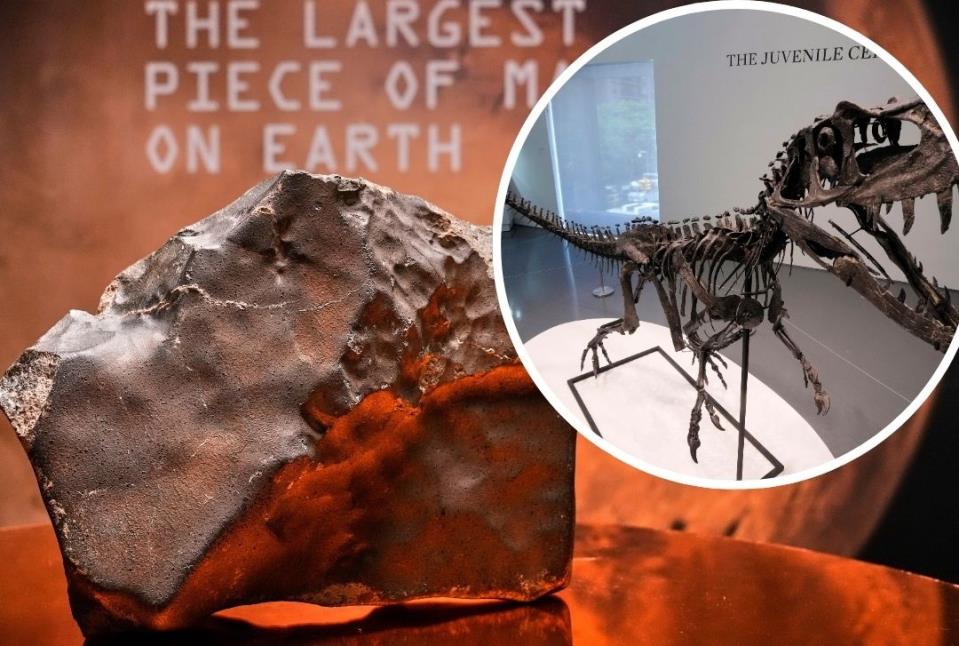
A rare Martian meteorite made history, then a juvenile dinosaur stole the show
A piece of Mars—yes, actual Mars—just sold for $5.3 million at a high-profile auction in New York. But in a surprise twist that even Sotheby’s couldn’t have scripted, it was a young dinosaur skeleton that truly captivated bidders, igniting a frenzy that ended with a jaw-dropping $30.5 million final price.
The Martian rock may be the largest ever found on Earth, but the dinosaur brought the drama.
What is the Martian meteorite, and why is it so valuable?
The rock, officially named NWA 16788, weighs 54 pounds (25 kilograms) and measures roughly 15 x 11 x 6 inches. It’s not just a space rock—it’s the largest known piece of Mars on Earth, more than 70% bigger than any other discovered so far. Only about 400 Martian meteorites have ever been confirmed among the 77,000+ documented meteorites on Earth.
Discovered in the Sahara Desert in Niger in 2023, NWA 16788 was likely blasted off the Martian surface by an asteroid impact before traveling a staggering 140 million miles to our planet. Experts confirmed its Martian origin by comparing its chemical makeup with samples collected during NASA’s Viking missions in the 1970s.
The rock’s official classification? An olivine-microgabbroic shergottite, a type of volcanic Martian material with a coarse-grained texture formed from slow-cooling magma. Its exterior is glassy from the searing heat of reentry through Earth’s atmosphere.
Why this rock matters
This is more than a geological oddity. According to Sotheby’s, the rock alone represents nearly 7% of all known Martian material on Earth. That rarity, combined with its pristine condition and size, is why it fetched such a high price. Its pre-auction estimate was $2 million to $4 million, but it exceeded expectations, despite slow bidding.
How did the auction play out?
Live bidding opened with two advance offers of $1.9 million and $2 million. Progress was sluggish, prompting the auctioneer to lower the required minimum increases. Eventually, the winning bid landed at $4.3 million. With fees and costs added, the final price came to $5.3 million, making it the most expensive meteorite ever sold at auction.
But the Martian meteorite wasn’t the evening’s main event for long.
What was the dinosaur skeleton, and why did it sell for six times more?
Enter the Ceratosaurus nasicornis, a predator that roamed what is now North America around 150 million years ago. Think of it as the smaller, spikier cousin of the Tyrannosaurus rex—still intimidating, but far more rare in fossil form.
Why this skeleton is special
- It’s one of only four known Ceratosaurus skeletons ever found.
- It’s the only known juvenile specimen of the species.
- Standing more than 6 feet tall and stretching nearly 11 feet long, it offers researchers a rare glimpse into the growth stages of Jurassic predators.
Discovered in 1996 near Laramie, Wyoming, at the fossil-rich Bone Cabin Quarry, the skeleton was later assembled using 140 original fossil bones and some reconstructed parts by Fossilogic, a fossil prep and mounting company in Utah. It’s museum-ready.
The bidding war
Estimated at $4 million to $6 million, the Ceratosaurus shattered expectations. Bidding opened with a $6 million offer and escalated rapidly—first in $500,000 increments, then by the millions. Within six minutes, it sold for $26 million, with a final cost of $30.5 million after fees. The buyer remains anonymous but plans to loan the skeleton to an institution.
That sale made it the third most expensive dinosaur ever auctioned. The current record is held by a Stegosaurus named Apex, which sold for $44.6 million last year, also through Sotheby’s.
Why these sales matter beyond the auction house
For science and education
- The dinosaur skeleton will likely go on public display, potentially helping paleontologists better understand juvenile dinosaur development.
- The Martian rock might end up in a private collection, though scientists hope it could be studied further to reveal new insights into the Red Planet’s history.
For collectors and the market
These record-breaking sales underscore the growing interest and rising value of natural history collectibles. Fossils, meteorites, and rare geological specimens are no longer niche; they’re now sought-after trophies in high-end auctions, on par with fine art and rare watches.
Should these specimens be in private hands?
Not everyone is thrilled. Some scientists argue that such rare finds should reside in museums or research institutions, not private collections. The concern is that critical data about planetary geology or evolutionary biology could be locked away and inaccessible to researchers.
In this case, the dinosaur skeleton will be loaned out, according to Sotheby’s. The fate of the Martian meteorite remains unknown.
What’s next for the Martian rock?
Whether it ends up in a museum, a billionaire’s office, or a university lab, NWA 16788 will likely remain a symbol of the increasingly blurred lines between science, commerce, and spectacle.
As Cassandra Hatton of Sotheby’s put it: “This Martian meteorite is the largest piece of Mars we have ever found by a long shot.” And in an auction full of headlines, that’s saying something.