A Martian meteorite found in the Sahara in 2022 formed at least 4.1 billion years ago. That makes the rock, Teghaza 001, one of the three oldest pieces of Mars on Earth, and possibly the oldest. Yang Liu of NASA’s Jet Propulsion Laboratory led the study, published Oct. 29 in Science.
Its minerals show water reacting with rock inside Mars’ crust around 4.1 billion years ago. A companion paper finds the planet was already losing that water to space. Mars formed about 4.5 billion years ago, according to NASA. By our arithmetic, that puts Teghaza 001 within roughly the first 400 million years of Martian history.
That matters because nearly every other piece of Mars we can hold is far younger. This one comes from the era when Mars was turning from a wetter world into the cold desert it is now.
A rose-colored rock from a Mali salt plain
The meteorite takes its name from the salt plain in Mali where it turned up, JPL said. It is rose-colored and weighs nearly 2 pounds (800 grams).
Nomadic meteorite hunters found it, Scientific American reported. It lay in eight pieces, the largest about the size of a fist. The site was roughly 21 miles from the village of Bir Chali, Reuters reported.
Researchers at the University of New Mexico first identified it as Martian. Their evidence was its oxygen isotopes, which work as a chemical fingerprint for each planet.
At first it looked ordinary. It seemed to be a shergottite, the most common class of Martian meteorite. Liu almost passed on studying it, according to JPL, until she noticed odd textures and unfamiliar minerals.
“It was only after we started looking closely that we realized this meteorite is really unique,” Liu said in the JPL release. “One of the paper’s reviewers called it a Rosetta Stone for Mars.”
How scientists dated it to 4.1 billion years
The key was zircon. These tough crystals trap uranium when they form. The uranium then decays into lead at a known rate, so zircons work as clocks. Liu’s team found zircons in Teghaza 001 and used that uranium-lead method, Reuters reported.
Caltech geochemist Francois Tissot added a second method. His lab’s rubidium-strontium dating reads single mineral grains on the rock’s surface, JPL said. It needed a piece smaller than a fingernail and left it intact, which matters for a rock this rare.
“Right now, we are one of very few labs in the world able to perform this kind of age-dating,” Tissot said in the JPL release. He added that his lab was “the first to date such an ancient Martian meteorite.”
The dates showed that water altered the rock around 4.1 billion years ago. So the rock itself must be older still. The paper’s title hedges the same way: it formed “≳4.1 billion years ago,” meaning at least that old.
Why it stands out among about 435 Mars meteorites
Every Martian meteorite shares a backstory. An impact blasted it off Mars, and its path through space later crossed Earth’s. Liu told Reuters that “we do not know when the sample landed on Earth.”
Scientists know of roughly 435 such rocks. Most sample only the last 600 million years or so of Mars’ history, Scientific American reported. Just three come from the planet’s early period. By our count, that is less than 1% of the collection.
The other two tell narrower stories. ALH84001 turned up in Antarctica in 1984. It is almost entirely one mineral and similar in age, JPL said.
A 2010 study put it at 4.091 billion years. The new study says Teghaza 001 is likely the older of the two, Reuters reported, and Scientific American put the gap at about 10 million years.
The third, nicknamed “Black Beauty,” came from the Sahara in 2011. It weighed about 11 ounces (320 grams), NASA said in 2013. JPL describes it as a mix of small volcanic fragments that formed about 2.1 billion years ago.
Teghaza 001 is about two and a half times heavier. More important, it is a single igneous rock that cooled slowly from magma. It records how a piece of Mars’ crust crystallized and how water later changed it. A jumble of fragments, or a rock made of one mineral, cannot show that as clearly.
What the rock says about water on early Mars
The Science paper says the rock’s altered minerals and oxygen isotopes point to reactions with fluids. Those reactions happened before an impact launched it into space. Liu told Reuters that “multiple lines of evidence” show Mars had water more than 4.1 billion years ago.
The hydrogen tells a second story. A June paper in Science Advances by Lee Saper, Liu and colleagues measured deuterium, a heavier form of hydrogen. When a planet loses water to space, light hydrogen escapes more easily. The deuterium left behind becomes more concentrated.
The team set a floor for that ratio in Martian water 4.1 billion years ago. It was about twice the level in Earth’s seawater. The authors say this supports models in which young Mars lost hydrogen fast. Put simply, the drying out was already well underway when this rock formed.
Saper, now at NASA’s Ames Research Center, called the rock “a snapshot in time” in comments to Reuters. It shows a wetter Mars with a thick atmosphere, he said, whose habitable conditions “were waning rapidly.”
He was careful about the limits. The findings support the idea that early Mars had the ingredients for life, Saper said. But they “do not directly answer the question of whether there was life on Mars.”
Where on Mars it came from is still an open question
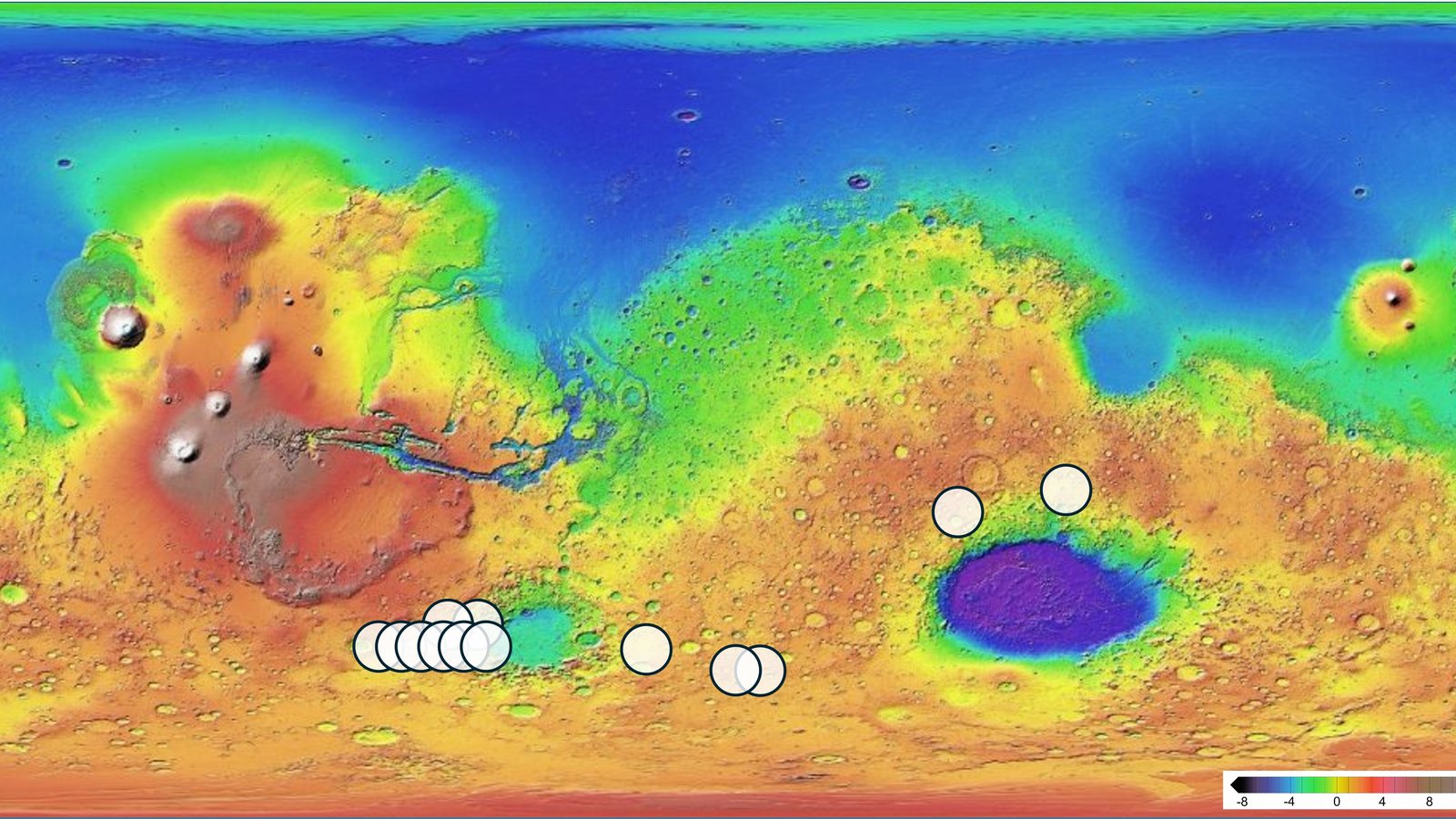
No one can trace a meteorite to its exact crater. The team compared the rock’s chemistry with data from NASA’s Mars Reconnaissance Orbiter. They found 13 matching locations, mostly in the cratered southern highlands, JPL said. Liu told Reuters it may come from near Hellas Basin, one of the largest impact craters on Mars.
That uncertainty is why some scientists want more than meteorites. Anya Udry of the University of Nevada, Las Vegas, was not involved in the study. “We don’t know exactly where it came from, so this is really another example of why we need to bring back samples,” she told Scientific American.
The water-loss question also lost an observer this year. NASA’s MAVEN orbiter studied what happened to Mars’ once-dense atmosphere. NASA declared its mission over on June 3, months after losing contact in December 2025. NASA’s Swift telescope ended its own mission this month.
It is a busy week for solar system science. Two days before the Mars study, the Rubin Observatory reported a possible dwarf planet beyond Pluto.
For Teghaza 001, the next step is more lab work on samples already cut from it. Liu calls this year’s papers a first look. “We’ve only scratched the surface,” she said in the JPL release.