NASA astronaut applications are open on USAJOBS until 11:59 p.m. EST on Thursday, Dec. 3, and the posting pays $164,395 a year. To qualify you need US citizenship and a STEM master’s degree or one of three approved alternatives. You also need three years of professional experience and must pass NASA’s long-duration flight physical.
The call comes as NASA plans a permanent Moon Base near the lunar south pole. The job posting opens “As NASA builds a Moon Base and advances the Artemis program” and says the new astronauts will work toward a lasting human presence there. The odds are long: in each of NASA’s last four classes, NASA picked fewer than 1 applicant in 700.
The minimum bar, line by line
We built this checklist from the USAJOBS announcement (NASA-13093568-27-AS) and NASA’s selection page, updated Nov. 7. You must meet every minimum by Dec. 3, and the posting says NASA grants no waivers.
- Citizenship: US citizen.
- Education, one of four: a master’s degree in engineering, biological science, physical science, computer science or mathematics; at least two years (36 semester hours) of doctoral coursework in those fields; a medical degree (MD, DO, PA, DNP, FNP or related); or Test Pilot School, finished by July 2027.
- Degrees that don’t count: technology degrees such as engineering technology, aviation or aviation management, exercise physiology, social sciences, and most psychology. Clinical, physiological and experimental psychology still count.
- Experience: three years of progressively responsible professional work after the qualifying degree. Pilots instead need 750 hours in command of a high-performance jet. Other fixed-wing pilots need 1,500 hours (750 in command), and helicopter pilots 1,000 (300 in command).
- Eyesight and health: near and distant vision correctable to 20/20 in each eye, with glasses, PRK or LASIK allowed, plus medical and psychiatric exams.
- Fitness: a swimming test in the first month. Expect up to two hours a day of scuba diving or up to seven in a pressurized suit.
There is no age limit and no height range in the posting. Applicants pick one of seven sub-disciplines: pilot, flight test, medical, biological and medical science, physical science, engineering or operations.
What changed since the 2024 call
We compared the new posting with NASA’s March 2024 announcement, which produced the class of 10 named in September 2025. The main differences are in pay, the medical and pilot routes, and timing.
Pay is higher. The 2024 posting listed $152,258. The new one lists $164,395, which NASA calls an approximation based on 2026 pay tables.
The medical route is wider. In 2024 the posting asked for “an M.D., D.O. or related medical degree” and listed nursing degrees as non-qualifying. The 2026 posting names physician assistants, Doctors of Nursing Practice and family nurse practitioners alongside MDs and DOs.
The pilot route is wider too. The 2024 rule was 1,000 hours in command with at least 850 in high-performance jets. Now 750 jet hours qualify, and helicopter and non-jet pilots have their own thresholds.
The window is shorter. The 2024 posting ran from March 5 to April 16, about six weeks. NASA announced this one on Saturday, Nov. 7, which leaves under four weeks. There is also a new warning: “cheating or use of SI (Super Intelligence) will result in removal from consideration.”
The master’s requirement is not new. NASA first required a STEM master’s for the 2021 class, when it also brought in an online assessment.
The odds, class by class
Applicant counts come from NASA’s announcements where we could open them, and from Spaceflight Now for 2013 and 2017. Each count is a “more than” figure, so the real odds were slightly longer than ours.
| Class announced | Applicants | Selected | About 1 in | Share picked |
|---|---|---|---|---|
| June 2013 | more than 6,000 (Spaceflight Now) | 8 | 750 | 0.13% |
| June 2017 | more than 18,300 (Spaceflight Now) | 12 | 1,525 | 0.07% |
| Dec. 2021 | more than 12,000 (NASA) | 10 | 1,200 | 0.08% |
| Sept. 2025 | more than 8,000 (NASA) | 10 | 800 | 0.13% |
The 2017 pool remains the record. PBS NewsHour reported in 2016 that the previous high was 8,000 applicants, in 1978.
The pool shrank after the master’s rule arrived. Even so, a class of 10 still means roughly 800 to 1,200 applicants per seat.
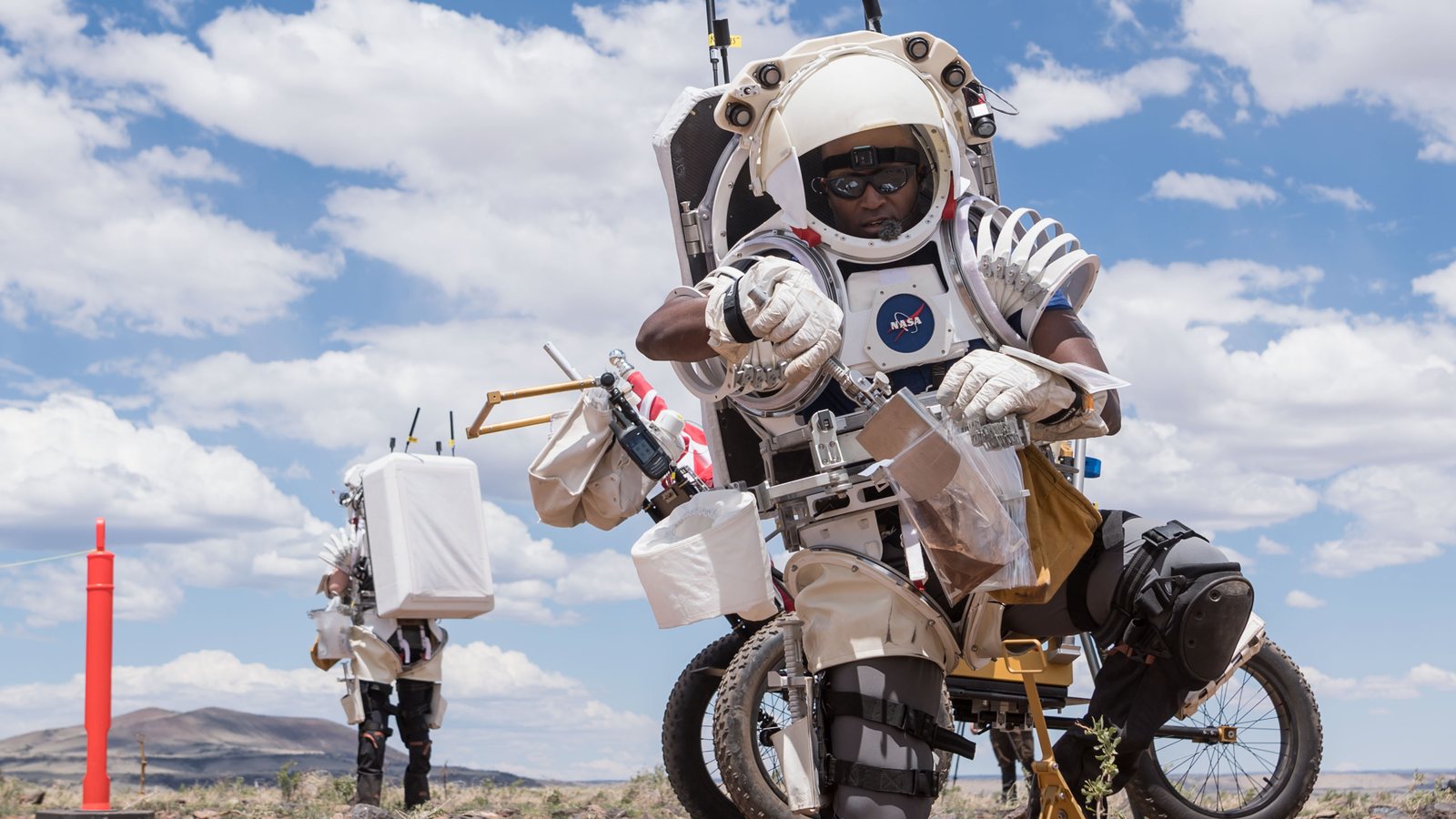
The man in the photo above, Andre Douglas, came out of the 2021 pool of more than 12,000. He is now a mission specialist on Artemis III.
Why this class lines up with the Moon base
NASA’s Moon Base page, updated Nov. 8, lays the outpost out in three phases. Robotic missions run until 2029, then power, cargo and communications go in from 2029 to 2032. Phase three, from 2032, carries the title “Live and Work on the Moon.” That is when NASA plans a permanent outpost “where astronauts can live and work for extended periods.”
The hiring schedule points at that third phase. NASA expects to choose the class by late 2027 and start training in early 2028, the Associated Press reported. Training takes about two years, and AP notes a first flight can take several more.
That puts this class’s earliest realistic missions around the start of phase three. So the “live and work” pitch fits a later stage of these careers, not a first flight.
Artemis III already has its crew. It will test two commercial landers in Earth orbit next summer rather than land, as our Artemis III explainer sets out. Artemis IV aims to land two astronauts near the south pole the year after.
NASA has only 32 active astronauts, AP reported. “We have far more work than we have astronauts,” Artemis III commander Randy Bresnik said at the Kennedy Space Center event that launched the call.
From application to the astronaut office
Applying is a multi-stage process. Qualified applicants take the USA Hire online assessments, for which the posting says to set aside at least 2.5 hours. NASA interviews the most competitive at Johnson Space Center in Houston. It says it calls about half of them back for a second round.
Those selected get a 30-month time-limited appointment, with a permanent one only after candidate training. The posting warns of travel 76% of the time or more. It also says getting selected does not guarantee a spot in the astronaut corps. Artemis III crew member Frank Rubio put the flying at “about 1% of your experience,” AP reported.
If the checklist rules you out, the paying route is slow too. Virgin Galactic pushed its first Delta-class passenger flights to early in the second quarter of 2027.
The USAJOBS posting closes at 11:59 p.m. Eastern on Dec. 3. NASA expects to name its 25th astronaut class by late 2027.