
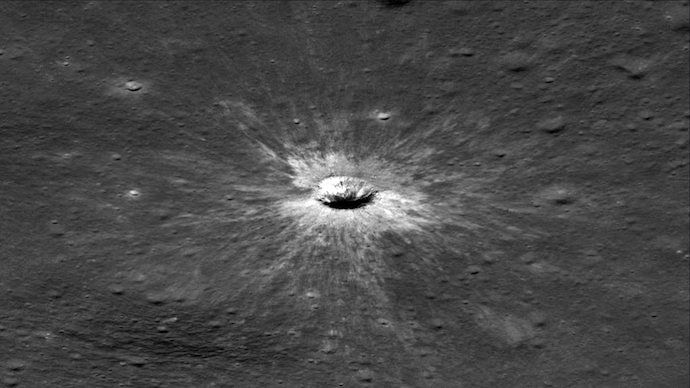
NASA has discovered a remarkably fresh impact crater on the that scientists say may be the largest newly formed crater identified anywhere in the solar system. Named McGetchin, the crater was created by a space rock that struck the lunar surface sometime between April 11 and May 22, 2024. NASA estimates the impactor was roughly the size of a three- to six-story building. The resulting crater is about 728 feet (222 meters) wide and up to 141 feet (43 meters) deep — roughly the length of two American football fields.
Scientists estimate an impact of this scale occurs on the Moon only about once every century or longer, making the discovery unusually valuable for researchers studying how the lunar surface changes over time.
Why is NASA’s new Moon crater so unusual?
The Moon is covered with impact craters. Some are hundreds of miles across and billions of years old.
What makes McGetchin different is not simply its size. It is the fact that scientists can study a large lunar impact almost immediately after it happened.
Most lunar craters are ancient. Their original features have been altered over millions or billions of years by subsequent impacts and the gradual movement of lunar dust, or regolith.
McGetchin, by comparison, is effectively a new geological event.
NASA says it is the largest newly formed crater ever identified in the solar system. The agency’s Lunar Reconnaissance Orbiter (LRO) has been circling the Moon since 2009, giving scientists an extensive archive of images that can be compared to newer observations.
Suggested visual: A scale graphic comparing McGetchin’s 728-foot width with two football fields and the Roman Colosseum.
How was the McGetchin crater formed?
Scientists believe an asteroid or comet struck the Moon in spring 2024.
The object itself was not enormous by astronomical standards. NASA estimates it was approximately comparable in size to a three- to six-story building.
But because the Moon has virtually no atmosphere, incoming space rocks do not experience the atmospheric friction that slows or destroys many objects approaching Earth.
The impact therefore released enormous energy when the object hit the lunar surface, excavating material and throwing debris outward.
That debris became one of the clues that eventually led researchers to the crater.
NASA’s analysis shows a bright area surrounding the crater, representing material blasted outward by the impact. The resulting debris pattern was sufficiently large that it stood out in comparisons of older and newer lunar images.
Why did NASA take more than a year to find it?
The crater was not discovered immediately after the 2024 impact.
Instead, it was identified in October 2025 by Robert Wagner, an image-processing specialist working with NASA’s Lunar Reconnaissance Orbiter Camera.
Wagner was examining lunar images during a routine data-quality check when he noticed an unusually prominent pattern on the Moon’s surface.
The LRO’s Wide-Angle Camera captures enormous areas of the lunar landscape, with individual pixels covering areas roughly comparable to American football fields. Wagner used software to compare hundreds of images taken at different times and highlight changes in the landscape.
Most apparent changes turn out to be false alarms caused by differences in lighting, shadows or viewing conditions.
McGetchin was different.
The debris pattern surrounding the newly formed crater was unusually obvious. Wagner subsequently used higher-resolution imagery from LRO’s Narrow-Angle Camera to examine the feature in much greater detail.
What does NASA’s Lunar Reconnaissance Orbiter reveal?
The discovery demonstrates why long-running lunar missions can be so valuable.
LRO has spent more than 17 years mapping the Moon’s surface and gathering information about its topography, composition, temperature and radiation environment.
NASA says researchers have identified at least 1,000 new impact craters during the mission, along with roughly 100,000 other surface changes caused by impacts and the debris they produce.
Most of those impacts are dramatically smaller than the one that created McGetchin.
NASA estimates that impacts producing craters around the minimum size detectable in LRO imagery occur roughly 140 times per year across the Moon. Many smaller impacts leave craters that cannot be identified from orbital imagery.
That makes McGetchin particularly useful: its size allows scientists to study not only the crater itself but also the much wider region affected by the impact.
The impact changed more than just the crater
One of the most interesting findings came from another LRO instrument.
After McGetchin was identified, scientists used the spacecraft’s Diviner Lunar Radiometer Experiment to examine temperatures around the new crater.
They discovered a cold region extending roughly 4 miles (6.4 kilometers) around the crater. At night, this area was about 16 degrees Fahrenheit (9 degrees Celsius) cooler than the surrounding terrain.
The reason is linked to the lunar soil.
A powerful impact can disturb and “fluff up” the regolith, making it less dense. The altered material does not retain heat in the same way as the undisturbed surface.
That means an impact can modify the Moon’s thermal environment well beyond the crater itself.
The finding could also have practical implications. NASA researchers say such changes may affect how rover wheels interact with the lunar surface — an important consideration as robotic and human exploration expands.
Why does studying a fresh lunar crater matter?
A newly formed crater provides something scientists rarely get: a geological experiment with a known approximate starting point.
Researchers can compare the Moon’s surface before and after the impact and examine:
- How far impact debris travels.
- How much material is excavated.
- How the surrounding regolith is disturbed.
- How surface temperatures change.
- How quickly the new feature evolves.
- How impact energy translates into changes in the lunar landscape.
Those observations can then be compared with older craters whose histories are far less certain.
In other words, McGetchin can serve as a reference point for interpreting millions of other impact sites across the Moon.
Why is this important for future Moon missions?
The discovery comes as the Moon is again becoming a major focus of human and robotic exploration.
NASA’s Artemis program is designed to support a sustained human presence around and on the Moon, while other countries and private companies are developing their own lunar missions.
Understanding the lunar surface is therefore more than an academic exercise.
Future spacecraft and astronauts will have to navigate terrain covered by loose regolith, rocks, craters and impact debris. Fresh impacts provide scientists with an opportunity to understand how that environment changes and how disturbances propagate across the surface.
NASA notes that the broader effects of impacts, including changes to the regolith, could influence the performance of lunar vehicles.
What makes the Moon different from Earth?
The frequency with which scientists can observe lunar impacts is partly explained by the Moon’s lack of a substantial atmosphere.
On Earth, many smaller objects burn up or break apart while passing through the atmosphere. The Moon does not have the same protective layer.
As a result, objects traveling through space can reach the lunar surface relatively easily and create new craters.
The Moon also lacks the weather systems, flowing water and active geological processes that constantly reshape Earth’s surface. A crater that appears on the Moon can therefore remain visible for extremely long periods.
That combination makes the lunar surface an unusually valuable record of the solar system’s impact history.
McGetchin could become a benchmark for lunar science
The significance of McGetchin is ultimately less about the crater’s dramatic dimensions than about the timing of its discovery.
Scientists have an opportunity to observe the aftermath of a major lunar impact while the evidence is still fresh.
NASA’s LRO observations can document the crater’s shape, the distribution of debris and the changes to the surrounding regolith. Future observations may reveal how those features evolve over the coming years.
The discovery also shows the value of maintaining long-term scientific missions. Without years of earlier LRO imagery, researchers would have had a much harder time establishing that McGetchin was new.
For a world where most geological evidence is measured in millions or billions of years, a crater created just two years ago offers something unusually rare: a chance to watch lunar geology happen in near-real time.
TL;DR
NASA’s Lunar Reconnaissance Orbiter has helped scientists identify McGetchin, a fresh impact crater on the Moon created between April and May 2024.
Key facts:
- Width: About 728 feet (222 meters)
- Depth: Up to 141 feet (43 meters)
- Impact date: Between April 11 and May 22, 2024
- Discovery: October 24, 2025
- Likely impactor: Roughly three to six stories tall
- Estimated frequency: About once every century or longer
- Surrounding thermal effect: A roughly 4-mile-wide region that is about 16°F cooler at night
- Scientific significance: It is described by NASA as the largest newly formed crater identified in the solar system
The discovery gives scientists an unusually detailed opportunity to study how a major impact reshapes the Moon’s surface — information that could prove useful as lunar exploration expands.