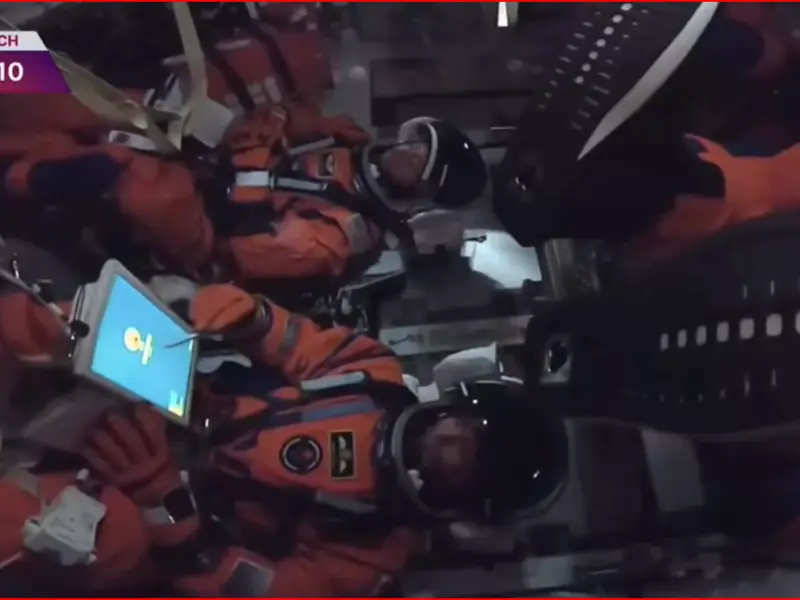
When NASA launched Artemis II, the world tuned in for history. What viewers didn’t expect was a blink-and-you-miss-it moment that quickly spiraled into a viral talking point: a password seemingly typed in plain view during the official livestream.
The clip, now circulating widely, has sparked questions about operational security, human error, and how even the most advanced missions can stumble over something as simple as a PIN.
What exactly happened during the Artemis II livestream?
Roughly 20 minutes before launch, the livestream briefly cut to the interior of the Orion capsule. Astronauts were strapped in, running through final checks.
During this window, mission commander Reid Wiseman interacted with a tablet mounted inside the spacecraft. As he entered a PIN, the camera angle made the input visible enough for sharp-eyed viewers to notice.
Within minutes, social media lit up.
Why the moment went viral
The virality wasn’t just about the slip. It was the contrast:
- A multibillion-dollar mission
- State-of-the-art engineering
- A basic security oversight unfolding in 4K
Users on platforms like X and Reddit quickly speculated about the PIN, with some even claiming to have decoded it.
Was this actually a “secret password”?
Short answer: not necessarily in the way people think.
What the tablet likely controls
Tablets inside spacecraft like Orion are multifunction tools. They are typically used for:
- Displaying flight data and checklists
- Supporting communication between crew and ground control
- Monitoring astronaut health metrics
- Running backup interfaces for certain systems
They are not the primary control systems for flight-critical operations.
Why the risk may be limited
Even if the PIN was visible, several factors reduce the real-world risk:
- Devices are part of isolated, highly secure onboard networks
- External access to spacecraft systems is heavily restricted
- Sensitive commands require multiple layers of authorization
In other words, this isn’t like someone leaking a Wi-Fi password at a coffee shop.
Still, perception matters. And in high-stakes missions, even minor lapses draw attention.
How did NASA respond, and what happens next?
As of now, NASA has not publicly detailed whether the PIN was changed immediately or whether additional safeguards were triggered.
But standard protocol in such scenarios typically includes:
- Resetting device credentials
- Reviewing camera angles and broadcast delays
- Reinforcing operational security procedures with crew
Why this matters beyond a viral clip
It’s tempting to treat this as a harmless “oops” moment. But it highlights something deeper: even elite systems rely on human behavior.
The human factor in high-tech missions
Space missions are engineered for redundancy and resilience. Yet:
- Humans still interact with systems in real time
- Live broadcasts introduce unpredictability
- Small oversights can scale instantly in the social media era
This is not unique to NASA. It mirrors cybersecurity incidents across industries, where human error often plays a central role.
The optics problem
For NASA, the challenge isn’t just technical. It’s reputational.
Moments like this can:
- Undermine public confidence, even if risk is minimal
- Fuel misinformation about mission safety
- Shift attention away from scientific achievements
That’s a steep price for a few seconds of unintended exposure.
What is Artemis II and why is it significant?
The irony is that this viral moment occurred during one of NASA’s most important missions in decades.
A return to deep space
Artemis II marks:
- The first crewed lunar mission since the Apollo era
- A test flight of the Orion spacecraft with astronauts onboard
- A key step toward future Moon landings under the Artemis program
The crew includes:
- Reid Wiseman
- Victor Glover
- Christina Koch
- Jeremy Hansen
The mission profile
- Launch from Kennedy Space Center
- Travel thousands of kilometers beyond the Moon
- Execute a lunar flyby
- Use the Moon’s gravity to return to Earth
It’s a complex ballet of physics, precision, and timing.
Lessons from the Artemis II “password moment”
Every mission teaches something. Sometimes it’s about propulsion systems. Sometimes it’s about people.
Key takeaways
- Live broadcasts need stricter visual controls
- Even non-critical devices should be treated as sensitive
- Public-facing missions require a blend of engineering and media awareness
This isn’t a failure of technology. It’s a reminder that technology is only as careful as the humans operating it.
TL;DR
- A livestream from Artemis II showed a tablet PIN being entered on camera
- The moment went viral, with users speculating about the password
- The device is unlikely to control critical systems, limiting actual risk
- The incident highlights how small human errors can become global talking points