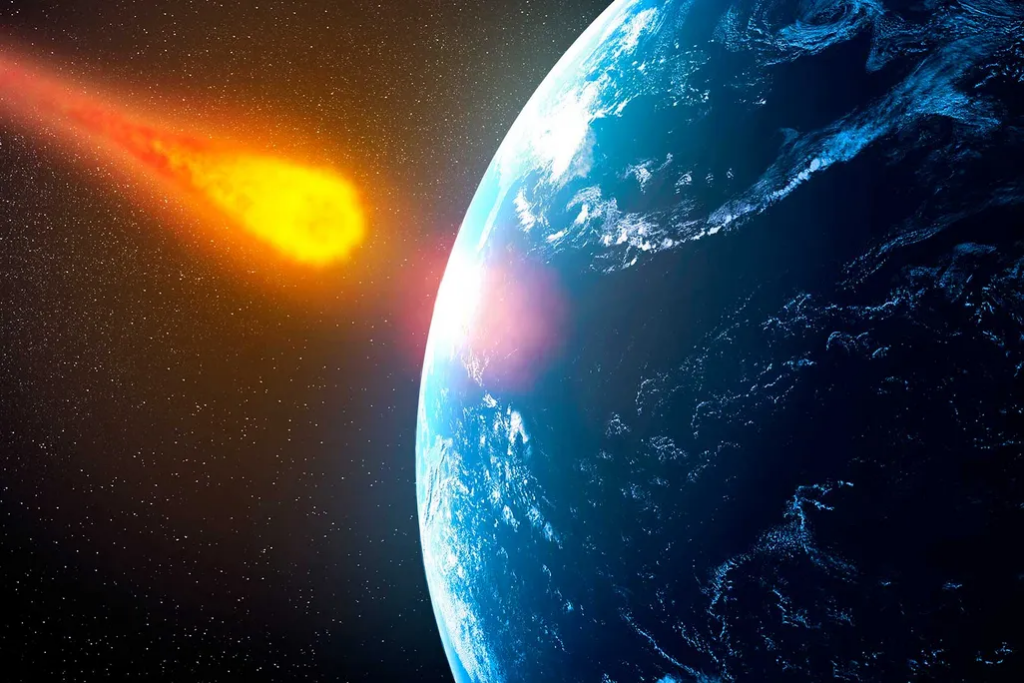
There may be more than 25,000 potentially dangerous asteroids near Earth that scientists haven’t yet identified—and that blind spot is what worries planetary defense experts the most.
According to officials at NASA, humanity has made real progress tracking large, civilization-ending asteroids. But thousands of mid-sized “city-killers”—space rocks roughly 140 meters (460 feet) or larger, remain undiscovered. If one of them were headed our way with little warning, experts say we currently don’t have a ready-to-launch system to stop it.
What Are the 25,000 “Hidden” Asteroids?
The concern centers on near-Earth objects (NEOs) about 140 meters or larger. These aren’t large enough to cause global extinction, but they can devastate a metropolitan area or region.
Kelly Fast, NASA’s acting planetary defense officer, recently acknowledged the limits of current detection efforts. Speaking at the American Association for the Advancement of Science, she said, “What keeps me up at night is the asteroids we don’t know about.”
Here’s what scientists mean:
- We’ve identified most of the largest, planet-killer asteroids (1 km+ wide).
- We’re good at spotting smaller rocks that burn up in the atmosphere.
- But mid-sized asteroids—around 140 meters—are harder to detect.
- Only about 40–50% of these have been discovered so far.
That leaves roughly 25,000 potentially hazardous asteroids still untracked.
For context, a 140-meter asteroid striking Earth could release energy equivalent to hundreds of megatons of TNT—enough to flatten a city and cause massive regional destruction.
Why Are These Asteroids So Hard to Detect?
Size and Darkness
Asteroids don’t glow. Most reflect very little sunlight, especially carbon-rich ones. A 140-meter rock can be extremely difficult to see unless it passes close enough and at the right angle.
Orbital Blind Spots
Some asteroids approach from directions that ground-based telescopes struggle to monitor—particularly those coming from the direction of the Sun.
Funding and Infrastructure Limits
Planetary defense programs compete for funding with other space and science priorities. While detection efforts are expanding, they’re not yet comprehensive.
NASA’s upcoming NEO Surveyor space telescope—if fully funded and deployed—aims to significantly close the detection gap.
Could a Mission Like DART Save Us?
In 2022, NASA successfully tested a planetary defense strategy with the Double Asteroid Redirection Test, or DART.
The Double Asteroid Redirection Test spacecraft deliberately crashed into Dimorphos, a moonlet orbiting the asteroid Didymos, successfully altering its orbit. It was the first real-world demonstration that humans can deflect an asteroid.
But there’s a major caveat.
Dr. Nancy Chabot of Johns Hopkins University, who led coordination for the DART mission, has warned that we don’t currently have a second DART spacecraft “sitting on a shelf.”
In other words:
- DART took years to design, build, and launch.
- It required a carefully calculated trajectory window.
- It targeted a known asteroid with no risk to Earth.
If a newly discovered asteroid were on a collision course with Earth—and detected too late—we would not have a ready-to-deploy deflection mission.
How Much Warning Would We Need?
Planetary defense depends almost entirely on early detection.
If scientists detect a threatening asteroid:
- 10+ years in advance → A deflection mission is feasible.
- 5 years or less → Options become limited and risky.
- Months or weeks → Mitigation would likely shift to evacuation, not deflection.
That’s why detection is more urgent than deflection technology. You can’t stop what you can’t see.
What About Asteroid 2024 YR4?
One recent example is 2024 YR4, which initially carried a small probability of impacting Earth in 2032. Subsequent calculations reduced the Earth-impact risk, though NASA indicated a higher probability of it striking the Moon.
Cases like this demonstrate how orbital predictions evolve with more data. Early risk estimates often shrink as scientists refine tracking models.
Are We Really Defenseless?
The situation is serious—but not hopeless.
Here’s where we stand:
What We’re Good At
- Tracking large extinction-level asteroids (1 km+).
- Improving global telescope coordination.
- Testing kinetic impact technology (DART).
Where We’re Vulnerable
- Undiscovered 140-meter class asteroids.
- Limited rapid-response capability.
- Funding gaps in planetary defense programs.
NASA estimates that over 95% of civilization-ending asteroids have already been found. The greater concern is regional-scale devastation.
Why Does This Matter Now?
Asteroid impacts are rare—but inevitable over long time scales.
Earth’s history is marked by impacts, including the one that contributed to the extinction of the dinosaurs 66 million years ago. Smaller impacts occur more frequently. The 2013 Chelyabinsk meteor over Russia, for example, injured over 1,000 people due to shockwaves from an airburst.
The difference today is that humanity has the technology to prevent some impacts—if we detect them early enough.
That’s the core message from planetary defense experts: the threat isn’t tomorrow. The risk is complacency.
What Needs to Happen Next?
Experts point to several priorities:
- Fully fund and launch NASA’s NEO Surveyor mission.
- Expand international asteroid-tracking cooperation.
- Develop ready-to-deploy deflection systems.
- Improve emergency preparedness for regional impacts.
Organizations such as NASA’s Planetary Defense Coordination Office and international bodies under the United Nations Office for Outer Space Affairs (UNOOSA) play key roles in global coordination.
TL;DR
NASA scientists warn that roughly 25,000 mid-sized asteroids capable of destroying a city remain undiscovered. While humanity has proven it can deflect an asteroid through the DART mission, we don’t currently have a rapid-response system ready to deploy. The biggest risk isn’t what we see—it’s what we haven’t found yet.