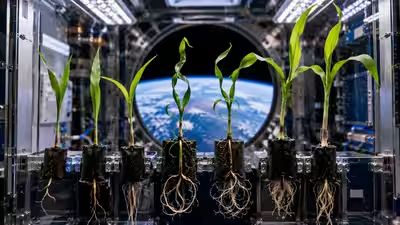
NASA’s experiments with corn seeds aboard space shuttles in the 1990s revealed an unexpected challenge for growing plants beyond Earth: without gravity, plants can lose their usual sense of direction.
The seeds were able to germinate and grow in microgravity, showing that plants can develop away from Earth. But their roots and shoots did not follow the organized growth patterns typically seen on the ground. Instead, researchers observed tangled and unusual growth as the plants responded to other environmental cues.
The experiments offered an early glimpse into one of the biggest challenges facing future space agriculture.
Why did NASA send corn seeds into space?
Plants have evolved on Earth under constant gravity. Their roots normally grow downward, while stems and shoots grow upward.
Scientists wanted to determine what happens when that gravitational signal becomes extremely weak.
During space shuttle experiments in the 1990s, researchers sent corn seeds into orbit and observed their development under microgravity conditions. The experiments were part of NASA’s broader effort to understand how plants respond to the unusual environment of space.
The basic question was simple:
Can plants figure out which way to grow when there is almost no gravity to guide them?
The answer was complicated.
The corn seeds could sprout and continue developing, but their roots and shoots showed unusual growth patterns rather than consistently following the familiar upward-and-downward arrangement seen on Earth.
How does gravity normally guide plant growth?
On Earth, plants use a biological process called gravitropism to sense gravity and adjust their growth.
Roots generally display positive gravitropism, meaning they grow in the direction of gravity. Shoots generally show negative gravitropism, growing away from gravity.
Specialized cells in plants contain tiny structures called statoliths, which help the plant detect the direction of gravity. This information contributes to the signals that tell roots and shoots how to orient themselves.
In microgravity, that gravitational reference becomes dramatically weaker.
As a result, plants have to rely more heavily on other environmental signals, particularly light.
What happens to plants when gravity is no longer a strong signal?
Microgravity does not mean plants simply stop growing.
Instead, their growth patterns can change.
Without a strong gravitational cue, roots may explore different directions rather than consistently growing downward. Shoots can also display altered orientation.
Light becomes particularly important because plants naturally respond to it through phototropism.
This creates a different set of instructions for the plant. Rather than receiving a dominant “down” signal from gravity, the plant has to interpret several environmental cues simultaneously.
That can produce growth that looks much less orderly than what we see on Earth.
Why is NASA studying plants on the International Space Station?
The research did not end with the shuttle experiments.
NASA and other space agencies have continued studying plant growth aboard the International Space Station (ISS) to understand how crops respond to microgravity and other space-related conditions.
Modern plant-growth systems provide controlled lighting, water, nutrients and environmental conditions.
These systems allow researchers to examine how plants respond when one of their most fundamental environmental signals—gravity—is significantly reduced.
NASA’s experiments include investigations into how plants grow, develop and respond to stress in space.
The findings could eventually help engineers design more effective systems for producing food during long-duration missions.
Why could growing plants matter for missions to the Moon and Mars?
Space food can be stored and transported, but relying entirely on supplies launched from Earth becomes increasingly difficult as missions become longer and farther away.
Growing at least some food during a mission could offer several advantages:
- Fresh produce: Plants could provide astronauts with fresh foods rather than relying entirely on packaged meals.
- Nutritional benefits: Crops can provide vitamins and other nutrients.
- Resource recycling: Plants can potentially play a role in future life-support systems by using carbon dioxide and producing oxygen.
- Psychological benefits: Caring for living plants could provide astronauts with a connection to Earth during long missions.
- Greater independence: Growing food locally could reduce the amount of food that must be transported from Earth.
For a short mission, growing crops may not be essential. For extended stays on the Moon or a future journey to Mars, however, biological food-production systems could become much more valuable.
Could astronauts grow crops on Mars?
Growing plants on Mars would be far more complicated than simply putting seeds into Martian soil.
Mars has a thin atmosphere, extremely low temperatures and radiation levels that are dangerous for humans and many living organisms. Its surface also does not provide the same environmental conditions as Earth’s agricultural soil.
Future space farms would therefore likely need controlled environments.
Inside a habitat or greenhouse, astronauts could potentially control:
- Light levels
- Temperature
- Water
- Nutrients
- Atmospheric composition
- Humidity
- Plant density
Understanding how plants respond to reduced gravity is another piece of that puzzle.
Mars has roughly 38% of Earth’s gravity, so it would not reproduce the near-weightless conditions of orbit. Scientists therefore need research from different environments to understand how plants behave across the range of gravitational conditions humans may encounter.
What did the corn experiments teach scientists?
The corn experiments helped establish an important principle of space biology: gravity is not merely something plants tolerate—it is one of the environmental signals they use to organize growth.
When that signal becomes weak, plants do not necessarily stop functioning. Instead, they alter how they grow.
That distinction is important.
The challenge for future space agriculture is not simply keeping plants alive. Researchers need to determine how to make plants grow reliably, efficiently and predictably in environments where conditions differ substantially from Earth.
For astronauts trying to harvest food inside a spacecraft or planetary habitat, a tangled plant is not necessarily a failure—but predictable growth is far more useful.
What comes next for space agriculture?
NASA’s ongoing plant research is helping scientists investigate whether crops can become a practical component of future exploration missions.
Researchers are studying everything from plant orientation and root development to lighting, nutrients and controlled growing environments.
The long-term goal is bigger than simply growing a salad in orbit.
Future spacecraft and habitats could potentially use plants as part of integrated systems that produce food while contributing to air and water management.
The humble corn seed experiments of the 1990s therefore addressed a question with much larger implications.
Plants can grow in space. The challenge is teaching them how to grow well there.
As humans prepare for longer missions beyond low Earth orbit, understanding how plants interpret—and compensate for—the absence of Earth’s familiar gravitational cues could become an important part of keeping astronauts fed and healthy far from home.