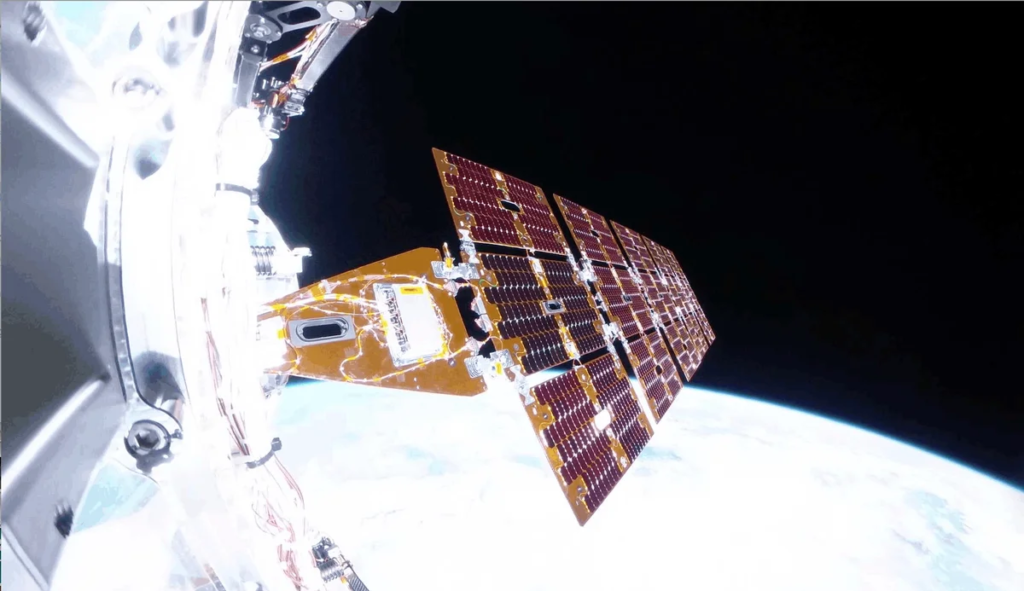
NASA has abandoned an ambitious attempt to save its aging Neil Gehrels Swift Observatory after the robotic spacecraft sent to rescue it developed serious control problems in orbit.
The commercial LINK spacecraft, built by Katalyst Space Technologies, was launched on July 3, 2026, with a simple but challenging objective: reach Swift, attach itself to the 22-year-old observatory and push it into a higher orbit.
That plan is now off.
NASA and Katalyst announced that LINK’s continuing attitude-control problems mean it will not capture or boost Swift. Instead, LINK will conduct limited rendezvous and proximity operations to demonstrate technologies that could be useful for future spacecraft-servicing missions.
Swift, meanwhile, is expected to eventually re-enter Earth’s atmosphere and burn up later in 2026.
What is NASA’s Swift Observatory?
The Neil Gehrels Swift Observatory is a space telescope launched in November 2004.
Its primary mission is to detect and study gamma-ray bursts, among the most powerful explosions known in the universe. Swift was designed to react quickly to these sudden events and observe them across multiple wavelengths, including gamma rays, X-rays, ultraviolet and visible light.
The spacecraft has dramatically outlived its original mission expectations.
Over more than two decades, Swift has become an important tool for astronomers studying some of the universe’s most energetic phenomena.
Its ability to rapidly locate gamma-ray bursts and redirect its instruments toward them made it particularly valuable.
Why was Swift falling toward Earth?
Like every spacecraft in low Earth orbit, Swift experiences atmospheric drag.
Even at hundreds of kilometers above Earth, the atmosphere does not completely disappear. Extremely thin particles create a small amount of resistance that gradually reduces a satellite’s orbital energy.
Normally, spacecraft designed to remain in low Earth orbit can periodically use propulsion to compensate for this drag.
Swift was not designed with an orbit-boosting system capable of indefinitely counteracting the accelerated orbital decay it eventually experienced.
Recent increases in solar activity made the situation considerably worse.
Solar storms heat and expand Earth’s upper atmosphere, increasing its density at satellite altitudes. That produces greater atmospheric drag, causing low-orbit spacecraft to lose altitude faster.
NASA says a recent period of heightened solar activity significantly accelerated Swift’s descent.
How low had Swift’s orbit fallen?
Swift was originally operating at roughly 600 kilometers, or about 373 miles, above Earth.
By 2026, its orbit had fallen to around 347 kilometers, or approximately 216 miles.
NASA had identified about 300 kilometers, or 185 miles, as an important threshold for the rescue effort.
Below that altitude, atmospheric drag becomes increasingly difficult to overcome and the prospects of successfully reaching and boosting the observatory become much worse.
NASA had therefore been making operational changes to slow Swift’s descent while the rescue spacecraft was being prepared.
What was the LINK mission supposed to do?
NASA contracted Katalyst Space Technologies in September 2025 to develop LINK, a robotic servicing spacecraft designed specifically for the unusual task of rescuing Swift.
The concept was ambitious.
LINK would have to:
- Find Swift in orbit
- Approach it safely
- Position itself precisely
- Capture the observatory using robotic arms
- Attach itself securely
- Raise Swift’s orbit
- Place the telescope into a substantially higher orbit
NASA planned to move Swift toward an altitude of roughly 600 kilometers, close to the orbit where it had spent most of its operational life.
The mission was notable because Swift was never designed to be serviced in orbit.
Why was LINK so difficult to build?
Katalyst had less than a year to design, build, test and launch the spacecraft.
NASA awarded the company the contract in September 2025, and LINK launched on July 3, 2026.
That extraordinarily compressed schedule was intentional.
Swift’s orbit was already deteriorating, so NASA could not spend several years developing a conventional servicing mission.
The agency instead accepted considerably more risk in an attempt to save a valuable scientific observatory before its orbit became unrecoverable.
The NASA contract for the rescue effort was worth approximately $30 million.
What went wrong with LINK?
The problem emerged shortly after launch.
LINK developed serious attitude-control issues and began spinning.
NASA’s initial investigation found that two of LINK’s three reaction wheels were not operational. The spacecraft also experienced reduced functionality in part of its cold-gas thruster system.
Reaction wheels are crucial components on many spacecraft.
They allow a satellite to change its orientation without continuously firing conventional thrusters.
By controlling the speed of the wheels, a spacecraft can rotate and point instruments or maneuver its body in space.
Losing two out of three wheels therefore created a major problem for a mission that depended on extremely precise positioning.
Could NASA stop LINK from spinning?
Engineers tried.
Following the initial failure, Katalyst and NASA worked to reduce LINK’s spin using the spacecraft’s electric propulsion system.
NASA also prepared new flight software and revised attitude-control algorithms designed to operate the spacecraft using its remaining available actuators.
For a time, engineers hoped these measures might stabilize LINK enough to resume the rescue attempt.
But the spacecraft’s attitude-control problems persisted.
Eventually, NASA and Katalyst concluded that attempting to capture Swift was no longer realistic.
Why can’t a spinning spacecraft rescue another satellite?
The rescue requires extraordinary precision.
LINK would have to approach a large spacecraft moving through orbit at extremely high speed relative to the ground while matching its velocity and orientation.
It would then need to position robotic arms precisely enough to capture Swift.
Any significant uncertainty in LINK’s attitude could make the approach dangerous.
A failed capture attempt could potentially damage either spacecraft or cause them to collide.
That is why NASA ultimately chose not to continue with a risky attempt once LINK’s control problems could not be fully resolved.
What will happen to Swift now?
Swift is expected to continue losing altitude until atmospheric drag eventually causes it to re-enter Earth’s atmosphere.
NASA has said the observatory is expected to re-enter later in 2026.
During re-entry, most or all of the spacecraft is expected to burn up in the atmosphere.
That will mark the end of a mission that began in 2004 and produced more than two decades of observations of high-energy cosmic events.
The exact date and location of re-entry will depend on how the spacecraft’s orbit evolves.
Why can’t NASA simply launch another rescue spacecraft?
The timing is the problem.
Swift’s orbit is already low and rapidly decaying.
Designing, launching and commissioning another spacecraft would take time that Swift may not have.
The original LINK mission itself had to be developed at extraordinary speed precisely because NASA was racing against orbital decay.
A second attempt would therefore face the same fundamental constraint.
By the time another spacecraft could be ready, Swift could already be too low to reach and safely boost.
Was the mission completely unsuccessful?
Not necessarily.
Although LINK failed to accomplish its primary objective, NASA still plans to use the spacecraft for additional demonstrations.
The current plan calls for LINK to conduct rendezvous and proximity operations with Swift, allowing engineers to gather information and demonstrate capabilities relevant to future spacecraft servicing.
That means the spacecraft could still produce useful engineering data even though it cannot save Swift.
The experience could also influence the design of future robotic spacecraft capable of repairing, refueling or repositioning satellites.
Why did NASA attempt such a risky mission?
The answer is partly scientific and partly technological.
Swift remains a uniquely useful observatory.
Replacing all of its capabilities with a new spacecraft would take years and require a large investment.
NASA therefore saw an opportunity to extend the life of a functioning scientific asset while simultaneously testing commercial robotic servicing technology.
The agency described the mission as high-risk but potentially high-reward.
Even though the rescue failed, NASA says the attempt can provide valuable lessons for future spacecraft-servicing missions.
Could the failure affect future satellite rescue missions?
Potentially.
One of NASA’s broader goals is developing a commercial ecosystem capable of servicing spacecraft after launch.
Future robotic vehicles could theoretically reposition satellites, repair components, refuel spacecraft or extend missions that would otherwise end prematurely.
But those missions require extremely reliable navigation, attitude control and robotic manipulation.
LINK’s failure illustrates how difficult those capabilities remain when a servicing spacecraft has to operate autonomously or semi-autonomously in orbit.
The mission therefore provides an expensive but potentially useful lesson.
Does this have implications for Hubble?
The Swift rescue effort was also watched because it represents a possible model for future satellite-servicing missions.
NASA’s Hubble Space Telescope is in low Earth orbit as well, and its orbit is gradually decaying.
That does not mean Hubble is immediately facing the same fate as Swift.
Hubble has a different history, orbital characteristics and servicing architecture.
But the loss of Swift’s rescue mission demonstrates how difficult it can be to design a robotic spacecraft capable of approaching and manipulating an aging satellite that was never originally designed for autonomous servicing.
The experience could inform future discussions about extending the lives of other valuable spacecraft.
What made Swift so scientifically important?
Swift’s greatest strength was its speed.
Gamma-ray bursts can appear suddenly and fade rapidly.
Swift was built to detect these bursts and quickly identify their locations, enabling other telescopes around the world to observe the resulting afterglows.
Over its lifetime, it has contributed to research into gamma-ray bursts, black holes, supernovae and other high-energy cosmic events.
Losing Swift therefore means losing a specialized observatory with a particular combination of instruments and rapid-response capabilities.
NASA can continue studying gamma-ray bursts using other facilities, but Swift’s exact role cannot simply be duplicated overnight.
The bigger picture
The attempt to save Swift was unlike a conventional NASA mission.
Instead of replacing an aging satellite, the agency tried to send a privately built robotic spacecraft to an observatory that was already falling toward Earth.
The strategy was bold precisely because Swift was running out of orbital altitude and time.
LINK launched successfully on July 3, but two of its three reaction wheels subsequently became unusable, leaving the spacecraft with persistent attitude-control problems.
NASA and Katalyst ultimately concluded that LINK could no longer safely capture and boost Swift.
The rescue has therefore failed, and Swift is expected to make its final atmospheric re-entry later in 2026.
But the mission’s legacy may extend beyond the telescope.
LINK is still expected to conduct proximity operations, and the engineering experience could help shape the next generation of robotic spacecraft designed to service satellites after launch.
For Swift, however, the end is approaching.
After more than 20 years of watching some of the universe’s most violent explosions, one of NASA’s most productive observatories is now on a final descent toward Earth.