The Vera C. Rubin Observatory has found its first dwarf planet candidate, an icy world beyond Pluto with the provisional name 2026 ED138. The Minor Planet Center, which catalogs solar system bodies on behalf of the International Astronomical Union, announced it on Oct. 27.
The team estimates it is 600 to 1,500 kilometers across (373 to 932 miles), according to Rubin Observatory. If astronomers confirm it, it would join the five dwarf planets the IAU recognizes: Pluto, Ceres, Eris, Haumea and Makemake.
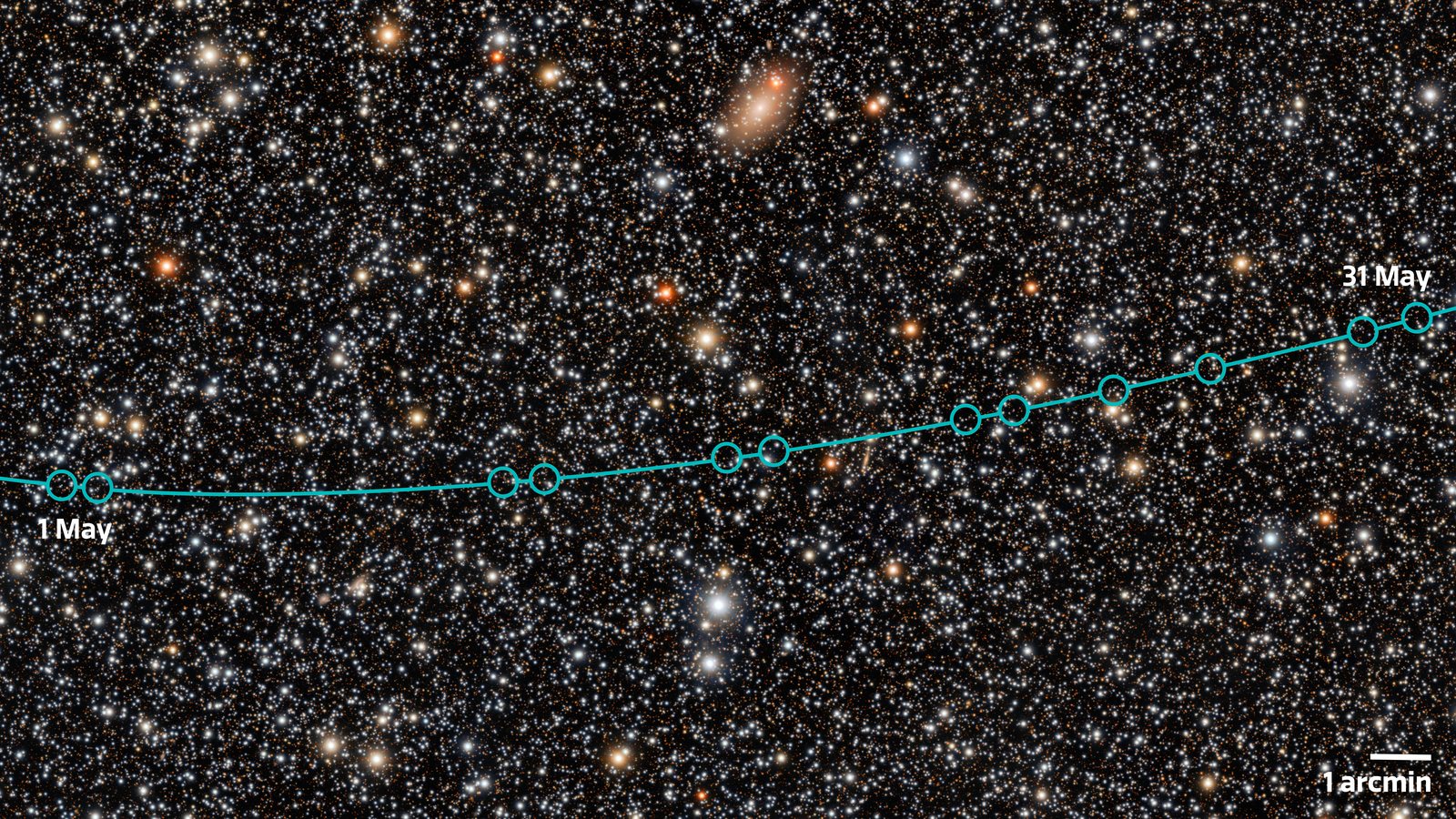
What makes ED138 unusual is less its size than where it was hiding. Telescopes photographed it as far back as 2016, but nobody picked it out. It sat in front of one of the most star-packed stretches of the Milky Way.
How Rubin picked it out of a crowded star field
ED138 lies in a part of the sky near the plane of the Milky Way, “a crowded region filled with millions of stars,” Rubin said. Most telescopes lost it among those background stars, which the observatory calls the likely reason nobody found it sooner.
We checked where it sits using the positions the Minor Planet Center published. In the 2016 images, ED138 was about 4.5 degrees below the midplane of the galaxy. This week it is about 11 degrees below, looking roughly toward the galaxy’s dense center. NOIRLab, which co-operates Rubin, places the discovery field in the southern constellation Corona Australis.
The code that linked a decade of sightings
A faint dot that moves a little each night is easy to miss when every frame is full of stars. Rubin’s design targets that problem. It images the whole southern sky again and again, and its software compares detections across nights to find the ones that move together.
Matthew Holman of the Center for Astrophysics | Harvard & Smithsonian found ED138 on the evening of Oct. 13. He was running Rubin data from earlier in 2026 through a search code he wrote with CfA colleague Kevin Napier. The code sifts billions of detections of moving objects and links the ones that belong to the same body.
“My first reaction was one of excited disbelief,” Holman said in the NSF announcement. “Objects like this are very rare, so I immediately started checking whether I or the code had done something wrong.”
Mario Jurić of the University of Washington, Rubin’s Solar System lead scientist, then searched Rubin’s catalogs and found 20 more observations going back to March 4. In all, Rubin’s Simonyi Survey Telescope caught ED138 30 times on 20 nights between March 4 and July 11.
The Asteroid Institute’s precovery service turned up older images from the Dark Energy Camera in Chile, going back to 2016. The circular lists the camera’s sightings in 2016, 2017, 2018, 2019 and 2023. That decade of data is what lets astronomers pin down an orbit for something this slow.
A 281-year orbit, tilted and stretched
ED138 is about 46 astronomical units from the sun, Rubin said, where one unit is the Earth-sun distance. That is roughly 4.3 billion miles, by our conversion. Pluto averages about 40 units, by Rubin’s figure.
The Minor Planet Center’s orbit adds detail. ED138 takes about 281 years to circle the sun, against Pluto’s 248, according to NASA. Its average distance is about 43 units, and its orbit is a mildly stretched oval, with an eccentricity of 0.14.
By our calculation from those elements, ED138 swings between about 37 units at its closest and 49 at its farthest. That puts it near the outer part of its loop right now.
The orbit tilts about 24.5 degrees from the plane where the planets travel. Rubin classifies it as a “hot classical” object in the Kuiper Belt and says the tilt suggests Neptune’s gravity knocked it off its original path long ago.
Why the size estimate spans 600 to 1,500 kilometers
Astronomers cannot see ED138 as a disk yet. It is a point of light, and its brightness depends on two unknowns: how big it is and how much sunlight its surface reflects.
The circular gives ED138 an absolute magnitude of 2.93, a standard measure of how bright an object would look at a fixed distance. NASA’s asteroid size formula, published by JPL, turns that into a diameter once you assume a reflectivity, or albedo. JPL itself warns that a wrong assumed albedo “can result in a significantly erroneous diameter.”
We ran the numbers. If ED138’s surface reflects about 5% of sunlight, it would be roughly 1,500 kilometers wide. If it reflects about a third, it shrinks to about 600 kilometers. The team’s range is essentially that uncertainty about how shiny it is.
Either way, it is smaller than Pluto, which is 2,377 kilometers across (1,477 miles), NASA says. Even the low end would make ED138 one of the larger objects known in that region, by Rubin’s account.
What makes something a dwarf planet
The rule dates to 2006, when the IAU wrote its first formal definition of a planet. A planet must orbit the sun, be massive enough for its own gravity to pull it round, and have cleared other objects of similar size from around its orbit, as NASA summarizes it.
A dwarf planet passes the first two tests but fails the third, and it is not a moon. Pluto shares its zone with many icy bodies in the Kuiper Belt, so it falls short. NASA says the discovery of Eris, a world similar in size to Pluto, “helped trigger the debate that led to Pluto’s reclassification as a dwarf planet in 2006.”
ED138 plainly fails the clearing test too. The open question is the second one: is it round? Rubin says icy bodies as large as the team’s estimate “are expected to be round.” That is a reasonable inference, not a measurement.
The IAU’s list still has five names, but NASA notes that the IAU estimates there could be “perhaps more than a hundred” dwarf planets still to find.
What it would take to confirm ED138
Rubin says astronomers need observations in infrared light to pin down ED138’s size and confirm it as a dwarf planet. Infrared measurements would help separate a small, bright object from a large, dark one, which is the albedo problem described above.
More observations could also show whether it has enough mass to have pulled itself round, Scientific American reported. Now that the orbit is public, other observatories can point at it. The public can follow its path on Rubin’s Orbitviewer app.
ED138 is an early result. The Legacy Survey of Space and Time, Rubin’s 10-year sky survey, formally began only in June. In April, before the survey started, the Rubin team submitted more than 11,000 new asteroids to the Minor Planet Center, including about 380 objects beyond Neptune.
That pace is new. NASA’s Swift satellite spent 22 years catching fast cosmic events, including a gamma-ray burst that flared for a record 27 days, before its team shut it down this month. Rubin’s job is to watch the whole southern sky for change night after night.
Holman expects more finds like this one: “Rubin will image the whole southern sky again and again for ten years, so any others hiding in the places earlier surveys skipped are now within reach.”
The next concrete step is an infrared follow-up to measure ED138’s reflectivity. That will settle whether it is closer to 600 or 1,500 kilometers, and with it, how strong its claim to dwarf planet status is.