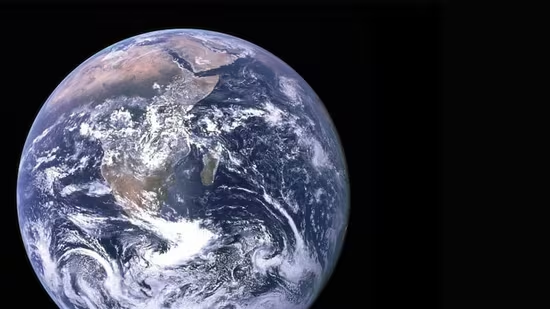
July 9, July 22, and August 5 Expected to See Record-Breaking Rotational Speeds
Earth is set to experience its shortest day ever recorded on Wednesday, July 9, with similar shortened days expected later this month and in August. Scientists say the phenomenon is caused by the Moon’s changing position, which is currently making Earth spin slightly faster than usual.
According to a report by Live Science, the change in Earth’s rotation could reduce each of these days by 1.3 to 1.51 milliseconds, based on data from the International Earth Rotation and Reference Systems Service (IERS).
First-Ever Negative Leap Second on the Horizon
The IERS, the global body responsible for managing Earth’s official timekeeping, may soon be forced to implement a “negative leap second”—a historical first. This adjustment, now expected by 2029, would compensate for the cumulative time lost due to Earth’s faster rotation.
“This is an unprecedented situation and a big deal,” said Duncan Agnew, geophysicist at the Scripps Institution of Oceanography at the University of California, San Diego.
Why Is Earth Spinning Faster?
Earth typically takes 86,400 seconds (24 hours) to complete one full rotation on its axis. However, this rotation isn’t fixed—it can be subtly altered by a range of factors including:
- The gravitational forces of the Sun and Moon
- Shifts in Earth’s magnetic field
- The distribution of Earth’s mass due to earthquakes, glaciers, or climate-related changes
Historically, Earth’s rotation has slowed over time due to the Moon gradually drifting farther away. Scientists believe that about 1 to 2 billion years ago, a single day lasted only 19 hours.
Yet, in recent years, this trend has reversed in short bursts. In 2020, Earth recorded some of its fastest rotations since accurate measurements began in the 1970s. The fastest day so far occurred on July 5, 2024, when Earth completed its rotation 1.66 milliseconds faster than usual.
The Role of the Moon: A Cosmic Tuning Fork
The upcoming shortest days on July 9, July 22, and August 5 are tied to the Moon’s unusual position farther from Earth’s equator, which alters the nature of its gravitational pull on our planet’s axis.
To visualize the effect, scientists compare it to spinning a top:
“If you grip and spin it from the ends rather than the center, it spins faster,” researchers explained. Similarly, when the Moon’s gravitational force acts more on Earth’s poles than its equator, it slightly increases the rotational speed.
Should We Be Concerned?
While the changes are minute—fractions of a millisecond—they’re significant for scientific accuracy, satellite operations, and atomic timekeeping.
“It’s not a huge change in Earth’s rotation that’s going to lead to some catastrophe,” Agnew noted, “but it is something notable.”