TL;DR: A spent SpaceX Falcon 9 rocket stage has reportedly impacted the Moon after drifting through space for more than a year. Scientists expect the collision to have created a crater about 60 feet wide and 12 feet deep. While the impact poses no threat to Earth, it offers researchers a rare opportunity to study how artificial objects collide with the lunar surface.
SpaceX Rocket Crashes Into the Moon, Leaving a Fresh Lunar Crater
A discarded SpaceX Falcon 9 rocket stage has reportedly crashed into the Moon after spending more than a year drifting through space, marking one of the relatively rare instances of human-made space debris striking the lunar surface.
The impact, which occurred after the rocket completed its mission in early 2025, is expected to have carved out a crater roughly 60 feet (18 meters) wide and 12 feet (3.7 meters) deep. Although the collision generated no risk to Earth, scientists say it could provide valuable data about lunar geology and the effects of high-speed impacts.
NASA is expected to analyze the impact site using lunar imagery to better understand how artificial objects interact with the Moon’s surface.
What crashed into the Moon?
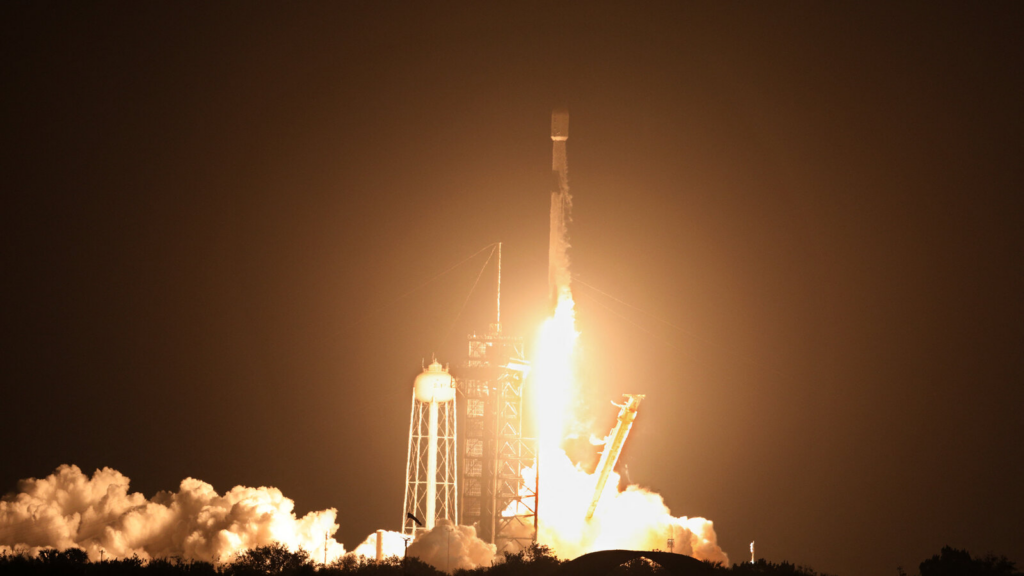
The object was the upper stage of a SpaceX Falcon 9 rocket used to launch Firefly Aerospace’s Blue Ghost lunar lander toward the Moon in January 2025.
After completing its primary mission, the approximately four-ton rocket stage remained in space. Instead of returning to Earth or being redirected into deep space, it continued on an uncontrolled trajectory until lunar gravity pulled it toward the Moon.
Scientists had predicted the impact days in advance based on orbital calculations.
How big was the impact?
Researchers estimated the rocket stage struck the lunar surface at approximately 8,700 kilometers per hour (5,400 mph).
According to NASA’s projections, the collision was expected to:
- Create a crater around 60 feet wide
- Dig approximately 12 feet deep
- Launch lunar dust and rock outward as ejecta
- Produce a temporary dust plume
Although dramatic, the impact is relatively small compared to naturally occurring asteroid strikes that regularly reshape the Moon over millions of years.
Why haven’t astronomers confirmed the impact yet?
Unlike meteor impacts visible from Earth, this collision occurred near the visible edge of the Moon, making direct observation extremely difficult.
Professional observatories and amateur astronomers equipped with high-powered telescopes were unable to immediately verify the crash.
Several factors complicated confirmation:
- The impact occurred on a portion of the Moon with limited visibility.
- Any flash from the collision would have been brief.
- The resulting dust cloud is too faint to be seen with the naked eye from Earth.
NASA plans to compare before-and-after images of the impact site once suitable orbital observations become available.
Why is NASA interested in this collision?
Although accidental, the impact presents a valuable scientific opportunity.
By studying the newly formed crater, researchers hope to learn more about:
- How lunar soil responds to high-speed impacts
- The distribution of dust and rock following collisions
- The mechanics of artificial versus natural impacts
- Surface composition beneath the Moon’s outer layer
These observations could improve future mission planning, particularly for lunar landers operating near impact-prone regions.
NASA has stated that examining the site will help scientists “better understand artificial impacts and their exploration implications.”
Are rocket crashes on the Moon common?
No. Human-made impacts on the Moon remain relatively rare.
Most spacecraft sent toward the Moon either:
- Land successfully,
- Intentionally crash as part of a scientific mission, or
- Miss the Moon entirely.
However, there have been a handful of notable incidents.
2022: Chinese rocket stage
A spent Chinese rocket stage unexpectedly crashed into the far side of the Moon after years in space, drawing attention to the growing issue of uncontrolled space debris.
2009: NASA’s LCROSS mission
NASA deliberately crashed a rocket stage into a permanently shadowed lunar crater to search for water ice.
The mission successfully detected water molecules, reshaping scientists’ understanding of the Moon’s resources.
Failed lunar landings
Several spacecraft intended to land softly on the Moon have instead crashed during descent, including:
- Russia’s Luna-25 mission in 2023
- India’s Chandrayaan-2 Vikram lander in 2019
Unlike the latest SpaceX impact, these crashes occurred during landing attempts rather than after spacecraft had completed their missions.
Does the crash create any danger for Earth?
No.
The Moon has no atmosphere capable of producing dangerous debris that could travel back toward Earth.
Likewise, the impact generated no measurable effect on Earth’s environment or orbital space.
The event is confined entirely to the lunar surface.
Does this highlight a growing space debris problem?
While the collision itself poses no immediate concern, it underscores a broader issue facing the global space industry.
As more governments and private companies launch missions beyond Earth orbit, experts are increasingly discussing how to responsibly manage spent rocket stages and other mission hardware.
Unlike satellites orbiting Earth, which can often be directed to burn up in the atmosphere, deep-space rocket stages may remain on unpredictable trajectories for years if no disposal plan exists.
Future lunar missions are expected to place greater emphasis on sustainable mission design, including controlled disposal of spacecraft after their operational lives end.
What happens next?
NASA and other space agencies will attempt to locate the newly formed crater using high-resolution lunar imagery.
Comparing images taken before and after the impact could reveal:
- The crater’s exact size
- The extent of debris scattered across the surface
- Changes in the surrounding terrain
- Insights into the Moon’s subsurface composition
Although accidental, the collision offers scientists another chance to better understand the lunar environment ahead of planned crewed and robotic missions later this decade.
Key takeaways
- A spent SpaceX Falcon 9 rocket stage has reportedly impacted the Moon after drifting through space.
- The object originally launched Firefly Aerospace’s Blue Ghost lunar lander in January 2025.
- Scientists estimate the impact created a crater about 60 feet wide and 12 feet deep.
- The crash poses no threat to Earth.
- NASA plans to study the impact site to improve understanding of lunar geology and artificial impacts