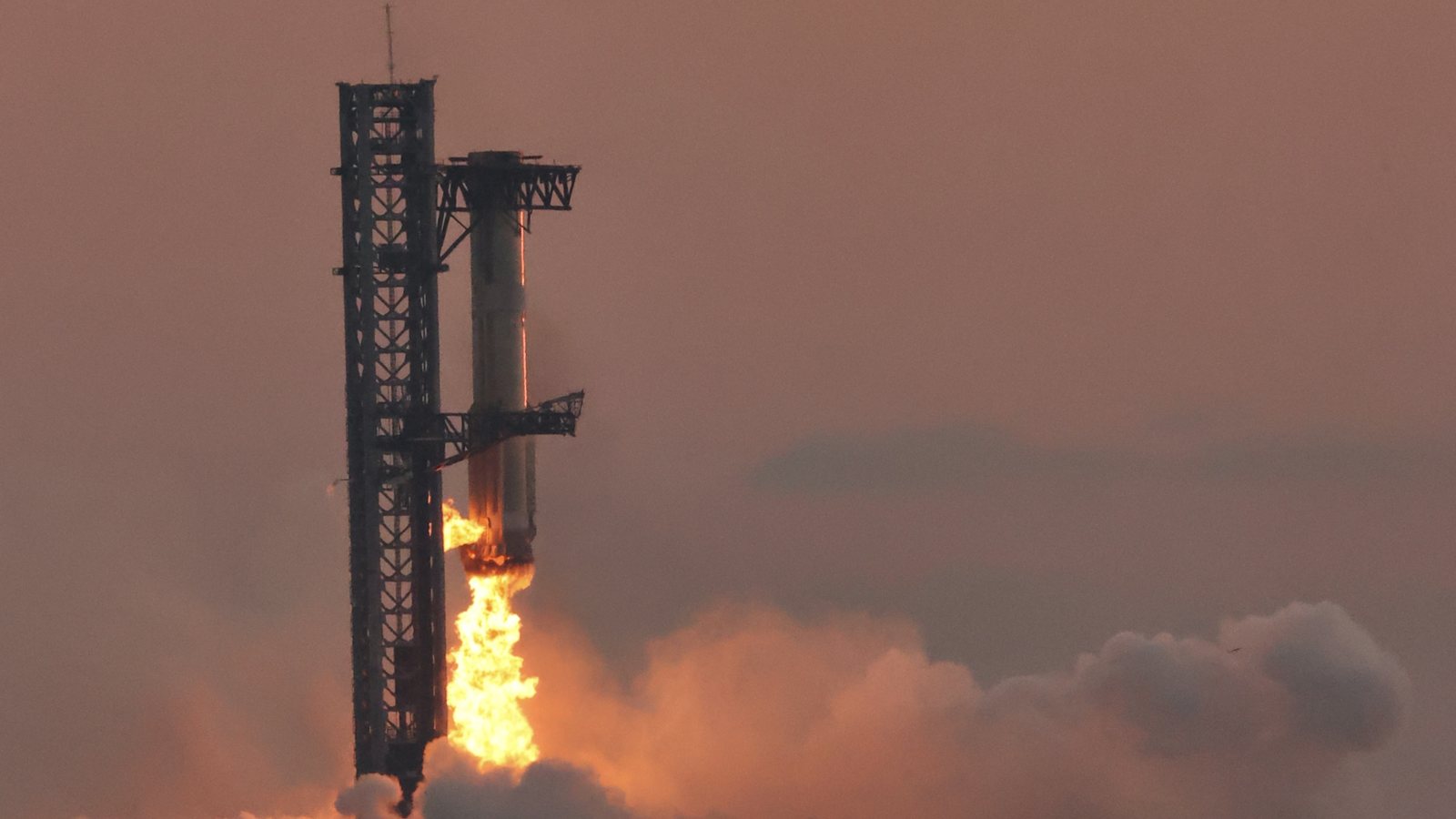
SpaceX plans to catch a returning Starship with its launch tower arms for the first time at about 4:17 p.m. ET on Saturday, Nov. 14. The attempt has not happened yet. No one has ever recovered the upper stage of an orbital rocket, and SpaceX has already lost one catch on this flight.
Flight 15 lifted off from Pad 2 at Starbase, Texas, at 4:47 p.m. CST on Friday, about 22.5 hours before the catch time Astronomy magazine published. The plan was to catch both halves of the rocket on the same mission. Controllers called off the first one.
Ship 42 is still flying. It reached orbit about 275 kilometers up, released 26 Starlink V3 satellites and began a coast of roughly 14 orbits.
The booster SpaceX has caught before went to the water instead
SpaceX planned to bring Super Heavy Booster 22 back to the tower about six and a half minutes after liftoff. Instead SpaceX diverted it offshore. “Super Heavy has diverted to an offshore splashdown in the Gulf,” the company posted. The booster then broke apart just before hitting the water, Starlust reported from its live coverage.
SpaceX has not explained the call. Company spokesperson Dan Huot told viewers he could not say for certain why controllers skipped it.
That failure matters less than it sounds, because the booster catch is the part SpaceX had already solved. The tower has caught a Super Heavy three times, on Flights 5, 7 and 8 between October 2024 and March 2025, according to the public flight record. Every one of those catches used the original Pad 1 tower. Flight 15 flies from the newer Pad 2, and the plan hands its arms both stages.
Coming back from orbit is the harder half
A booster never leaves the neighborhood. It separates a few minutes into flight, turns around and falls back through thin air at a few thousand kilometers an hour. The ship has to shed orbital speed, which is roughly 27,000 kilometers an hour, and it does that by turning its belly into the atmosphere and riding the heat.
That is why the heat shield decides this. SpaceX built the inspection into the mission. Three of the 26 Starlink satellites carry cameras.
The ship rotated a full turn after release so they could photograph its tiles. Controllers will read those images before committing.
The approach is also different. Earlier ships flipped upright and splashed into the Indian or Pacific Ocean, far from anyone. This one would fly back over northern Mexico and southern Texas, flip, light its engines and stop in mid-air between two steel arms. Residents of Cameron County may hear sonic booms on the final turn.
The Federal Aviation Administration issued the Flight 15 license on launch day, and unlike the Flight 14 license it covers the return of both stages, Teslarati reported. The agency’s October 14 notice allows SpaceX up to 25 Starship launches and 50 landings a year at Starbase.
Three gates stand between orbit and the tower arms
SpaceX said it would be “extremely conservative” about going ahead. The flight plan sets checkpoints where the ship can bail out and come down at cleared ocean sites near Hawaii or off Chile instead. It passed the Hawaii gate on Friday evening.
The final gate falls about 20 hours and 41 minutes into the mission, and it decides between a tower catch and a North Pacific splashdown.
Watch for that decision before the deorbit burn. The ship goes in the water if controllers do not like what the tile cameras showed. The same applies to the Raptor engines, the flight computers and the tanks. Then the catch waits for Flight 16.
Reuse is the whole argument for Starship
A booster that flies again removes most of the hardware cost from a launch, and a ship that flies again removes the rest. SpaceX frames a double recovery as the first full recovery of an orbital launch system.
The bigger payoff is rate rather than price. Building a new upper stage for every flight caps how often you can fly, and that cap is the problem NASA has inherited.
Our Artemis III explainer laid out the current plan. Artemis III is a 14- to 17-day test in Earth orbit in 2027. The first landing has moved to Artemis IV in 2028. Both landers need something nobody has demonstrated, which is transferring propellant between spacecraft in orbit.
A Starship lunar lander cannot reach the moon on one tank. A stream of tanker Starships has to fill it in Earth orbit first. Estimates of how many tankers that takes differ wildly.
A 2021 GAO audit put the architecture at up to 16 launches. Charlie Precourt of NASA’s Aerospace Safety Advisory Panel told an October 2026 public meeting it could take as many as 22, SatNews reported. Elon Musk has said the number will be closer to six or eight.
Our math: 16 tanker flights would take two and a half years
Here is our own calculation from the published flight record. Starship has flown 15 times between April 20, 2023 and November 13, 2026, which is 1,303 days, or one launch every 93 days. The pace this year is better: the three gaps between Flights 12, 13, 14 and 15 were 63, 66 and 46 days, averaging 58.
At 58 days per flight, 16 tanker launches would take about two and a half years. Precourt’s 22 would take three and a half. Even Musk’s eight would run to about 15 months.
A refueling campaign cannot run for years, because cryogenic propellant boils off while it sits. It has to happen within weeks. Going from one flight every two months to several a month means reflying the same vehicle. Saturday’s attempt aims squarely at that gap.
NASA is recruiting for these missions already. Its astronaut application window closes Dec. 3, and the agency is hiring for flights that assume this hardware works.
The 2023 GAO review is blunt about the gap. SpaceX “has made limited progress maturing the technologies needed to support this aspect of its plan,” the agency wrote in its November 2023 report on the Artemis landing. SpaceX has said it will fly a separate propellant-transfer demonstration in early 2027.
Saturday’s result sets up that demonstration or delays it. The webcast runs through the catch window, and the final go or no-go call comes a little over an hour before the ship reaches Starbase.