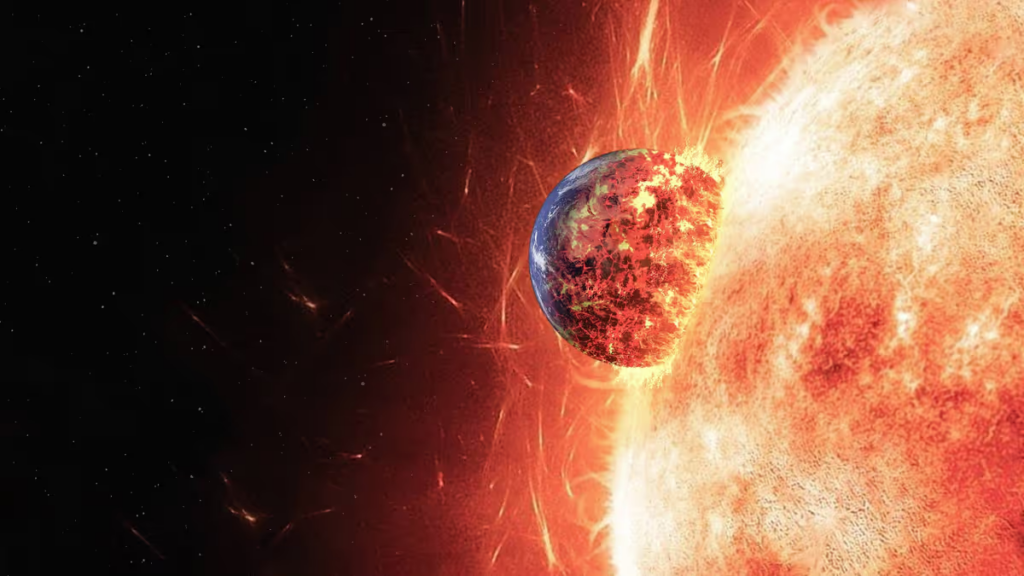
For decades, one of astronomy’s most widely accepted predictions has been that Earth’s final chapter would end inside the Sun. As our star exhausts its nuclear fuel and expands into a massive red giant billions of years from now, scientists believe it would eventually engulf the inner planets—including Earth.
A new study, however, is challenging that long-held assumption.
Researchers now say there is a realistic possibility that Earth could escape destruction altogether by drifting into a wider orbit, surviving the Sun’s violent transformation. The finding doesn’t guarantee our planet’s survival, but it introduces a significant twist to one of the most enduring questions about the future of the solar system.
What Does the New Study Say About Earth’s Fate?
The study, published in the journal Astronomy & Astrophysics, examines what will happen when the Sun reaches the final stages of its life cycle, roughly 5 billion years from now.
Scientists have traditionally argued that as the Sun expands into a red giant, its increased size and gravitational influence would pull Earth inward. Eventually, our planet would spiral into the swollen star and be destroyed.
The new research suggests the outcome may not be so straightforward.
According to the researchers, Earth’s fate depends on a cosmic tug-of-war between two competing forces:
- The Sun’s expanding gravitational and tidal effects could pull Earth inward.
- The Sun’s mass loss through powerful stellar winds could push planets outward.
The balance between these forces will determine whether Earth is consumed or escapes.
Lead author Mats Esseldeurs, an astrophysicist at Belgium’s University of Leuven, described the outcome as a delicate competition between stellar expansion and mass loss.
If tidal interactions dominate, Earth would likely be swallowed by the Sun. If mass loss proves stronger, Earth could migrate into a safer, more distant orbit.
Why Scientists Are Rethinking Earlier Predictions
Previous models focused heavily on the Sun’s expansion phase and the gravitational consequences that come with it. The latest study takes a closer look at how giant stars lose mass during their final evolutionary stages.
When stars like the Sun approach the end of their lives, they eject enormous amounts of material into space through stellar winds. As the star loses mass, its gravitational grip weakens.
That weakening gravitational pull can cause surrounding planets to drift outward.
To better understand this process, researchers studied L2 Puppis, a giant star often described as an older cousin of our Sun. Observations of the star provided valuable insights into how solar-like stars evolve and shed mass near the end of their lifetimes.
The team’s findings indicate that previous models may have underestimated the impact of stellar mass loss on planetary orbits.
Could Earth Really Survive?
The answer remains uncertain.
Scientists are not claiming that Earth’s survival is guaranteed. Instead, they argue that both outcomes remain plausible based on current knowledge.
The study highlights how small differences in the Sun’s future behavior could dramatically alter the destiny of the solar system.
In one scenario:
- The Sun expands.
- Tidal forces strengthen.
- Earth gradually spirals inward.
- The planet is engulfed.
In the alternative scenario:
- The Sun loses mass more rapidly.
- Gravity weakens.
- Earth’s orbit expands.
- The planet remains outside the Sun’s reach.
The research essentially moves Earth’s future from a near certainty to a scientific possibility.
What About Mars, Venus, and Mercury?
The study’s conclusions extend beyond Earth.
Researchers suggest that Mars could also benefit from the Sun’s mass-loss effect and potentially survive the Red Giant phase.
Mercury and Venus, however, are far less likely to escape.
Because both planets orbit much closer to the Sun, they are expected to be consumed regardless of how much mass the star sheds during its final evolution.
This means the inner solar system would still undergo dramatic changes, even if Earth and Mars avoid direct destruction.
Planet-by-Planet Outlook
| Planet | Expected Fate |
|---|---|
| Mercury | Likely engulfed by the Sun |
| Venus | Likely engulfed by the Sun |
| Earth | Outcome uncertain |
| Mars | Could potentially survive |
Why Survival Doesn’t Mean Life Survives
Even if Earth avoids being swallowed by the Sun, that does not mean life on the planet will endure.
Long before the Sun becomes a red giant, it will gradually grow hotter and brighter.
Scientists estimate that within approximately 1 to 2 billion years:
- Global temperatures will rise dramatically.
- Earth’s oceans will begin evaporating.
- Atmospheric conditions will deteriorate.
- A runaway greenhouse effect could take hold.
- Surface temperatures may exceed the boiling point of water.
At that stage, Earth’s surface would become uninhabitable for complex life.
In other words, humanity’s long-term challenge isn’t whether Earth falls into the Sun billions of years from now. The more immediate cosmic issue is that our planet is expected to become inhospitable long before that event occurs.
What This Discovery Means for Astronomy
The findings underscore how much scientists are still learning about stellar evolution and planetary dynamics.
Predicting events billions of years into the future requires sophisticated computer models, and even small changes in assumptions can lead to dramatically different outcomes.
The study also has implications beyond our solar system.
Astronomers studying exoplanets around aging stars may need to reconsider how planetary systems evolve as their host stars enter the final stages of life.
Understanding whether planets migrate outward or are consumed by their stars could help scientists better identify worlds that survive stellar aging elsewhere in the galaxy.
The Bigger Picture
Earth’s ultimate fate remains one of astronomy’s most fascinating unanswered questions.
For years, the dominant narrative was simple: the Sun would expand, engulf Earth, and end the story.
The latest research suggests the ending may be more complicated.
While the planet’s long-term habitability is still expected to disappear long before the Sun dies, Earth’s physical survival may no longer be off the table. Whether our world is swallowed or pushed to safety will depend on a delicate balance of forces playing out billions of years from now.
For now, the Sun remains roughly halfway through its 10-billion-year lifespan, giving Earth and humanity plenty of time before this cosmic drama unfolds.
TL;DR
- A new study suggests Earth may not be swallowed by the Sun when it becomes a red giant.
- Earth’s fate depends on a balance between tidal forces pulling it inward and stellar mass loss pushing it outward.
- Mars may also survive, while Mercury and Venus are still expected to be engulfed.
- Even if Earth escapes, life will likely disappear 1–2 billion years earlier due to rising temperatures and ocean loss.
- The research challenges decades of assumptions about the solar system’s distant future and may reshape how scientists study aging planetary systems.