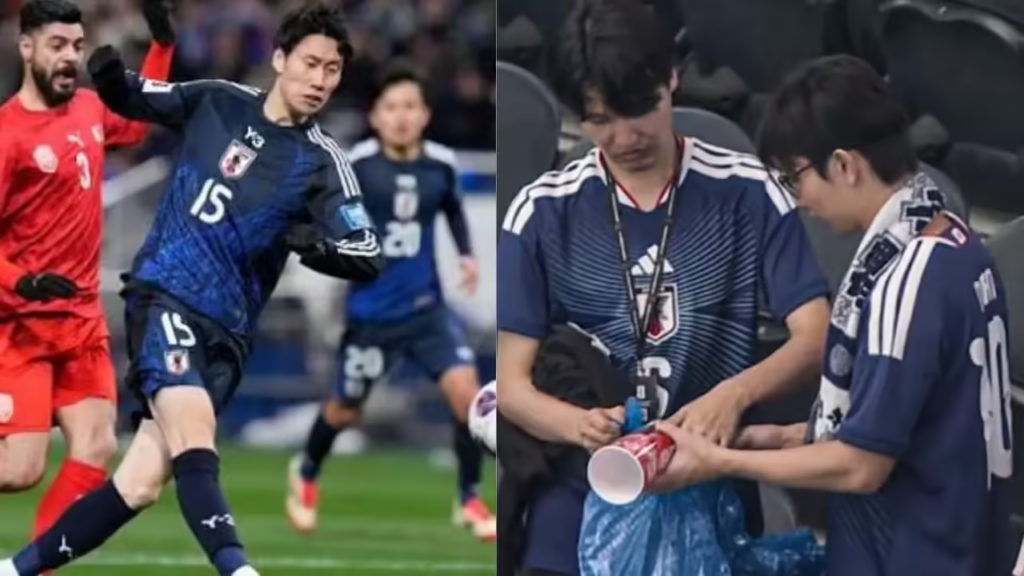
Japanese football fans have long been celebrated for a unique World Cup tradition: staying behind after matches to clean up stadiums. The practice has become a symbol of civic responsibility and has repeatedly drawn admiration from fellow fans, players, and tournament organisers around the world.
At the FIFA World Cup 2026, the tradition is once again making headlines. But this time, the praise has been accompanied by criticism.
A viral social media post in Japan has sparked a debate over whether public displays of responsibility are masking a deeper issue at home: gender inequality and the unequal distribution of household labor.
Why Are Japanese Men Being Criticized During the FIFA World Cup 2026?
The controversy began after images circulated of Japanese supporters collecting trash in stadium stands following World Cup matches.
While international audiences largely viewed the scenes as admirable, some social media users in Japan questioned whether the same men showing consideration in public spaces were contributing equally inside their own homes.
The discussion intensified after a poster shared on X urged men to “share unpaid work at home.”
The message highlighted a longstanding social issue in Japan, arguing that many men devote relatively little time to household chores and caregiving compared to women.
The poster’s message was direct:
- Share unpaid care work at home.
- Respect starts within the household.
- Public acts of responsibility should be matched by private responsibilities.
The post quickly gained traction, attracting millions of views and tens of thousands of likes, turning a feel-good World Cup story into a broader conversation about gender roles.
What Did the Viral Poster Say?
The poster referenced international comparisons showing that Japanese men spend significantly less time on housework and caregiving than women.
Its central argument was simple: cleaning a stadium for a few minutes after a football match should not overshadow responsibilities at home.
The message resonated with many users who argued that household labor remains disproportionately carried out by women despite gradual social changes.
One widely shared comment quoted American author PJ O’Rourke:
“Everyone wants to save the world, but no one wants to help mom do the dishes.”
Another user suggested that some of the men enthusiastically cleaning stadium seats may be leaving childcare duties entirely to their spouses while they attend World Cup matches.
While these comments were speculative, they reflected broader frustrations about persistent gender expectations in Japanese society.
Why Does Household Labor Remain a Sensitive Issue in Japan?
The debate taps into a larger national conversation that extends far beyond football.
Japan has made progress in increasing female participation in the workforce, but traditional gender roles remain influential in many households.
Women continue to perform a significant share of the following:
- Childcare
- Elder care
- Cooking
- Cleaning
- Other unpaid domestic work
Researchers and policymakers have frequently identified the unequal distribution of unpaid labor as a major factor affecting women’s career opportunities, economic advancement, and work-life balance.
As a result, the World Cup cleanup images became a symbol through which some social media users expressed frustrations about broader societal issues.
Are Japanese Football Fans Still Being Praised Internationally?
Yes.
Outside Japan, the cleanup tradition continues to be widely admired.
Japanese supporters have earned global recognition at multiple FIFA tournaments, often remaining in stadiums long after matches end to collect litter left behind by spectators.
The tradition reflects cultural values emphasizing
- Respect for shared spaces
- Community responsibility
- Consideration for others
- Cleanliness and order
Many international fans and media outlets continue to view the practice as a positive example of sportsmanship and civic behavior.
The current criticism is not directed at the cleanup tradition itself. Instead, critics argue that public responsibility should be accompanied by equal responsibility in private life.
A Debate About Symbolism and Reality
At the heart of the controversy is a broader question: Should public acts of social responsibility be judged independently, or should they be viewed alongside behavior in everyday life?
Supporters of the criticism argue that celebrating stadium cleanups without addressing domestic inequalities risks overlooking important social issues.
Others contend that cleaning public spaces is still a positive act regardless of how broader societal challenges are addressed.
The debate highlights how a simple gesture can take on different meanings depending on the social context in which it is viewed.
Why This FIFA 2026 Story Matters
What began as another example of Japanese fans earning praise at the World Cup has evolved into a conversation about gender equality, unpaid labor, and cultural expectations.
The viral reaction demonstrates how global sporting events often become platforms for wider social debates.
For many observers, the issue is not whether stadium cleanup is commendable—it clearly is. The question being raised online is whether the same sense of responsibility should extend beyond football stadiums and into everyday family life.
As FIFA World Cup 2026 continues, the discussion serves as a reminder that even the most celebrated traditions can spark deeper conversations about the societies from which they emerge.
Key Takeaways
- Japanese football fans are once again cleaning stadiums after FIFA World Cup 2026 matches.
- A viral social media post criticized some men for allegedly neglecting household responsibilities while participating in public cleanup efforts.
- The debate centers on Japan’s longstanding gender gap in unpaid domestic and caregiving work.
- International audiences continue to praise the cleanup tradition.
- The controversy has transformed a World Cup feel-good story into a wider discussion about gender equality and social responsibility.