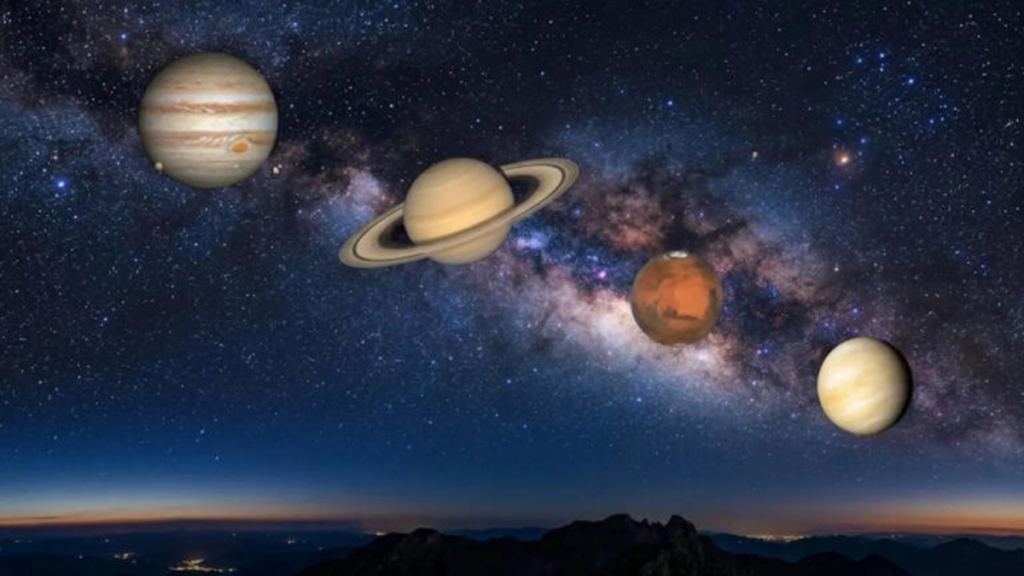
Early risers on May 14 are getting a sky worth losing sleep over. A rare pre-dawn alignment involving Saturn, Neptune, Mars, and a thin crescent Moon will create one of the most visually striking astronomical events of May 2026.
For a brief window before sunrise, the planets and Moon will appear grouped in the sky, offering a layered display of color, brightness, and planetary contrast.
Astronomy enthusiasts, photographers, and casual skywatchers across multiple continents are expected to turn their eyes eastward before dawn.
What is happening in the sky on May 14?
The event is a planetary alignment, sometimes called a conjunction grouping, where multiple celestial bodies appear relatively close together from Earth’s perspective.
The planets are not actually clustering tightly in space.
Instead, they line up visually because of:
- Their orbital positions
- Earth’s viewing angle
- The geometry of the Solar System
On May 14:
- Mars
- Saturn
- Neptune
- The crescent Moon
will appear close together in the pre-sunrise sky.
A helpful visual addition here would be:
- A labeled sky map showing the position of each planet relative to the Moon before sunrise
Which planets will be visible?
Each object will bring a different visual character to the alignment.
Mars: the bright reddish beacon
Mars will likely be the easiest planet to identify.
It typically appears:
- Bright
- Orange-red
- Steady in color
That reddish glow comes from iron-rich minerals covering the Martian surface, essentially making the planet look faintly rusted even across millions of kilometers.
Saturn: the soft golden glow
Saturn will appear
- More subdued
- Golden-yellow
- Less intense than Mars
Through binoculars or a telescope, observers may even glimpse Saturn’s famous rings, depending on viewing conditions.
Neptune: the elusive participant
Neptune is the difficult guest at the cosmic gathering.
Because Neptune is:
- Extremely distant
- Relatively dim
Most viewers will likely need the following:
- Binoculars
- A telescope
- Dark skies
to spot it clearly.
Without optical aid, Neptune may remain invisible to many observers.
When to watch the planetary alignment in India
For viewers in India, the best viewing window is expected to be 4:00 AM to 5:30 AM IST
The alignment will occur before sunrise, so timing matters.
Best viewing conditions
To improve visibility:
- Find an open eastern horizon
- Avoid city light pollution
- Check weather forecasts in advance
- Allow your eyes 15 to 20 minutes to adjust to the darkness
Rooftops, open fields, hilltops, and rural areas typically offer the best views.
Where will the alignment be visible?
The event should be observable across large parts of the world, including:
- India
- United States
- Canada
- United Kingdom
- Australia
- New Zealand
- Several regions of Europe
Visibility will depend heavily on:
- Local weather
- Cloud cover
- Atmospheric clarity
- Urban lighting conditions
Why planetary alignments fascinate people
Planetary alignments are scientifically routine but emotionally powerful.
They create the illusion that distant worlds are momentarily gathering together across the night sky.
Events like this resonate because they compress enormous cosmic distances into something visually intimate.
In reality:
- Neptune sits billions of kilometers away
- Saturn remains over a billion kilometers from Earth
- Mars is comparatively closer
- The Moon is Earth’s nearest celestial companion
Yet for a few hours, they appear woven into the same celestial neighborhood.
The sky becomes less like space and more like choreography.
Why alignments matter scientifically
These events are not only beautiful but also inspiring.
They also help astronomers:
- Track orbital motion
- Refine planetary calculations
- Study celestial mechanics
- Improve observational models
Planetary alignments additionally serve an important educational role by:
- Encouraging public interest in astronomy
- Increasing telescope use
- Inspiring amateur astrophotography
- Drawing attention to space science
Historically, alignments helped ancient civilizations develop:
- Calendars
- Navigation systems
- Early astronomical observations
Modern astronomy may use supercomputers instead of stone observatories, but the human fascination remains remarkably unchanged.
How to photograph the event
For photographers hoping to capture the alignment:
- Use a tripod for stability
- Shoot before dawn brightens the sky
- Use longer exposure settings carefully
- Include foreground objects for scale
Good foregrounds can include:
- Trees
- Temples
- Mountains
- Skylines
- Lakes
A crescent Moon beside glowing planets often creates dramatic compositions because the Moon acts almost like a natural spotlight in the frame.
Will this happen again soon?
Planetary groupings happen periodically, but every alignment differs in:
- Brightness
- Planet positions
- Visibility conditions
- Moon phase
- Geographic viewing angles
What makes the May 14 event particularly appealing is the combination of:
- A thin crescent Moon
- Bright Mars
- Golden Saturn
- The challenge of spotting Neptune
It offers both accessibility for casual viewers and a rewarding hunt for experienced observers.
TL;DR
A rare pre-dawn alignment involving Mars, Saturn, Neptune, and the crescent Moon will be visible on May 14, 2026. Skywatchers in India can view the celestial event between 4:00 AM and 5:30 AM IST before sunrise. Mars and Saturn should be visible to the naked eye, while Neptune may require binoculars or a telescope.