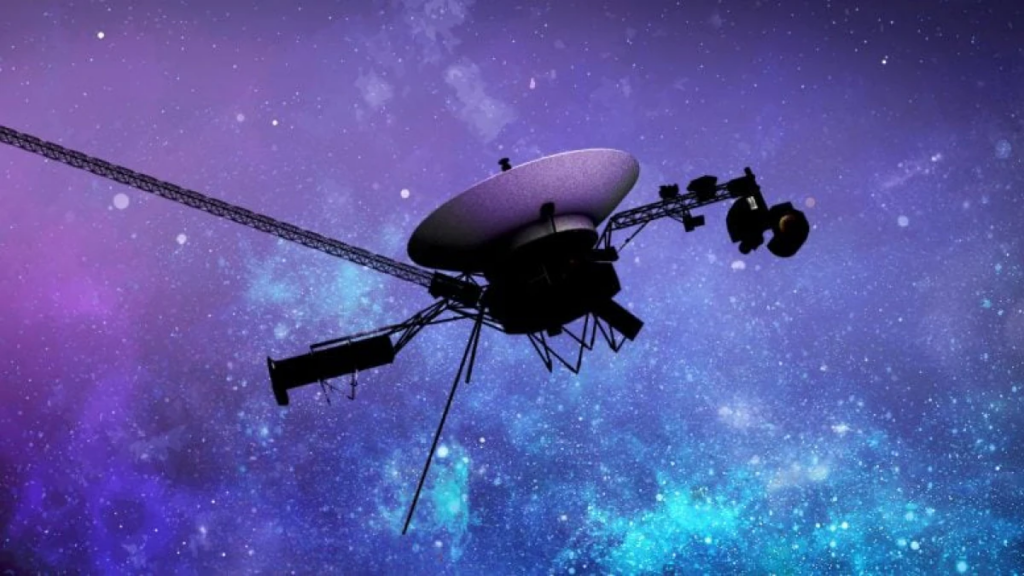
NASA has shut down another instrument on Voyager 1, a strategic move aimed at squeezing more life out of the most distant human-made object in space. As the spacecraft approaches five decades in operation, engineers are making tough decisions to preserve its remaining power—and extend humanity’s reach into interstellar space.
The latest shutdown highlights a simple reality: Voyager 1 is running out of energy. What happens next will determine how much longer it can continue sending back data from beyond our solar system.
Why did NASA switch off another Voyager 1 instrument?
The decision comes down to one constraint: power.
Voyager 1 relies on a radioisotope thermoelectric generator (RTG), which converts heat from decaying plutonium into electricity. But that energy source diminishes over time.
Key facts:
- The spacecraft loses about 4 watts of power per year
- Its systems are now operating on extremely tight energy margins
- Engineers must balance scientific output vs. survival
On April 17, NASA’s team at Jet Propulsion Laboratory sent a command to shut down the Low-Energy Charged Particle (LECP) instrument, which had been measuring cosmic rays, ions, and electrons in deep space.
Turning it off wasn’t optional—it was necessary to keep the spacecraft functioning.
What does the LECP instrument do and why does it matter?
The LECP instrument has been one of Voyager 1’s key scientific tools.
Its role:
- Measures charged particles like ions and electrons
- Helps scientists understand cosmic radiation
- Provides insights into the boundary of our solar system and interstellar space
For nearly 50 years, it has contributed to our understanding of the environment beyond the Sun’s influence.
Shutting it down means:
- Less scientific data
- But more time for the spacecraft to stay operational
How many instruments are still working?
Voyager 1 originally carried 10 scientific instruments.
Current status:
- 2 instruments remain active on Voyager 1
- Voyager 2 still has 3 active instruments
This gradual shutdown has been ongoing for years as NASA prioritizes the most critical systems.
How much longer can Voyager 1 survive?
Not long—at least under current conditions.
According to NASA engineers:
- The latest shutdown adds roughly one year of life
- Without further intervention, the spacecraft could go silent within the next few years
One of the biggest risks is temperature:
- If the power drops too low, heaters may fail
- That could cause fuel lines to freeze, ending the mission permanently
What is NASA’s “Big Bang” plan?
To extend the mission further, NASA is preparing a bold power-management strategy informally called the “Big Bang.”
What it involves:
- Switching off multiple systems at once
- Replacing them with lower-power alternatives
- Redistributing energy to keep essential systems running
This coordinated shift is designed to:
- Keep the spacecraft warm enough to function
- Extend its ability to collect scientific data
Timeline:
- Tests will begin on Voyager 2 in May–June 2026
- If successful, Voyager 1 will undergo the same process in July 2026
A strong visual here would be an infographic showing power allocation before and after the “Big Bang” adjustment.
Could the LECP instrument be turned back on?
Possibly.
NASA engineers have kept a small half-watt motor running within the LECP system, meaning:
- The instrument could be reactivated later
- This would depend on successful power redistribution
In other words, the shutdown may not be permanent—it’s a calculated pause.
Why Voyager still matters in 2026
Even after nearly 50 years, Voyager 1 remains scientifically valuable.
Why the mission is unique:
- It is the farthest human-made object from Earth (~25 billion km away)
- It provides real-time data from interstellar space
- No other spacecraft has reached this region
The data helps scientists study:
- Cosmic radiation
- The heliosphere’s boundary
- The structure of space beyond our solar system
The bigger picture: Engineering at the edge of possibility
Voyager’s longevity is a testament to human engineering—and adaptability.
What makes this remarkable:
- Designed for a much shorter mission, yet still operational after decades
- Engineers continue to reprogram and optimise systems remotely
- Every watt of power is now treated as a critical resource
This phase of the mission is less about discovery alone—and more about sustaining exploration under extreme constraints.
TL;DR
- NASA has shut down another instrument on Voyager 1 to conserve power.
- The spacecraft now runs only 2 active instruments.
- Power from its plutonium-based system is steadily declining.
- A “Big Bang” power strategy in 2026 could extend its life further.
- Voyager 1 may have just a few years—or less—left, but it’s still sending valuable data from interstellar space.