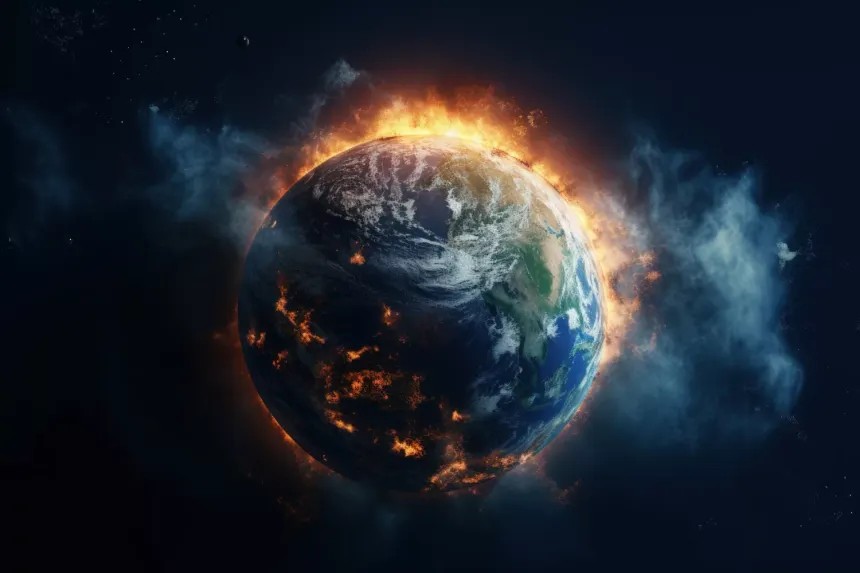
Earth has survived asteroid impacts, ice ages, and mass extinctions over its 4.5-billion-year history. But its greatest long-term threat isn’t an incoming space rock or a supervolcano; it’s the Sun itself.
A new study suggests that life on Earth still has a remarkably long future, but not an endless one. Researchers estimate that most plant life could survive for another 1.8 billion years before our increasingly bright Sun transforms Earth into a world too hot and dry to support complex ecosystems.
The findings offer one of the most detailed projections yet of Earth’s distant future, showing how gradual changes in the Sun’s energy output could eventually make the planet uninhabitable.
How long before the Sun destroys life on Earth?
According to researchers, Earth’s vegetation could survive for approximately 1.8 billion more years.
That doesn’t mean the Sun will suddenly destroy the planet. Instead, Earth’s environment will slowly become less hospitable as the Sun naturally grows brighter over time.
Scientists estimate that:
- Plant life may persist for roughly 1.8 billion years.
- Earth’s oceans could eventually evaporate into space.
- Complex animals, including humans, would likely disappear long before plants do.
- The planet would gradually transition into a hot, dry world incapable of supporting most known life.
Rather than a sudden catastrophe, Earth’s end as a habitable planet is expected to unfold over hundreds of millions of years.
Why is the Sun becoming brighter?
The Sun generates energy by fusing hydrogen into helium within its core.
As this process continues:
- The core gradually contracts.
- Temperatures inside the Sun increase.
- Nuclear fusion becomes more efficient.
- The Sun slowly emits more energy.
Astronomers estimate that the Sun’s brightness increases by roughly 10% every billion years.
Although that change sounds modest, it is enough to dramatically alter Earth’s climate over geological timescales.
Why does a brighter Sun threaten life?
As solar radiation increases, Earth’s climate changes in several ways.
Scientists expect:
- Global temperatures to rise steadily.
- Oceans to evaporate more rapidly.
- Weather patterns to shift dramatically.
- Atmospheric moisture to increase.
- Carbon dioxide levels to decline over time.
One of the biggest problems is carbon dioxide.
Plants rely on CO₂ for photosynthesis. As geological processes remove carbon dioxide from the atmosphere, many plants would eventually struggle to produce enough energy to survive.
Without plants, food chains would collapse.
How did scientists estimate Earth’s future?
Researchers from the University of Colorado Boulder and Blue Marble Space used advanced three-dimensional climate models to simulate Earth’s future.
Unlike earlier models, the new simulations incorporated:
- Atmospheric circulation.
- Ocean behavior.
- Rainfall patterns.
- Cloud formation.
- Long-term climate interactions.
These factors provide a more realistic picture of how Earth’s climate may evolve over billions of years.
The study examined multiple climate scenarios, including different rates of atmospheric carbon dioxide decline.
Despite varying assumptions, both scenarios reached similar conclusions regarding Earth’s long-term habitability.
Which life forms would survive the longest?
Not all plants respond equally to extreme environments.
Researchers believe the last surviving vegetation would likely include species already adapted to harsh climates.
Potential survivors include:
- Cacti.
- Desert succulents.
- Drought-resistant shrubs.
- Plants using specialized photosynthesis pathways.
These species can tolerate higher temperatures and lower water availability than most forests or grasslands.
Even so, they would eventually reach their biological limits.
Will humans still be around?
Almost certainly not.
Scientists expect humans and most large animals to disappear long before Earth’s final vegetation dies out.
Long before the Sun reaches its later evolutionary stages, Earth may experience:
- Severe global warming.
- Water scarcity.
- Ecosystem collapse.
- Agricultural failure.
- Loss of habitable regions.
Of course, these events lie so far in the future that human civilization, if it still exists, may possess technologies impossible to predict today.
Does this mean Earth itself will be destroyed?
No.
The study focuses on Earth’s habitability—not the planet’s physical destruction.
Earth is expected to continue orbiting the Sun even after becoming uninhabitable.
Billions of years later, however, the Sun will enter its Red Giant phase.
As it expands, it may:
- Engulf Mercury.
- Swallow Venus.
- Potentially engulf Earth or leave it as a scorched, lifeless world.
Astronomers are still refining models of exactly what will happen during that stage.
Could evolution or technology change the outcome?
Possibly.
The researchers note several uncertainties.
Future possibilities include:
- Plants evolving greater heat tolerance.
- New photosynthesis mechanisms emerging.
- Human technologies modifying Earth’s climate.
- Space colonization allowing life to continue elsewhere.
Because evolution over billions of years is impossible to predict precisely, the study should be viewed as a projection based on current scientific understanding.
Why this research matters
Although these events are unimaginably distant, they help scientists better understand how planets evolve over time.
The research has implications beyond Earth.
It also helps astronomers evaluate:
- The habitability of exoplanets.
- The lifespan of planetary biospheres.
- The long-term evolution of Earth’s climate.
- How stellar evolution affects life throughout the galaxy.
Studying Earth’s future also improves our understanding of the conditions needed for life to emerge—and survive—on other worlds.
TL;DR
- Scientists estimate Earth’s plant life could survive for another 1.8 billion years.
- The Sun naturally becomes brighter over time, gradually warming Earth.
- Rising temperatures, shrinking oceans, and declining carbon dioxide will eventually make photosynthesis impossible.
- Drought-adapted plants like cacti are expected to outlast most other vegetation.
- The research models Earth’s long-term climate evolution but does not account for future biological evolution or advanced human technology.