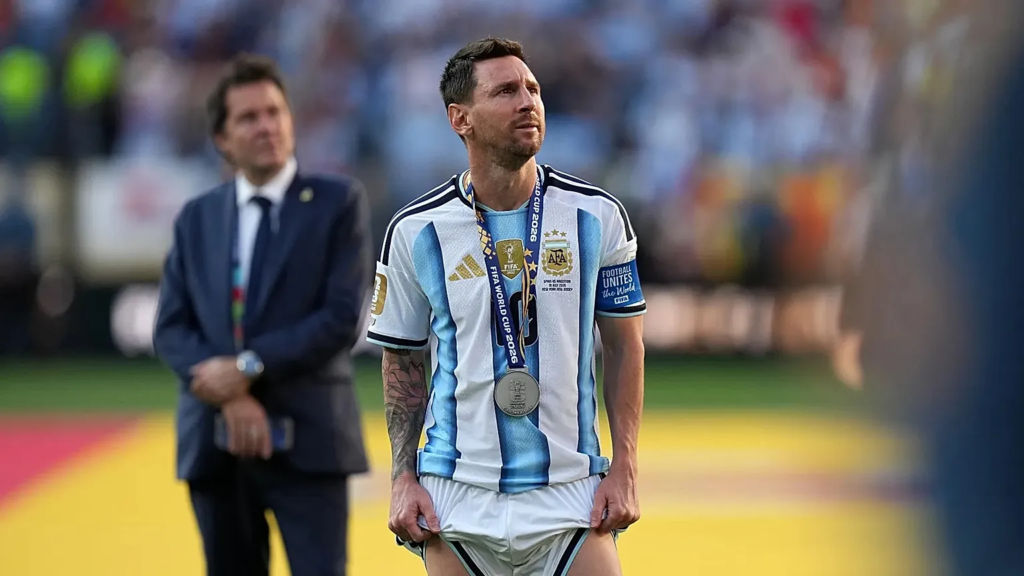
Lionel Messi has announced his retirement from international football, bringing an extraordinary 20-year chapter with Argentina to an end.
The announcement came after Argentina’s appearance in the 2026 FIFA World Cup final, where Spain defeated the defending champions 1-0 in New Jersey. Messi, who had already lifted the World Cup in 2022, said he had spent considerable time thinking about his decision before concluding that it was time to step away from the national team.
The decision marks the end of one of the most decorated international careers in soccer history.
Messi is expected to continue his club career with Inter Miami in Major League Soccer, meaning his announcement concerns his future with Argentina rather than an immediate end to his playing career.
Why is Lionel Messi retiring from international football?
Messi said the decision was painful but that he believed it was the right moment to leave Argentina’s national team.
In his statement, he emphasized that he had given everything he could to the national side throughout his career and pointed to the emergence of younger players who deserved opportunities.
The timing also comes after the death of his father, Jorge Messi, earlier in August. Messi said he had written his retirement statement on July 21, two days after the World Cup final, but that events surrounding his father’s death strengthened his conviction about the decision.
He described the end of his international career as one of the most difficult chapters to close, while making clear that his connection with Argentina would remain.
What did Messi say about Argentina?
Messi’s farewell was less about statistics than about his relationship with the national team and Argentine supporters.
He said he would miss being inside the national team but would now support it from the outside, particularly during difficult moments.
The sentiment reflects how dramatically Messi’s relationship with Argentina changed over two decades.
For years, his international career was defined as much by disappointment as achievement. He eventually transformed that narrative by leading Argentina to a run of major international titles, including the Copa América and the 2022 World Cup.
He leaves the national team after helping Argentina reach another World Cup final in 2026.
How did Messi’s Argentina career begin?
Messi made his senior international debut for Argentina in August 2005 in a friendly against Hungary.
He was only 18 years old and was sent off shortly after coming onto the field, an unusually turbulent beginning for a player whose international career would eventually become one of the longest and most successful in Argentina’s history.
He soon became a central figure in the national team.
Messi appeared at multiple World Cups and Copa América tournaments, carrying enormous expectations as Argentine fans waited for him to reproduce the success he had enjoyed at the club level with Barcelona.
That wait became a defining part of his story.
Why was Messi’s international career so difficult at first?
Messi reached major tournament finals with Argentina but repeatedly came away without the biggest trophies.
Argentina lost the 2007 Copa América final to Brazil, followed by defeats in the 2014 World Cup final and the 2015 and 2016 Copa América finals.
The 2016 Copa América Centenario final proved particularly painful.
After Argentina lost to Chile on penalties, Messi announced his retirement from international football at the time. He later reversed that decision and returned to the national team.
That episode showed just how much pressure surrounded his role.
Messi was not simply Argentina’s best player. For much of his career, he was expected to solve every problem for a national team whose success was measured against the achievements of Diego Maradona and Argentina’s 1986 World Cup triumph.
When did everything change for Messi and Argentina?
The breakthrough came in 2021.
Argentina defeated Brazil 1-0 at the Maracanã to win the Copa América, giving Messi his first major senior international trophy with the national team.
The victory changed the atmosphere around Messi.
The player who had spent years being criticized for failing to deliver a major title had finally done it.
Argentina then won the 2022 Finalissima against Italy before producing the defining achievement of Messi’s international career at the 2022 FIFA World Cup in Qatar.
How did Messi win the 2022 World Cup?
Argentina’s World Cup campaign began disastrously with a 2-1 defeat to Saudi Arabia.
The loss immediately increased pressure on Messi and his teammates.
Argentina responded by defeating Mexico and Poland in the group stage before progressing through the knockout rounds.
Messi scored against Australia in the round of 16 and then played a decisive role against the Netherlands, Croatia and France.
The final against France became one of the most dramatic World Cup matches ever played.
Messi scored twice as Argentina drew 3-3 with France after extra time. Argentina eventually won the match on penalties, with Messi finally lifting the World Cup trophy that had eluded him for so long.
The triumph completed the most important missing piece of his international résumé.
What did Messi achieve with Argentina?
Messi’s international legacy extends well beyond the World Cup.
His major honors with Argentina include:
- 2021 Copa América
- 2022 Finalissima
- 2022 FIFA World Cup
- 2024 Copa América
He also became Argentina’s all-time leading scorer and earned the distinction of becoming one of the country’s most-capped players.
His longevity was extraordinary.
Messi represented Argentina across multiple generations of players, coaches and tactical systems, remaining a key figure from his teenage years into his late 30s.
How did Messi perform at the 2026 World Cup?
The 2026 World Cup represented Messi’s sixth appearance at the tournament, according to the supplied report.
He scored eight goals and provided four assists during the competition, making it his most productive World Cup campaign in terms of goal contributions.
Argentina ultimately fell short in the final, losing 1-0 to Spain in New Jersey.
Although the result denied Messi another World Cup triumph, Argentina’s run gave him one final appearance on soccer’s biggest stage.
His decision to retire from international football followed shortly afterward.
What happens to Messi’s career after Argentina?
Messi’s international retirement does not necessarily mean the end of his professional playing career.
He is expected to continue playing for Inter Miami in MLS.
That distinction is important.
A player can retire from international soccer while continuing to compete for a club. International football involves representing a country during tournaments and national-team windows, while club football operates separately through domestic leagues and competitions.
For Messi, that means fans could still see him play even though his Argentina career is over.
Why does Messi’s retirement matter?
Messi’s departure represents more than the retirement of a superstar from one national team.
It closes the international chapter of a career that produced an unusual combination of longevity, individual records and major trophies.
His Argentina story also changed dramatically over time.
He began as a teenage prodigy expected to become the country’s next great footballing icon. He endured years of criticism after repeated final defeats. He briefly walked away from international football. He returned, won major trophies and eventually lifted the World Cup.
The arc from frustration to fulfillment is central to understanding Messi’s legacy with Argentina.
What will Messi leave behind?
For Argentine soccer, Messi leaves behind a national team transformed by his generation.
The 2021 Copa América ended a 28-year wait for a senior men’s major international trophy. The 2022 World Cup then delivered the prize Argentina had been chasing since 1986.
The 2024 Copa América added another major title.
Messi’s international career therefore ends not with the disappointment that once defined it, but with a collection of trophies few players could match.
His final World Cup also provided a fittingly grand stage for the conclusion.
After two decades of wearing Argentina’s colors, Messi has decided that there is little more he can give the national team.
The end of Messi’s Argentina era
Messi’s international career began in 2005 with an 18-year-old stepping onto the field for the first time.
It ends more than two decades later with the same player having become Argentina’s captain, record scorer, World Cup champion and one of the defining figures in the history of the sport.
His farewell carries an unmistakable sense of finality.
“I gave everything I had, and I don’t have anything more to give,” Messi said in his statement, while acknowledging the young players now coming through Argentina’s ranks.
For a player who spent much of his career chasing an international trophy, the final chapter ultimately contained nearly everything he had once been accused of lacking.
The World Cup trophy is in his collection. The major continental titles are there too. The records are his.
Now, after 20 years with Argentina, Lionel Messi is stepping away from the shirt that became inseparable from his name.