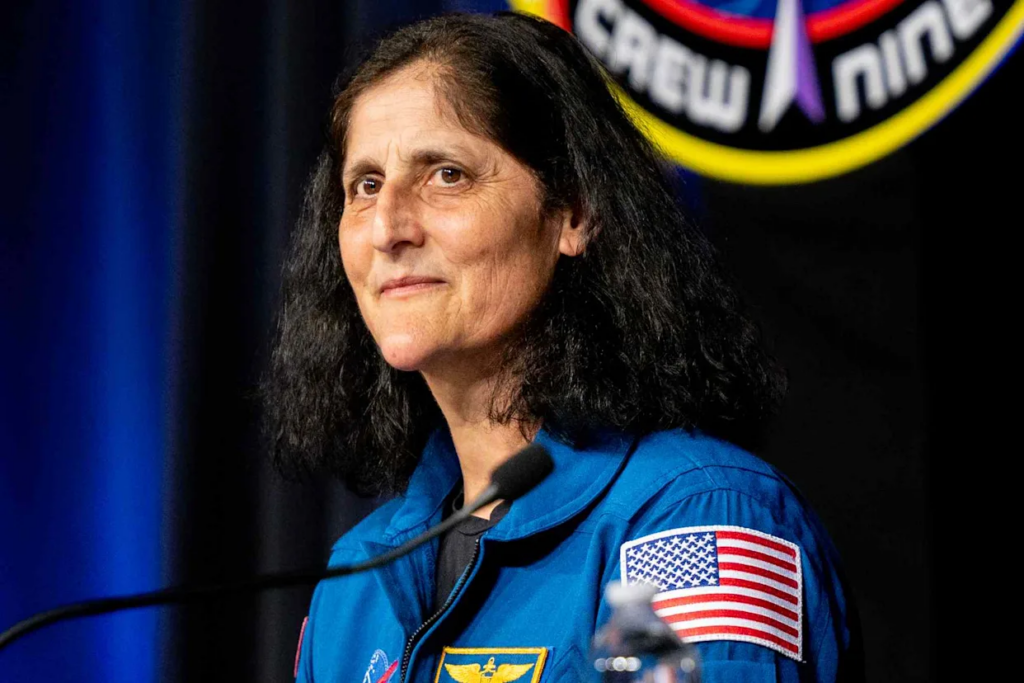
The Boston Marathon has seen its share of remarkable finishes, but few carry the narrative weight of Sunita Williams crossing the line in 2026. At 60, the retired astronaut completed the race in 5:52:49, returning to a course she first tackled as a teenager 43 years ago. The moment was not just about endurance. It was about continuity, memory, and a life that has stretched from Earth’s streets to orbit and back.
What makes Sunita Williams’ Boston Marathon 2026 run unique?
Sunita Williams’ participation in the Boston Marathon 2026 stands out for more than her age or finishing time. It closes a loop that began in adolescence and traveled through one of the most unusual chapters in marathon history.
A runner shaped by persistence, not perfection
At 17, Williams ran the Boston Marathon unofficially in high-top sneakers. Around mile 17, near Newton-Wellesley Hospital, she nearly quit after seeing her mother. Instead, she pushed forward and ultimately finished barefoot. That gritty, imperfect race became part of her personal mythology and offers a sharp contrast to her 2026 run, where she finished steadily, in proper gear, with decades of experience behind her.
The only runner to complete Boston from space
In 2007, Sunita Williams did something no one else had done or has replicated since. She ran the Boston Marathon while aboard the International Space Station, tethered to a treadmill. That feat transformed her from a determined runner into a symbol of human adaptability. It also blurred the boundaries of what a marathon could represent.
Why does her return matter beyond the finish line?
The 2026 race was not just a personal milestone. It carried broader meaning tied to resilience, public service, and the evolving image of aging athletes.
Recognition through the Patriots’ Award
Sunita Williams received the Patriots’ Award from the Boston Athletic Association, an honor given to individuals who embody resilience and service. In her case, the award bridges two worlds: elite athletics and space exploration. It signals that endurance is not confined to sports arenas. It can define a career.
Redefining age and athletic longevity
At 60, Williams’ performance challenges conventional expectations about marathon runners. While elite athletes often peak earlier, endurance sports have increasingly become a space where older competitors can excel.
Key takeaways for readers:
- Marathon running is as much about pacing and mental discipline as raw speed.
- Long-term fitness habits can extend competitive participation well into later decades.
- High-profile examples like Williams help normalize active aging.
- http://x.com/BreezyScroll/status/2046809039208845434
How does her NASA career amplify this story?
Sunita Williams’ Boston Marathon narrative gains depth when viewed alongside her achievements as a NASA astronaut.
A record-breaking astronaut
Over the course of three spaceflights, Williams logged more than 62 hours of spacewalks, the most by any woman. Her work involved complex repairs and installations outside spacecraft, tasks that demand both physical stamina and psychological resilience.
The overlap between space training and endurance sports
Astronaut training and marathon preparation share surprising similarities:
- Cardiovascular conditioning is critical in both environments.
- Mental resilience determines performance under stress.
- Routine and discipline drive long-term success.
This overlap helps explain why Williams could sustain a lifelong connection to running, even while operating in one of the most extreme environments humans have ever entered.
Who else stood out at the Boston Marathon 2026?
Sunita Williams was not the only notable participant in this year’s race, though her story drew particular attention.
High-profile finishers
- Zdeno Chara, former captain of the Boston Bruins, finished in an impressive 3:18:00.
- Chelsea Clinton completed the race in 3:40:52.
These performances highlight how the Boston Marathon continues to attract athletes and public figures from diverse fields, reinforcing its cultural significance beyond professional running.
What does this say about the Boston Marathon’s legacy?
The Boston Marathon is more than a race. It is a stage where personal histories intersect with broader cultural narratives.
A race that rewards stories as much as speed
From elite runners chasing records to individuals marking personal milestones, Boston has always been about more than podium finishes. Williams’ journey exemplifies this ethos. Her 2026 run is not her fastest or most dramatic. It is her most complete.
The enduring appeal of the event
The marathon’s longevity and prestige stem from its ability to accommodate:
- Elite competition
- Amateur participation
- Personal storytelling
Sunita Williams’ presence reinforces that balance. She is neither just an elite athlete nor just a participant. She occupies a rare middle ground shaped by experience.
How does her story resonate today?
In an era defined by rapid change and short attention spans, Williams’ return offers a different kind of narrative. It unfolds over decades, not days.
A reminder of long-term achievement
Her journey underscores that meaningful accomplishments often span years, even lifetimes. The arc from a barefoot teenager to a decorated astronaut to a marathon finisher at 60 is not linear. It is layered.
Inspiration without exaggeration
What makes Williams’ story compelling is its realism. She did not win the race. She did not break records in 2026. She simply showed up, finished, and added another chapter to an already extraordinary life. That kind of achievement resonates more deeply than a single moment of triumph.
TL;DR
- Sunita Williams completed the Boston Marathon 2026 at age 60 in 5:52:49.
- She first ran the race unofficially at 17 and later ran it from space in 2007.
- She received the Patriots’ Award for resilience and service.
- Her story highlights endurance, longevity, and the evolving meaning of athletic achievement.