
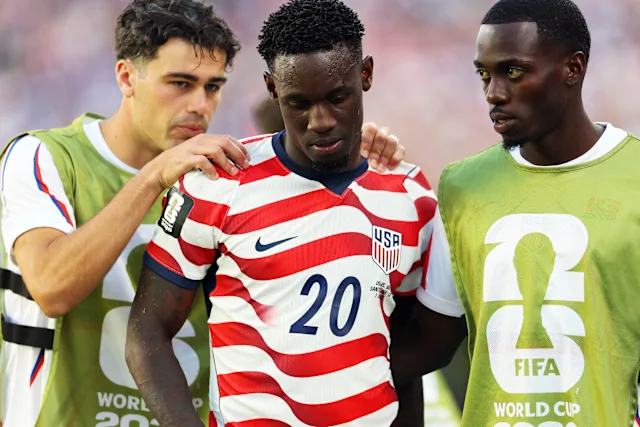
The United States will be without one of its most dangerous attacking players when it faces Belgium in the FIFA World Cup 2026 Round of 16, but not because of an injury. Forward Folarin Balogun is suspended after receiving a straight red card against Bosnia and Herzegovina, and under FIFA’s tournament rules, there is virtually no avenue for the U.S. Soccer Federation to appeal the decision.
The incident has sparked debate among fans and pundits, especially after U.S. head coach Mauricio Pochettino criticized the dismissal. However, FIFA’s disciplinary regulations make it clear why the red card stands and why Folarin Balogun is set to miss the next match.
Why can’t the USA appeal Folarin Balogun’s red card?
The key reason is FIFA’s interpretation of the role of the Video Assistant Referee (VAR).
According to FIFA, once the referee reviews an incident using VAR and confirms the decision to issue a straight red card, that review serves as the competition’s effective appeals process. As a result, the decision becomes final and cannot be challenged afterward.
FIFA has confirmed to multiple media outlets that teams competing at the 2026 World Cup cannot appeal the issuance of a red card that has already undergone VAR review during the match.
In Folarin Balogun’s case, Brazilian referee Raphael Claus reviewed the tackle after being advised by VAR before showing the red card. That means the disciplinary sanction automatically takes effect.
What happened in the Bosnia and Herzegovina match?
Folarin Balogun had already made a major impact before the incident.
The 24-year-old striker scored the opening goal and increased his tournament tally to three goals, making him the United States’ leading scorer at the World Cup.
However, in the 64th minute, VAR alerted referee Raphael Claus to a challenge involving Bosnia defender Tarik Muharemovic.
After reviewing the footage, Claus determined that Folarin Balogun’s studs caught Muharemovic’s ankle and Achilles area, leading him to issue a straight red card for serious foul play.
The dismissal forced the United States to finish the match with 10 players, although it ultimately held on to secure victory and advance to the Round of 16.
What do FIFA’s rules say?
FIFA’s disciplinary regulations leave little room for interpretation once a player is sent off.
Article 66.4: Automatic suspension
Under Article 66.4 of FIFA’s Disciplinary Code:
- A player who receives a red card is automatically suspended for the team’s next match.
- The suspension applies immediately.
- Teams cannot overturn the automatic ban by appealing the referee’s decision.
This rule is designed to ensure consistency across FIFA competitions and avoid lengthy post-match disputes over on-field decisions.
Rule 10.5: Suspension can be extended
While the initial one-match ban cannot be removed, FIFA retains the authority to impose additional punishment.
If the disciplinary committee determines that a challenge involved excessive force or particularly dangerous conduct, it may extend the suspension beyond one match.
That means Balogun’s case is technically not closed, although any further action would involve increasing the penalty rather than reducing it.
Has FIFA extended suspensions before?
Yes.
One of the most notable recent examples involved Qatar midfielder Assim Madibo.
After a challenge that resulted in Canada’s Ismaël Koné suffering a broken leg, FIFA increased Madibo’s suspension from the standard one-match ban to five matches.
The precedent demonstrates that FIFA’s disciplinary committee has the power to impose harsher sanctions when it believes the circumstances warrant additional punishment.
Whether Balogun’s challenge reaches that threshold remains uncertain.
Could Folarin Balogun face a longer suspension?
At present, only one suspension has been confirmed.
However, FIFA’s disciplinary panel could still review the incident and decide whether further action is necessary.
According to reports, U.S. Soccer plans to contest any suspension beyond the mandatory one match, although no decision has been announced regarding whether FIFA will open additional disciplinary proceedings.
Unless FIFA extends the punishment, Balogun would be eligible to return if the United States advances beyond the Round of 16.
What does Folarin Balogun’s suspension mean for the USA?
The absence of Balogun presents a significant challenge for head coach Mauricio Pochettino.
The striker has been the United States’ most productive attacking player during the tournament, leading the team in goals while providing pace and movement in the final third.
Against Belgium, the United States may need to
- Reshape its attacking formation.
- Look to other forwards for goals.
- Place greater creative responsibility on its midfield.
- Adjust its pressing strategy without its leading striker.
Pochettino has publicly criticized the decision, insisting the challenge did not warrant a straight red card. Nevertheless, the coach will have to prepare without one of his key players.
Why are FIFA’s red card rules so strict?
FIFA’s disciplinary framework aims to balance fairness with consistency.
Allowing teams to routinely appeal red cards after VAR reviews could create delays, inconsistent rulings, and scheduling complications during a tightly organized tournament like the World Cup.
By treating the VAR review as the final stage of decision-making, FIFA seeks to provide certainty for teams while minimizing prolonged disciplinary disputes.
Critics argue the system leaves little room to correct potential errors, while supporters believe it reinforces the authority of match officials and maintains competitive integrity.
The bottom line
Folarin Balogun’s red card has become one of the biggest talking points of the FIFA World Cup 2026 knockout stage, but FIFA’s regulations leave the United States with few options.
Because the incident was reviewed and confirmed through VAR, the red card cannot be appealed. The automatic one-match suspension is mandatory, meaning Balogun will miss the USA’s crucial Round of 16 meeting with Belgium.
The only remaining uncertainty is whether FIFA’s disciplinary committee decides the tackle merits an even longer ban, a decision that could significantly affect the United States’ hopes of making a deep World Cup run.
TL;DR
- Folarin Balogun received a straight red card against Bosnia and Herzegovina after a VAR review.
- FIFA says the red card itself cannot be appealed during the 2026 World Cup.
- A straight red automatically results in a one-match suspension under FIFA’s disciplinary rules.
- FIFA’s disciplinary committee can increase the suspension if it considers the challenge especially serious.
- Balogun will miss the USA’s Round of 16 clash against Belgium.