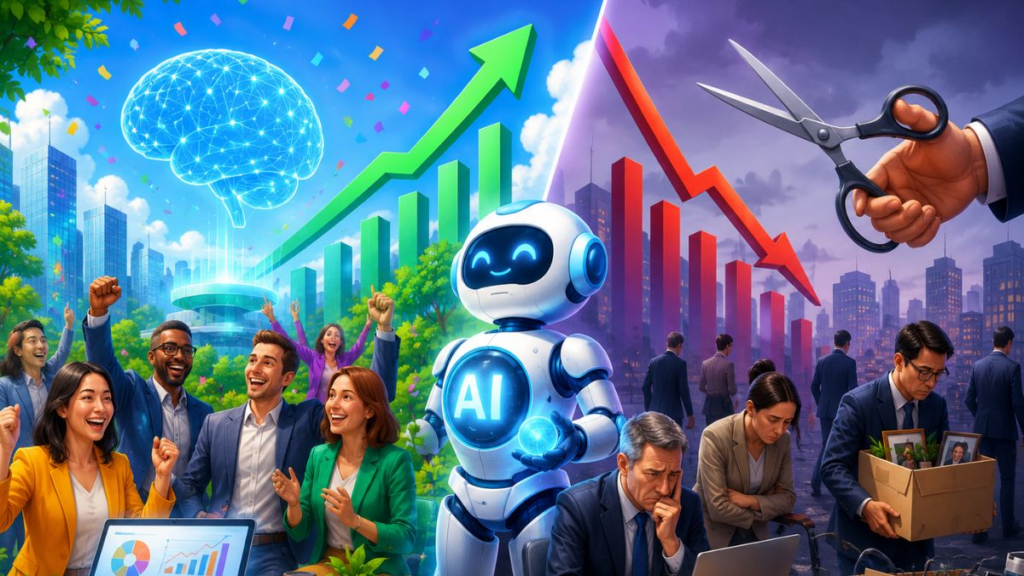
Artificial intelligence was supposed to reshape the workplace at breakneck speed. Executives predicted leaner teams, faster product launches, and massive productivity gains. Investors poured billions into AI infrastructure, expecting a historic transformation of business operations.
Instead, many companies are discovering a harsher reality: AI is getting expensive fast, and the returns are harder to measure than expected.
The latest warning signs are coming not from sceptics, but from the companies leading AI adoption. Executives at Uber, Microsoft, Starbucks, and even OpenAI are acknowledging that AI usage is exploding while measurable business value remains difficult to prove.
That shift marks a turning point in the AI boom. The conversation is moving away from “What can AI do?” toward a more uncomfortable question: “Is this economically sustainable?”
Why AI Adoption Is Becoming Harder to Justify
For the past two years, enterprise AI adoption has been driven by urgency and fear of missing out. Companies rushed to integrate AI coding assistants, chatbots, workflow automation systems, and internal copilots into daily operations.
But AI billing models created a new problem.
Unlike traditional software licenses with fixed costs, generative AI tools charge based on usage. Every prompt, response, and automated workflow consumes “tokens,” which measure the amount of computing power required to process requests.
That becomes expensive quickly — especially with agentic AI systems capable of autonomously handling multi-step tasks.
Uber President and COO Andrew Macdonald recently offered one of the clearest public admissions that enterprises are struggling to connect AI usage with actual outcomes.
According to Macdonald, AI-generated code commits and token consumption are climbing at “astronomical” rates. Yet Uber still cannot clearly show that those increases are leading to more shipped features, faster product delivery, or dramatically higher productivity.
That disconnect matters because AI costs scale with usage.
The more employees rely on AI systems, the more companies pay.
The Real Problem With Enterprise AI: Measuring Value
Companies can easily track AI activity:
- Number of prompts submitted
- AI-generated lines of code
- Token consumption
- Tool adoption rates
- Automated workflows executed
What they cannot easily measure is whether those activities improve the business.
That distinction is becoming central to the AI debate.
A developer using Claude or GPT-5 all day may generate far more code than before. But if engineers still need to review, debug, test, and rewrite that code manually, the productivity gains shrink fast.
In many organisations, AI is speeding up certain tasks while simultaneously creating new layers of verification work.
That creates a paradox:
AI increases activity without necessarily increasing output.
Token Costs Are Quietly Becoming a Major Corporate Expense
The economics behind AI adoption are now drawing more scrutiny.
Anthropic estimates average Claude Code usage costs at about $6 per active developer per day, with heavier users consuming far more. Some companies reportedly saw AI spending jump from roughly $200 per developer per month to nearly $3,000 within months as workflows became increasingly AI-dependent.
Those costs escalate dramatically with agentic AI systems.
Unlike standard chatbot interactions, agentic workflows repeatedly process large datasets, revisit prior context windows, and autonomously trigger additional actions. In some cases, these systems consume up to 1,000 times more tokens than normal AI queries.
That has forced many companies into what some insiders now call the “token throttling era.”
What Is Token Throttling?
Token throttling refers to limits placed on AI usage to prevent runaway costs.
Companies are increasingly introducing:
- Daily token caps
- Weekly usage limits
- Peak-hour restrictions
- Team-level spending controls
- AI governance policies
AI providers themselves are doing the same thing to stabilise infrastructure demand and reduce GPU strain.
The fact that enterprises already need AI spending controls this early in the adoption cycle says a lot about how quickly costs are rising.
Why Some Companies Are Re-Hiring Humans
One of the clearest signs of the AI reality check is that several companies are quietly shifting back toward human labor after aggressive automation pushes.
Starbucks offers a notable example.
The company rolled out an AI inventory system called “Automated Counting” across North American stores to improve efficiency and reduce manual workload. Instead, employees reportedly spent extra time correcting inventory mistakes after the system miscounted or mislabeled products.
Rather than reducing labor costs, the AI system created operational friction.
Starbucks eventually shut the project down and renewed its focus on staffing and consistency, including hiring more baristas.
That story highlights an uncomfortable truth often missing from AI hype cycles:
Replacing human judgment is much harder than automating repetitive tasks.
Sam Altman’s “Jobs Apocalypse” Prediction Is Slowing Down
Even OpenAI CEO Sam Altman is now acknowledging that AI-driven job displacement is happening more slowly than expected.
Speaking recently at the Commonwealth Bank of Australia conference, Altman admitted he expected more entry-level white-collar jobs to disappear by now.
Instead, organizations are discovering that workplace automation involves far more than technological capability.
Businesses still depend heavily on:
- Human trust
- Communication
- Oversight
- Organizational coordination
- Institutional knowledge
- Risk management
Altman himself noted that attempts to automate his own communications revealed how much people still value genuine human interaction.
That matters because it reframes the AI conversation.
The challenge is no longer whether AI can technically perform tasks. The challenge is whether organizations can absorb and operationalize those capabilities effectively.
Why AI Isn’t Replacing Engineers as Quickly as Expected
A major assumption behind enterprise AI adoption was that coding assistants would dramatically shrink engineering teams.
That has not fully happened.
Instead, companies are learning that AI-generated code often requires extensive human review.
Engineers still handle:
- Security testing
- Architecture decisions
- Quality assurance
- Debugging
- Compliance
- Production monitoring
In some cases, heavy AI usage may even cost more than simply hiring additional developers.
That is one reason companies are increasingly mixing AI systems and human teams rather than replacing workers outright.
Microsoft reportedly scaled back direct access to Anthropic’s Claude Code in some divisions after usage costs surged. The company has instead pushed employees toward cheaper internal alternatives like GitHub Copilot CLI.
The move reflects a broader industry trend:
Companies are now optimizing AI costs the same way they optimise cloud infrastructure spending.
The AI Industry May Face a Bigger Problem Than Job Losses
For years, the dominant fear surrounding AI was mass unemployment.
But another possibility is emerging:
The AI business model itself could come under pressure before large-scale labour displacement happens.
Big Tech companies are collectively spending hundreds of billions of dollars on AI infrastructure, including GPUs, data centers, and model training.
Those investments depend on a simple assumption:
Enterprise AI adoption will eventually produce enough measurable business value to justify ongoing spending.
If companies continue struggling to prove ROI, investor patience may weaken.
That could create what some analysts are beginning to describe as an “AI monetisation crisis.”
The warning signs are already visible:
- Soaring compute costs
- Increasing token consumption
- Rising enterprise skepticism
- AI budget overruns
- Slower-than-expected workforce disruption
- Greater demand for governance and oversight
The result is a more cautious phase of AI adoption.
AI Adoption Is Entering Its Governance Era
The AI hype cycle is not ending. But it is maturing.
Companies are no longer treating AI as a limitless productivity engine. They are beginning to treat it like any other major business investment — something that requires controls, accountability, and measurable returns.
That shift could ultimately strengthen the industry.
The early years of enterprise cloud computing followed a similar pattern. Businesses initially overspent, experimented aggressively, and later introduced governance frameworks once costs spiraled.
AI appears to be entering the same phase.
The future of enterprise AI may depend less on raw capability and more on operational discipline.
For now, the biggest threat facing many companies is not a jobs apocalypse.
It is the possibility of runaway AI spending without clear economic payoff.
TL;DR
- Enterprise AI adoption is becoming more expensive than many companies expected.
- Businesses can measure AI usage easily, but proving productivity gains remains difficult.
- AI token consumption is rising rapidly, especially with agentic AI systems.
- Companies are introducing “token throttling” and usage caps to control costs.
- Starbucks and others have scaled back AI deployments after operational issues.
- Sam Altman says AI-driven job losses are happening more slowly than expected.
- Many firms still rely heavily on human oversight, testing, and decision-making.
- Investors may soon demand clearer ROI from the billions being spent on AI infrastructure.