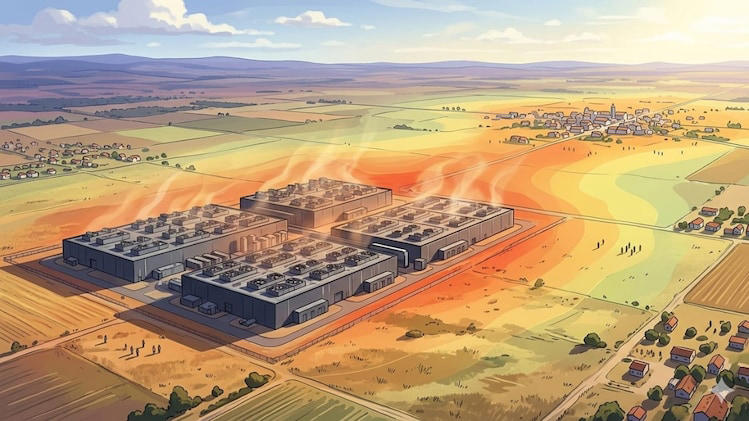
The rapid rise of artificial intelligence isn’t just transforming software; it’s reshaping the physical environment. A new study from the University of Cambridge suggests that the massive facilities powering AI—data centers—are heating up the land around them, affecting more than 340 million people globally.
This phenomenon, tied to what researchers call AI-driven heat islands, raises urgent questions about sustainability as demand for AI infrastructure surges.
What Did the Study Find About AI Data Centers and Heat?
Researchers analyzed two decades of satellite and ground-based temperature data, comparing it with the locations of large-scale data centers—facilities often spanning more than 93,000 square meters and housing thousands of servers.
The findings are striking:
- Average temperature increase: ~2°C around operational data centers
- Extreme spikes: Up to 2°C or more in certain conditions
- Impact radius: Temperature changes detected up to 10 km away
- Population affected: Over 340 million people globally
To put this in perspective, a 2°C increase can feel like the difference between a mild winter morning in New Delhi and the onset of peak summer heat.
What Are “Heat Islands,” and Why Do Data Centers Create Them?
Understanding the Heat Island Effect
A heat island refers to an area that experiences significantly higher temperatures than its surroundings due to human activity.
This is already common in cities, where
- Concrete and asphalt absorb heat
- Vegetation is limited
- Waste heat from vehicles and buildings accumulates
Data centers are now emerging as a powerful new contributor.
Why AI Data Centers Generate So Much Heat
AI systems require enormous computational power, which translates into the following:
- High electricity consumption to run servers 24/7
- Intensive cooling systems to prevent overheating
- Massive heat output as a byproduct of processing
In simple terms, data centers act like giant heaters, constantly running and continuously releasing heat into their surroundings.
How Far Does the Heat Spread?
One of the study’s most concerning findings is the distance over which temperature increases are observed.
Heat isn’t confined to the facility itself. Researchers found:
- Temperature rises extending up to 10 kilometers
- Comparable to the distance between Connaught Place and Noida Sector 18
This means entire neighborhoods, not just industrial zones, can be affected.
Where Is This Happening Globally?
The trend isn’t isolated. It’s visible across major data center hubs worldwide.
Key Regions Identified
- Bajío region, Mexico
- Aragon, Spain
Both areas showed unexplained temperature increases of around 2°C compared to nearby regions without large data center clusters.
These findings suggest a consistent global pattern: where data centers scale up, localized warming follows.
Why This Matters for India
India is rapidly expanding its digital infrastructure, with major data center growth in:
- Mumbai
- Chennai
- Hyderabad
A Perfect Storm of Heat Risks
These cities already face:
- High summer temperatures
- Dense urban infrastructure
- Limited green cover in key areas
Adding large-scale data centers into this mix could:
- Intensify urban heat waves
- Increase energy demand for cooling
- Strain water resources
This is especially concerning as India experiences increasingly frequent extreme heat events.
The Hidden Costs of AI Infrastructure
The environmental footprint of AI goes beyond just heat.
Electricity Consumption
Data centers consume vast amounts of power, often comparable to small cities.
- AI workloads significantly increase energy demand
- Fossil fuel-based grids can amplify carbon emissions
Water Usage
Cooling systems often rely on water:
- Millions of liters used annually per facility
- Competes with local water needs in already stressed regions
Land Use and Urban Planning
Large data centers:
- Occupy significant land areas
- Reduce space for green cooling solutions like trees and parks
What Experts Are Warning
Andrea Marinoni, the study’s lead researcher, told CNN that unchecked expansion of data centers could have “dramatic impacts on society”—affecting:
- Environmental stability
- Public health
- Economic systems
Sustainability expert Deborah Andrews added that the current rush toward AI infrastructure risks outpacing responsible planning, calling it a race that may be “overriding good practice and systemic thinking.”
Can the Heat Problem Be Solved?
The issue isn’t unsolvable—but it requires proactive design and policy changes.
Smarter Cooling Technologies
- Liquid cooling systems (more efficient than air cooling)
- Waste heat recovery (redirecting heat for other uses)
Better Location Planning
- Building data centers in cooler climates
- Avoiding densely populated urban areas
Renewable Energy Integration
- Powering facilities with solar, wind, or hydro energy
- Reducing reliance on heat-generating fossil fuels
Urban Green Design
- Increasing vegetation around facilities
- Creating buffer zones to absorb heat
The Bigger Picture: AI’s Physical Footprint
AI is often seen as a digital revolution, but it has very real, physical consequences.
The rise of AI data centers highlights a broader truth:
The infrastructure behind “invisible” technology is anything but invisible.
As AI continues to expand, the challenge will be balancing innovation with sustainability—ensuring that the systems designed to power the future don’t overheat the present.
TL;DR
- A University of Cambridge study finds AI data centers raise nearby temperatures by ~2°C
- Heat impacts can extend up to 10 km and affect over 340 million people
- The phenomenon is part of a growing “heat island” effect
- India’s expanding data center hubs face significant risk
- Sustainable design and planning are critical to managing the impact