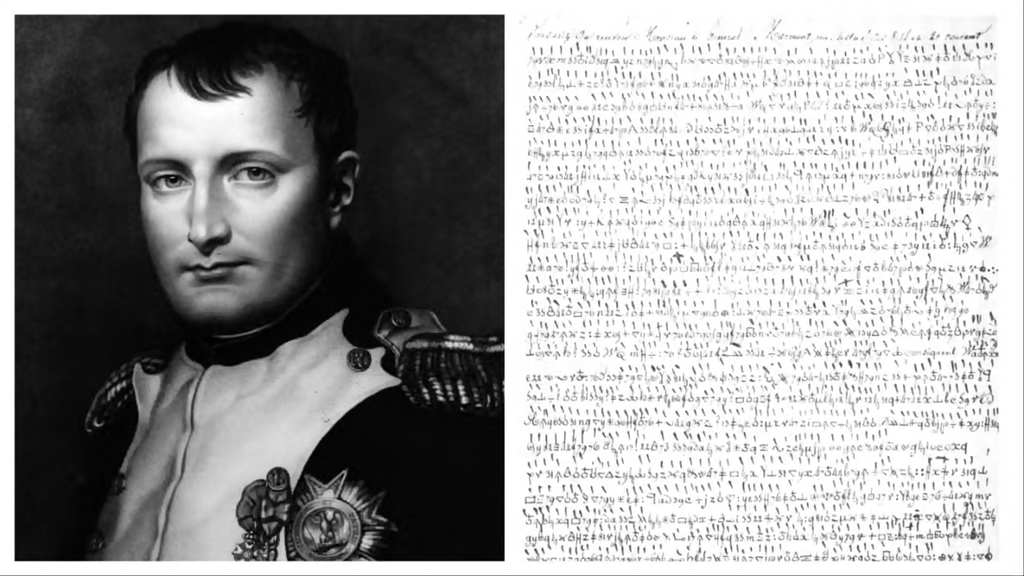
A secret military message from the Napoleonic Wars remained unread for more than two centuries. In September 2026, an artificial intelligence system helped crack the code in roughly six hours of model execution, revealing details about troop positions and military intelligence on the eve of a major European conflict.
The breakthrough came when Carter Church, a 27-year-old AI engineer at cybersecurity company SentinelOne, used OpenAI’s GPT-6 Astra to decipher an encrypted French military dispatch dating to 1809. The message had been sent to General Auguste de Marmont under orders from Napoleon Bonaparte, but its complicated cipher had resisted a complete solution for generations.
Church’s achievement highlights a growing role for artificial intelligence in historical research. AI systems can now combine image recognition, language analysis, programming, and historical reasoning to tackle problems that once required specialists to work through thousands of possible solutions.
But the discovery also raises an important question: when an AI system solves a historical mystery, how do researchers know the answer is correct?
What Was in Napoleon’s Secret Letter?
The document was a military briefing intended for Marmont, a French general operating in Dalmatia, a region on the eastern Adriatic coast. In 1809, French forces faced a complex strategic situation as Austria prepared to challenge Napoleon’s expanding empire.
The message originated from the headquarters of Eugène de Beauharnais, Napoleon’s stepson and the Viceroy of Italy. Napoleon had instructed Eugène to send Marmont a coded account of French and allied military positions.
The purpose was practical, not ceremonial. Marmont needed intelligence about the deployment of forces across a region where Austrian territory separated his troops from other French armies.
The dispatch contained information about troop positions and the broader military situation. Its contents offered a snapshot of Napoleon’s strategic concerns in the weeks before Austria launched its campaign against France and its allies.
The letter was not entirely unknown to historians. A reproduction had appeared in a 1969 article in the French military-history journal Revue historique des Armées. However, the cipher had not been fully deciphered, and the document was incorrectly associated with 1807 in some historical listings.
The original cipher key was no longer available in a complete form. Without that key, researchers faced the challenge of identifying what the symbols represented and how they combined to form a readable message.
The breakthrough therefore did more than reveal a forgotten military dispatch. It demonstrated how a document preserved in an academic publication could become newly accessible when modern computational tools were applied to it.
How Did AI Crack a Cipher That Defeated Researchers for 217 Years?
Church began with a scanned image rather than a clean digital transcription. The document contained 24 lines of coded material made up of numbers, letters, and unusual handwritten symbols.
That presented two connected challenges: first, accurately identifying the symbols; second, determining the rules that transformed them into French text.
Step 1: Reading the coded symbols
Before a cipher can be solved, its characters must be transcribed accurately. A single misread symbol can produce an incorrect letter or word, particularly when handwriting is inconsistent or several symbols look alike.
GPT-6 Astra helped analyze the scanned image and organize the symbols into a workable transcription. This reduced the need to manually enter every character before attempting the cryptographic analysis.
The task was more complicated than recognizing ordinary handwriting. The solver also had to determine whether visually similar marks represented the same character and how the symbols were grouped.
Step 2: Using clues from an incomplete key
Church did not approach the problem without any historical clues. A previously compiled partial key provided known values for some of the symbols, giving the solver a starting point.
A partial key is useful because it narrows the range of possible interpretations. If certain symbols already have known values, researchers can test how the remaining characters fit into the emerging text.
The difficulty lies in finding a consistent solution for the unknown symbols without forcing the results to fit a preferred interpretation.
Step 3: Testing possible solutions computationally
The process then moved beyond transcription into computational cryptanalysis.
Church’s account describes the use of a search method known as simulated annealing. This technique explores possible solutions and gradually adjusts them to find combinations that better satisfy a scoring function.
In a historical substitution cipher, for example, a candidate solution can be assessed against the patterns commonly found in the language being decoded. Plausible letter combinations and French word patterns can help distinguish a promising interpretation from a meaningless sequence.
The method does not simply guess what a letter should say. It searches through possible mappings, evaluates the resulting text, and improves the candidate solution over repeated iterations.
Step 4: Checking the message against historical evidence
A plausible French translation is not enough to prove that a cipher has been solved correctly. A successful decipherment must also account for the document’s structure and fit what is known about the people, places, and events involved.
Church compared the emerging message with historical information and surviving accounts. Satoshi Tomokiyo, the maintainer of the Cryptiana historical-cryptography website, subsequently reviewed the proposed solution.
The result was sufficiently convincing for the cipher to be marked as solved in the online catalogue. Some individual symbols remain uncertain, however, so the achievement should not be interpreted as proof that every character has an uncontested reading.
Why Did the Decipherment Take Only Six Hours?
The most striking aspect of the discovery is the speed of the computational work. Church reported that GPT-6 Astra completed the main decipherment process in approximately six hours of model execution.
That does not mean the entire research effort began and ended within six hours. Church spent several evenings working on the problem, examining the result and preparing his account. The distinction matters when assessing what AI actually contributed.
Traditional cryptanalysis can require substantial manual effort, particularly when researchers must transcribe a document, identify its encryption system, develop a candidate key, and repeatedly test possible readings.
AI can connect these stages in a single workflow. A model can examine an image, generate code, test hypotheses, and use the resulting output to decide what to investigate next.
In this case, the combination of visual analysis, a partial key, computational search, and historical context helped accelerate a task that would otherwise have demanded considerable specialist work.
However, the result should not be reduced to the claim that AI independently solved a 217-year-old mystery with a single guess. The achievement depended on existing historical scholarship, known cipher information, computational techniques, and human evaluation.
The significance lies in how these elements worked together.
What Does the Decoded Message Reveal About Napoleon’s Military Strategy?
The deciphered letter provides a more complete account of the military information Napoleon wanted Marmont to receive in March 1809.
The message describes the positions of French and allied forces, including units associated with Bavaria, Poland, Saxony, and French marshals operating in the region. It also discusses Austrian military movements and the strategic situation facing Napoleon’s forces.
The timing is important. Austria invaded French-controlled territories in April 1809, escalating the conflict that became the War of the Fifth Coalition.
The dispatch therefore offers historians a contemporary record of military planning shortly before the fighting intensified. Rather than relying exclusively on later memoirs or retrospective accounts, researchers can compare the newly readable message with other surviving documents.
Why does a single letter matter to historians?
Historical documents are rarely interpreted in isolation. Researchers compare letters, military orders, maps, memoirs, and official records to reconstruct events and understand why decisions were made.
An encrypted message can contain information that was deliberately withheld from public circulation. Deciphering it may reveal not only troop deployments but also the assumptions, intelligence assessments, and concerns that shaped military decisions.
The newly reconstructed text also appears to shed light on a passage in Napoleon’s published memoirs that had remained incomplete. That connection illustrates how a newly accessible document can change the interpretation of an existing historical source.
Still, the letter should be treated as one piece of evidence. Military intelligence can be incomplete, mistaken, or deliberately misleading. Historians must compare its claims with independent records before drawing firm conclusions about what Napoleon knew or how accurately his forces understood the enemy.
How Is AI Changing Historical Code-Breaking?
The Napoleonic letter is part of a broader wave of AI-assisted cryptanalysis reported in 2026.
Satoshi Tomokiyo, who maintains Cryptiana, has documented a growing number of historical ciphers being solved with the help of AI systems. The collection has long served as a resource for enthusiasts and researchers interested in encrypted historical documents.
According to reporting by Euronews, the recent increase in successful solutions has led to questions about whether publicly accessible AI models are changing the field.
The potential benefits extend beyond code-breaking.
Recovering forgotten information
Libraries and archives contain enormous collections of historical material, including documents that are difficult to read, poorly catalogued, or available only as scanned images.
AI tools can help transcribe handwriting, identify recurring patterns, translate languages, and connect references across collections. These capabilities can make it easier for researchers to identify material worth examining more closely.
Making specialist research more accessible
Historical cryptanalysis traditionally requires knowledge of mathematics, languages, historical context, and encryption techniques.
AI can lower the barrier to entry by helping users investigate possible solutions and write programs to test them. That does not eliminate the need for expertise, but it can allow researchers without formal cryptography training to attempt problems that previously seemed out of reach.
Accelerating repetitive work
A large part of historical research involves comparing sources, checking dates, identifying names, and testing interpretations. AI can automate some of these repetitive steps, freeing researchers to concentrate on evaluating evidence and understanding its significance.
The same technology can also produce convincing mistakes. A model might misread a symbol, invent a plausible-looking word, or favor a translation that fits its expectations rather than the document.
For that reason, the strongest applications combine AI-generated hypotheses with reproducible methods and independent verification.
Why Are Some Cryptography Enthusiasts Concerned?
The growing success of AI has created mixed feelings among people who have spent years studying historical codes.
For amateur cryptographers, solving a difficult cipher can represent months or years of painstaking work. The process involves testing ideas, learning from failed attempts, and gradually finding the key that makes the message readable.
When a general-purpose AI system can tackle a similar challenge in hours, the experience of solving such puzzles changes.
Tomokiyo has expressed both excitement about the newly solved ciphers and concern that AI is removing some of the satisfaction associated with being the first person to crack a code. His reaction captures a tension between technological progress and the human experience of discovery.
Yet AI does not make human expertise irrelevant. Someone still has to identify promising historical documents, establish their provenance, assess the quality of a transcription, evaluate competing readings, and decide whether the proposed solution stands up to scrutiny.
The role of the researcher may shift from performing every step manually to directing the investigation and verifying its conclusions.
There is also a limit to what AI can achieve. Some ciphers contain too little text to reveal reliable patterns. Others depend on missing documents, unknown codebooks, or encryption systems for which no useful clues survive.
In those cases, more computing power does not necessarily produce a solution. The evidence itself may be insufficient.
Can AI Be Trusted to Decode Historical Documents?
AI can be a powerful research assistant, but its output should not be treated as automatically authoritative.
A credible decipherment should meet several tests:
- Reproducibility: Other researchers should be able to follow the method and obtain comparable results.
- Consistency: The proposed key should explain the ciphertext as a whole, rather than only a handful of convenient passages.
- Historical plausibility: Names, dates, military units, and events should fit the document’s known context.
- Transparency: Researchers should disclose any partial keys, external sources, software, and assumptions used during the analysis.
- Independent review: Specialists should examine uncertain readings and investigate alternative explanations.
These standards are particularly important because AI-generated text can sound convincing even when the underlying analysis is wrong.
In Church’s case, the existence of a partial key and the use of computational search provide a more concrete basis for evaluation than an unsupported claim that a model simply understood the message. The subsequent review by Tomokiyo adds another layer of scrutiny.
Nevertheless, the remaining uncertain symbols and the need to compare the result with other historical evidence show why verification remains part of the process.
What Does Napoleon’s Decoded Letter Tell Us About AI’s Future?
The decipherment demonstrates a meaningful change in how researchers can approach difficult historical questions. An old document does not need to be completely legible, and its encryption system does not need to be fully understood in advance, for modern computational tools to make progress.
The most important development is the ability to combine multiple research tasks. AI can help read the source, generate a transcription, explore possible encryption rules, write code to test them, and compare candidate interpretations with historical evidence.
That integrated workflow could help unlock other documents that have remained inaccessible because the time and expertise required to analyze them were too costly.
But the lesson is not that AI has made historians or cryptographers obsolete. It is that problems once considered impractical may now be worth attempting, provided the results can be checked.
Napoleon’s letter survived for 217 years without a complete decipherment. Its recovery shows how AI can help turn an obscure archival artifact into a source that historians can investigate and debate.
The code may have been the first obstacle. Establishing exactly what the message means, how reliable its intelligence was, and what it changes about our understanding of 1809 remains a task for human scholarship as well as machines.