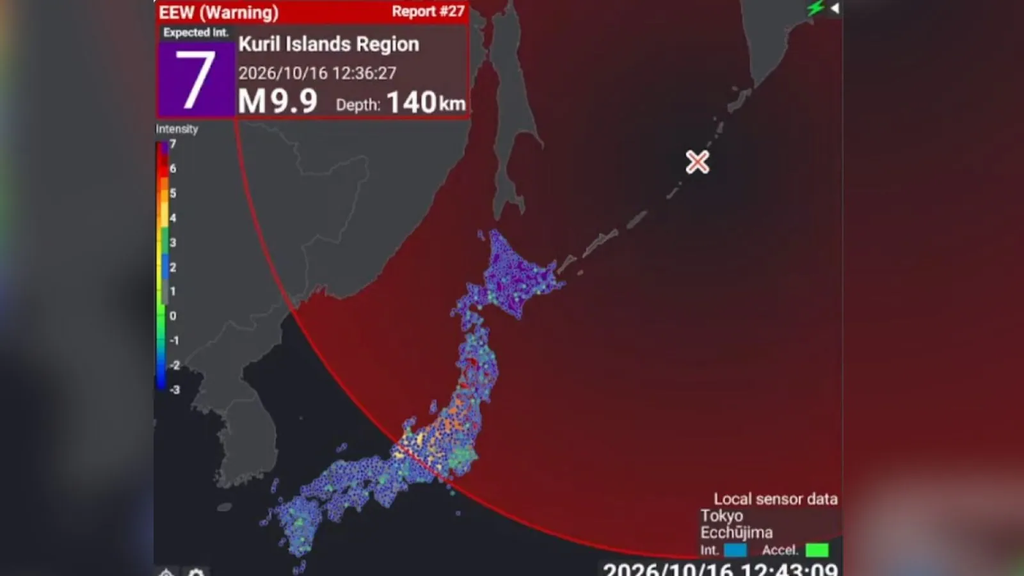
Japan’s weather agency mistakenly issued an emergency earthquake warning predicting a magnitude 9.9 earthquake after a powerful tremor struck Russia’s Kamchatka Peninsula on October 16. The alert, which warned of potentially intense shaking across parts of Japan, was withdrawn within eight minutes after officials identified an error in the estimated magnitude.
The actual earthquake registered magnitude 6.9, according to the European-Mediterranean Seismological Centre (EMSC). It occurred off Russia’s Far Eastern Kamchatka Peninsula at a depth of approximately 134 kilometres, according to the centre’s reviewed data.
The Japan Meteorological Agency (JMA) issued the erroneous alert at 12:40 p.m. local time, warning residents in northern Japan and other eastern regions to prepare for strong shaking. It cancelled the warning at 12:48 p.m.
The incident prompted concern after emergency notifications reached mobile phones and public warning systems. However, the earthquake did not produce the extreme shaking forecast by the faulty alert.
How did Japan’s earthquake warning go wrong?
The JMA issued an emergency earthquake early warning after a tremor struck near the Kamchatka Peninsula. During its initial assessment, the system incorrectly estimated the earthquake’s magnitude at 9.9 and placed the event near the Kuril Islands, triggering warnings for areas including Hokkaido and northeastern Japan.
A magnitude 9.9 earthquake would be far stronger than any earthquake recorded by modern instruments. The largest instrumentally recorded earthquake was the magnitude 9.5 Valdivia earthquake in Chile in 1960.
The warning prompted mobile alerts and public notifications, with residents told to prepare for potentially severe shaking. The agency subsequently reviewed the information and withdrew the alert when the magnitude estimate was found to be incorrect.
JMA officials apologised for the disruption. Ayataka Ebita, director of the agency’s Earthquake and Tsunami Observation Division, said a problem with computer software processing was considered the likely explanation. The agency said there was no confirmed evidence of an external cyberattack.
What was the actual earthquake near Kamchatka?
The earthquake struck the Kamchatka Peninsula region of Russia, part of a seismically active area along the Pacific Ring of Fire.
The EMSC recorded the earthquake at magnitude 6.9, while early reports from other sources rounded the figure to 7.0. The reported depth was around 134 to 140 kilometres, depending on the source and assessment.
Although the earthquake was powerful, its depth helped limit the intensity of shaking experienced in Japan. In Hakodate, on Japan’s northern island of Hokkaido, the observed seismic intensity was reported at level 1 on the country’s seven-level scale.
No tsunami warning or advisory was issued following the event, and there were no immediate reports of widespread damage or casualties in the initial coverage.
Did Japan face a tsunami threat?
The false earthquake warning and the possibility of a tsunami are separate issues. The JMA’s emergency alert concerned the expected intensity of ground shaking, not confirmation that a tsunami had formed.
The United States’ tsunami warning authorities reported no tsunami threat from the earthquake. The seismic event’s location and depth were assessed separately from the erroneous 9.9-magnitude estimate.
Japan is vulnerable to earthquakes and tsunamis because it lies along several active tectonic plate boundaries. Its early-warning network is designed to provide people with a short window to take protective action before strong shaking reaches them.
However, earthquake early-warning systems rely on rapid calculations made shortly after a seismic event begins. Initial estimates can be revised as additional data become available, making accurate processing and prompt corrections essential.
Why the Kamchatka region experiences powerful earthquakes
The Kamchatka Peninsula lies within the Pacific Ring of Fire, a vast zone of tectonic activity surrounding much of the Pacific Ocean. The region experiences frequent earthquakes and volcanic eruptions because oceanic plates move beneath neighbouring plates along subduction zones.
The area has experienced major earthquakes before. In July 2025, a magnitude 8.8 earthquake struck off Kamchatka, generating tsunami warnings across parts of the Pacific.
Such events are a reminder that the region faces genuine seismic hazards, even though the 9.9-magnitude estimate issued on October 16 was incorrect.
JMA investigates the false alarm
The JMA is investigating the circumstances that caused its system to generate the incorrect estimate. Officials have indicated that a software-processing problem was the likely cause, although the full technical explanation had not been established in the initial reports.
The episode highlights the importance of reliability in public warning systems. Early alerts must be issued quickly enough to protect lives, but errors can also cause unnecessary alarm and reduce public confidence if they are not corrected promptly.
Japan’s decision to withdraw the warning within eight minutes limited the time the incorrect estimate remained active. The agency’s investigation is expected to focus on how the system processed the seismic data and why the magnitude was so substantially overestimated.
For now, the confirmed earthquake near Kamchatka remains a magnitude 6.9 event, not the unprecedented magnitude 9.9 earthquake described in the initial alert. The false warning has raised questions about earthquake-monitoring software, but authorities have not confirmed a cyberattack or identified the precise technical cause.