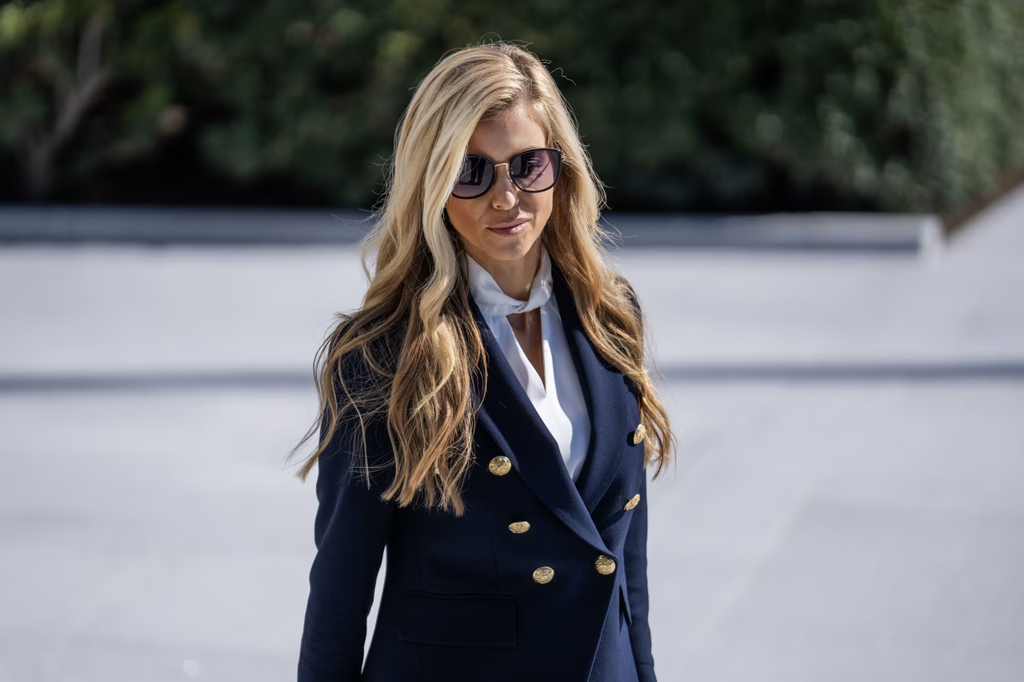
White House press secretary Katie Zacharia has acknowledged that she never passed a U.S. bar exam, addressing questions about her legal credentials after describing herself as a lawyer and being identified as an attorney by President Donald Trump.
In an interview Thursday with conservative commentator Jack Posobiec, Zacharia confirmed that she took the California bar exam in 2011 but failed. Her admission followed a Wall Street Journal report that she had not passed the bar in any other U.S. state where she had lived.
Zacharia graduated from Pepperdine University’s law school and has said she worked in international transactions after moving to China with her husband. However, earning a law degree and being licensed to practice law are separate qualifications in the United States.
The distinction has become central to the controversy surrounding her professional background. While the White House has defended her qualifications for the press secretary role, questions remain about what credentials she held while working in China and how she previously described her legal experience.
What Did Katie Zacharia Say About the Bar Exam?
During Thursday’s interview, Zacharia acknowledged that she had taken the California bar exam but did not pass.
She attributed the result partly to personal circumstances at the time, including preparations for her marriage and plans to relocate to China for her husband’s job. She said she did not attach much importance to the outcome because passing the examination was not necessary for the work she intended to pursue in China.
The admission followed questions from reporters earlier in the week about where she had passed the bar exam. As Trump departed for a trip to Alaska, Zacharia responded, “I went to China,” prompting further questions about whether she held a U.S. law license.
In her Thursday interview, she also disputed suggestions that she had deliberately represented herself as an attorney licensed to practice law.
“I was very careful how I executed this. I never came across as someone who was an attorney at law,” Zacharia said.
She added that she had consulted multiple experts about how to describe her professional background, arguing that misinformation had circulated about her use of the word “lawyer.”
Her comments have not resolved the central question: what professional credentials did she hold while performing the international transaction work she has described?
What Is the Difference Between a Law Degree and a Bar License?
Zacharia’s case highlights an important distinction in the U.S. legal profession: graduating from law school does not, by itself, authorize someone to practice law.
A Juris Doctor (J.D.) is an academic degree awarded by a law school. Admission to a state bar is a separate process that generally involves meeting eligibility requirements, passing the relevant bar examination or qualifying through an alternative route, and satisfying character and fitness requirements.
The precise rules vary by jurisdiction, and certain legal or international business roles may not require the same license as representing clients in court.
However, the distinction matters when a person describes their professional background as that of a lawyer or attorney. The meaning of those terms can depend on the context, applicable law, and the specific activities performed.
In Zacharia’s case, the available information establishes that she earned a law degree from Pepperdine and did not pass the California bar exam in 2011. It does not, on its own, establish the full scope of her subsequent professional qualifications or the legal services she was authorized to provide in China.
That distinction is essential to understanding the controversy without conflating an unsuccessful bar examination with the absence of all legal training or experience.
Did Zacharia Work as a Corporate Lawyer in China?
Zacharia has previously described herself as a corporate lawyer who lived and worked in Beijing for three years.
During an appearance on Fox News in April, she discussed her experience in China. A White House official also said she moved there with her husband, who worked for an American private equity firm, and worked on international transaction law.
In a statement to CBS News on Thursday, Zacharia said she had practiced international transaction law with all the appropriate credentials. However, it remains unclear which credentials she was referring to.
The distinction is significant because legal practice in China is governed by its own professional and licensing requirements. Only Chinese nationals may take China’s national legal professional qualification examination, according to the account provided in the reporting. Foreign nationals may undertake certain legal, consulting, or international transactional work, but the scope of permitted activities depends on the applicable rules and circumstances.
Consequently, the fact that Zacharia did not pass a U.S. bar examination does not, by itself, establish that she could not perform any legal-related work in China. Equally, describing her work as international transaction law does not establish that she held a license to practice law in either the United States or China.
The available information does not clarify the precise legal status under which she worked, the nature of her responsibilities, or the credentials she cited. Those questions remain separate from the confirmed fact that she graduated from law school.
Why Has the Word “Lawyer” Become a Point of Contention?
The controversy extends beyond the failed examination to how Zacharia has publicly described her professional background.
Her Instagram biography identifies her as a lawyer. Trump has also referred to her as an attorney in a post on Truth Social, describing her as a distinguished graduate of Pepperdine University and its Caruso School of Law.
Zacharia has argued that she did not present herself as an “attorney at law.” She told The New York Times that she had discussed the issue with Pepperdine’s president after she began appearing on cable news.
According to the newspaper’s account, she said she had been warned against using the terms “attorney” or “esquire,” but was told that “lawyer” was acceptable.
That reported conversation raises questions about the distinction between describing an academic background and implying professional licensure. However, without the full context of the advice she received, it would be premature to draw conclusions about whether her use of the term violated any particular rule.
The terminology also varies across contexts. In everyday conversation, “lawyer” may refer broadly to someone trained in law. In professional and regulatory settings, however, the same description can create an expectation that the individual is authorized to provide legal services.
The central issue is therefore not simply whether Zacharia earned a law degree. It is whether her public descriptions accurately conveyed the nature and limits of her professional qualifications.
How Has the White House Responded?
The White House has defended Zacharia’s suitability for the press secretary position despite the questions surrounding her legal credentials.
White House communications director Steven Cheung described her as a valuable addition to the administration and emphasized her ability to communicate its policies to the public.
“Katie is a fabulous and wonderful addition to the team,” Cheung said in a statement to CBS News. He also called her “uniquely qualified and whip smart” and expressed confidence that she would perform well in the role.
The administration’s defense focuses on her ability to serve as a spokesperson rather than on whether she holds a U.S. law license.
That distinction matters. The White House press secretary is responsible for communicating the president’s positions, answering questions from journalists, and explaining administration policy. The position does not inherently require admission to a state bar.
Nevertheless, the controversy has drawn attention because Zacharia’s legal background forms part of her public professional identity. Questions about that background are likely to persist until the nature of her credentials and past work is explained more fully.
What Remains Unclear About Her Professional Credentials?
Several questions remain unanswered based on the available reporting:
- Her licensing status: The reporting says she failed the California bar exam in 2011 and did not pass the bar in other states where she had lived. The complete record of any other professional authorizations has not been established.
- Her work in China: Zacharia says she worked on international transactions, but the precise scope of her responsibilities and the credentials under which she performed that work remain unclear.
- Her use of professional titles: She disputes claims that she represented herself as an attorney at law. The controversy concerns how her descriptions would reasonably have been understood, not merely which words she used.
- The advice she received: Her account of discussions with Pepperdine’s president suggests she sought guidance about professional terminology. The full circumstances and substance of that advice have not been independently established in the information available.
These distinctions are important for accurate reporting. A failed bar examination is a verifiable professional fact, but it does not automatically establish dishonesty, unlawful practice, or a lack of expertise in every aspect of legal work.
Likewise, a law degree does not confer the same authority as a professional license. Any definitive conclusion about Zacharia’s conduct would require evidence addressing the particular representation, activity, and rules involved.
Why Does the Controversy Matter?
The dispute comes at a time when public officials face intense scrutiny over their qualifications, past statements, and professional histories.
For a White House press secretary, credibility is central to the job. The person briefing journalists is expected to explain the administration’s positions accurately and respond to difficult questions under pressure.
Questions about professional credentials can therefore become politically significant even when the role itself does not require those credentials. They can affect public perceptions of transparency and the administration’s willingness to address uncomfortable issues.
At the same time, the facts need to be kept in proportion. Zacharia’s failure to pass the California bar examination does not mean she lacks a law degree, nor does it establish that she was unqualified for her current communications position.
The unresolved issue is whether her descriptions of her past work and professional standing gave audiences an accurate understanding of her qualifications.
The Bottom Line
Katie Zacharia has acknowledged that she never passed a U.S. bar examination, confirming that she failed California’s exam in 2011. She maintains that she worked on international transactions in China with the appropriate credentials and disputes the suggestion that she falsely presented herself as an attorney at law.
The White House has defended her ability to serve as press secretary, a position that does not itself require a law license.
What remains unclear is the exact nature of the credentials Zacharia held while working in China and how her professional descriptions should be understood in light of her licensing history.
Until those questions are answered, the most accurate conclusion is that Zacharia holds a law degree but has acknowledged that she did not pass the California bar exam. The broader questions about her past professional status remain unresolved.