
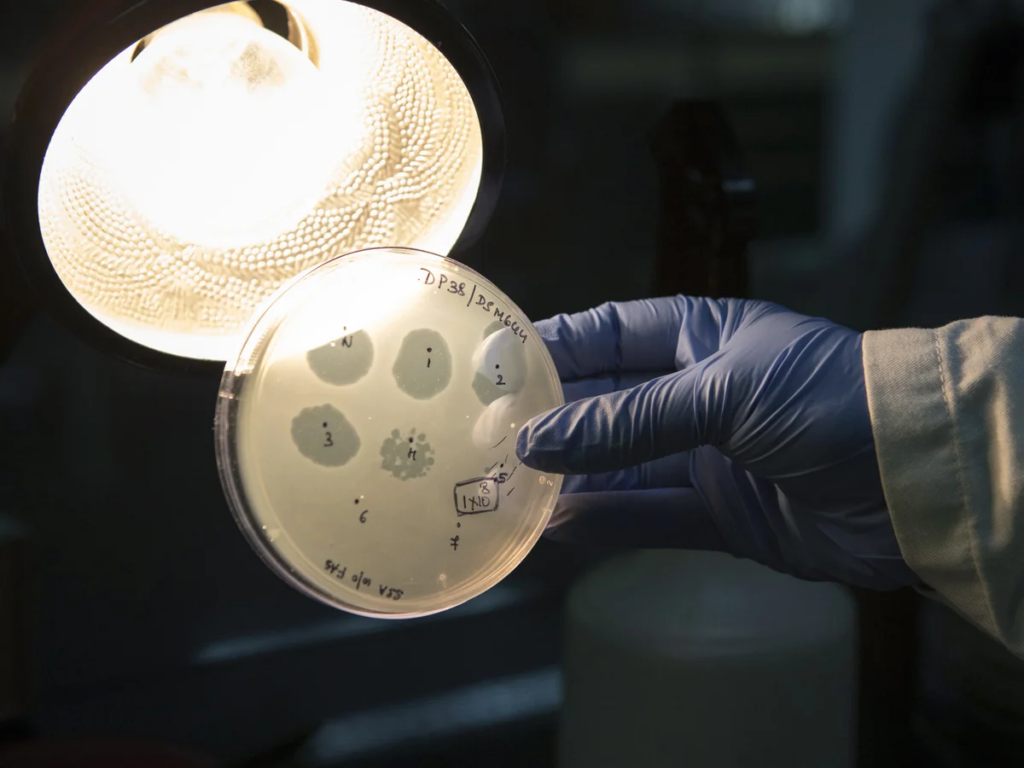
Artificial intelligence has helped scientists design functional viruses that have never existed in nature, marking a significant milestone in synthetic biology. While the achievement could accelerate the development of new treatments for drug-resistant bacterial infections, it has also reignited concerns about biosafety and the potential misuse of increasingly powerful AI tools.
The research, published in the journal Science, has sparked alarm on social media, with some users warning of “zombie viruses” and lab leaks. However, the viruses created in the study were bacteriophages, a type of virus that infects bacteria, not humans, animals, or plants.
Here’s what researchers accomplished, why it matters, and why experts say stronger safeguards are needed.
What did scientists create?
Researchers led by Dr. Brian Hie of Stanford University used artificial intelligence to design entirely new genomes for bacteriophages, commonly known as phages.
Phages are viruses that infect and kill bacteria. They do not infect humans.
Using AI-generated genetic sequences, the researchers synthesized the viral genomes in the laboratory and tested whether they could function as intended.
Several of the engineered phages successfully infected and destroyed strains of Escherichia coli (E. coli) that are resistant to naturally occurring bacteriophages.
The work represents one of the first demonstrations that generative AI can design entirely novel, functional viral genomes.
Why is this considered a breakthrough?
The study could significantly advance phage therapy, an emerging medical approach that uses bacteriophages instead of antibiotics to fight bacterial infections.
Scientists hope AI-designed phages could eventually help combat:
- Antibiotic-resistant bacteria.
- Hospital-acquired infections.
- Hard-to-treat bacterial diseases.
- Bacteria that have evolved resistance to naturally occurring phages.
Because AI can rapidly generate thousands of potential genome designs, researchers may be able to develop customized phages much faster than through conventional methods.
How did AI design the viruses?
The researchers used genome language models known as Evo 1 and Evo 2.
Rather than writing viral DNA manually, the AI models learned patterns from approximately 2 million bacteriophage genomes.
Importantly, the models were not trained on viruses that infect humans, animals, or plants, reducing the likelihood of generating dangerous pathogens.
The research process involved:
- Training AI on bacteriophage genetic sequences.
- Generating thousands of candidate viral genomes.
- Selecting roughly 300 promising designs.
- Synthesizing those genomes in the laboratory.
- Using bacteria to assemble the viruses.
- Testing whether the new phages could infect drug-resistant E. coli.
Only 16 of the synthesized viruses proved functional, illustrating that creating viable organisms remains technically challenging.
Does this mean AI created dangerous new viruses?
No.
The viruses created in this study infect bacteria only.
There is no evidence that the engineered phages can infect humans or other animals.
However, the research demonstrates that AI can now generate functioning viral genomes, a capability that has prompted biosecurity experts to call for stronger oversight before similar techniques are applied to more complex organisms.
Why are biosafety experts concerned?
Although the study focused exclusively on bacteriophages, several experts argue that the technology’s rapid progress raises important long-term questions.
In an accompanying commentary, Professor Tom Inglesby and Dr. Moritz Hanke of the Johns Hopkins Center for Health Security wrote that generative AI now has the capability to compose viral genomes, while governance and oversight have not kept pace.
Potential concerns include:
- Misuse by malicious actors.
- Creation of novel pathogens with harmful properties.
- Insufficient oversight of increasingly capable AI models.
- Uneven biosafety standards across laboratories.
The researchers emphasized that these risks do not stem from the current study alone but from the broader trajectory of AI-assisted biological design.
Why are people comparing this to COVID-19?
Some social media users cited ongoing debates about the origins of COVID-19 to argue that scientists should avoid creating new viruses in laboratories.
However, those reactions largely reflect public concern rather than evidence related to the current research.
The study itself did not involve human viruses, nor does it support claims about the origins of COVID-19.
Scientists involved in the work argue that AI-designed phages could become valuable medical tools if developed responsibly under strict safety standards.
What safeguards are researchers recommending?
The authors and independent experts agree that advances in AI-driven biology should be accompanied by stronger governance.
Recommended safeguards include:
- Independent biosafety reviews.
- Biosecurity assessments throughout research projects.
- Careful oversight of powerful biological AI models.
- Strict laboratory containment procedures.
- Responsible publication practices.
- International cooperation on governance standards.
Many researchers argue that safety measures should evolve alongside advances in AI rather than after problems emerge.
What happens next?
The study demonstrates that AI can successfully design functional bacteriophages, opening new possibilities for medicine and biotechnology.
Future research is likely to focus on improving the efficiency of AI-generated genome design and exploring therapeutic applications against antibiotic-resistant bacteria.
At the same time, policymakers and biosecurity experts are expected to intensify discussions about how to regulate increasingly powerful AI systems capable of designing biological molecules and organisms.
TL;DR
Scientists have used AI to design functional bacteriophages, viruses that infect bacteria, creating viral genomes that do not exist in nature. The research could transform treatments for antibiotic-resistant infections but has also raised concerns about biosecurity and the potential misuse of AI-assisted biological design. The engineered viruses do not infect humans, and experts say stronger safeguards are needed as the technology advances.