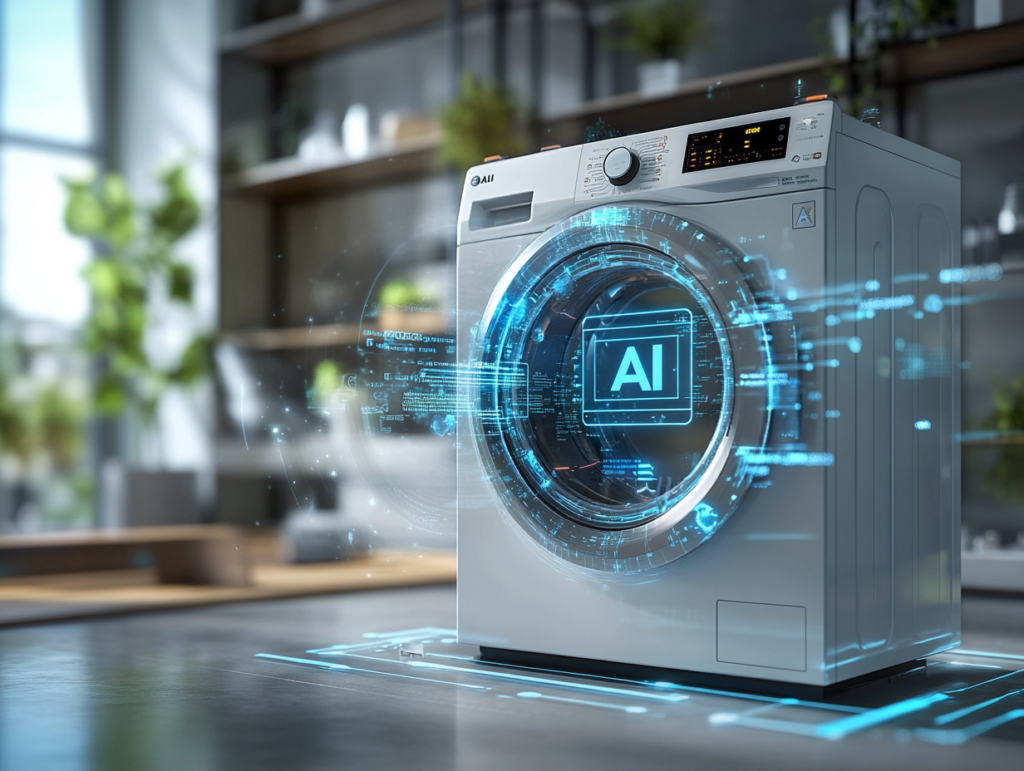
Artificial intelligence is transforming industries, but the hype surrounding it is creating a new problem: AI washing.
From healthcare promises that sound closer to science fiction than science, to layoffs blamed on “AI efficiencies,” and household appliances marketed as intelligent machines, companies are increasingly stretching the truth about what artificial intelligence can actually do. The result is a growing gap between public perception and reality.
Much like greenwashing turned sustainability into a marketing slogan, AI washing is turning artificial intelligence into a catch-all label used to attract investors, reassure shareholders, and persuade consumers.
As billions of dollars flow into AI, understanding where genuine innovation ends and marketing spin begins has never been more important.
What is AI washing?
AI washing refers to the practice of exaggerating, misrepresenting, or falsely claiming artificial intelligence capabilities in products, services, or business operations.
The goal is usually straightforward:
- Attract investors
- Increase product sales
- Boost company valuations
- Generate media attention
- Justify business decisions
In many cases, the AI component may be minimal, unproven, or absent.
The concept mirrors greenwashing, where companies market products as environmentally friendly despite offering little measurable environmental benefit.
Today, AI has become the latest buzzword capable of influencing stock prices, consumer behavior, and corporate reputation.
Why AI washing is becoming more common
The AI boom has created intense pressure on companies to appear technologically advanced.
Investors want exposure to AI. Consumers expect AI-powered products. Executives fear being perceived as falling behind competitors.
As a result, businesses across sectors are racing to attach AI labels to products and strategies, even when the technology involved is relatively basic.
This pressure has created a marketplace where perception often matters more than technical reality.
The startup funding effect
Many startups now position themselves as AI companies because the label can increase investor interest.
In some cases, businesses simply build interfaces around existing large language models and present the result as proprietary AI innovation.
While such products may provide value, the marketing often implies deeper technological breakthroughs than actually exist.
Can AI really cure diseases?
One of the most ambitious claims frequently promoted by AI advocates is that artificial intelligence will cure diseases.
The reality is far more nuanced.
AI has become a powerful tool for researchers, physicians, and pharmaceutical companies. It can analyze large datasets, identify patterns, assist in diagnostics, and accelerate certain stages of drug development.
But AI is not independently discovering cures.
Doctors, scientists, researchers, and clinical investigators remain central to every major medical breakthrough.
The lessons from IBM Watson Health
Few examples illustrate AI hype better than IBM Watson Health.
The platform was promoted as a revolutionary system capable of assisting cancer diagnosis and treatment decisions. Expectations were enormous.
However, investigations later revealed limitations in how recommendations were generated, including reliance on hypothetical scenarios and limited datasets rather than extensive real-world clinical evidence.
Several healthcare organizations scaled back adoption, and IBM eventually sold significant portions of the Watson Health business.
The case remains one of the most cited examples of AI expectations exceeding practical clinical outcomes.
AI can accelerate research, not replace science
Drug discovery companies increasingly use AI to identify promising compounds faster than traditional methods.
This can shorten parts of the research process.
However, every potential treatment still requires:
- Laboratory validation
- Animal testing
- Multiple phases of human clinical trials
- Regulatory review and approval
- Long-term safety monitoring
AI can help researchers move faster, but it cannot bypass the scientific method.
Why doctors remain essential
Medical imaging offers one of AI’s strongest success stories.
AI systems can help identify abnormalities in:
- X-rays
- CT scans
- Mammograms
- MRI scans
Yet these systems function primarily as decision-support tools.
Human oversight remains necessary because AI models can produce errors, miss unusual cases, and perform differently across patient populations.
The future of healthcare is likely to involve doctors working alongside AI, not being replaced by it.
How AI is being used to justify layoffs
Another growing form of AI washing involves workforce reductions.
In recent years, many technology companies have announced layoffs while simultaneously highlighting AI-driven productivity gains.
The messaging often suggests that automation has made certain jobs unnecessary.
The reality is frequently more complicated.
The economics behind the cuts
Building advanced AI systems requires enormous investment.
Companies are spending billions on:
- AI chips and GPUs
- Data centers
- Cloud infrastructure
- Electricity and cooling systems
- AI research and development
At the same time, many firms are still adjusting after aggressive hiring during the pandemic era.
In this context, layoffs are often driven by traditional financial considerations rather than direct AI replacement.
Framing job cuts as AI efficiency can make difficult decisions appear strategic and future-focused, even when the primary motivation is cost reduction.
The narrative shareholders want to hear
Investors generally reward companies that demonstrate operational efficiency.
Associating layoffs with AI transformation can create a more appealing story than admitting that a company is simply cutting costs to protect profitability.
This doesn’t mean AI plays no role. It often does.
But the connection is frequently more complex than public announcements suggest.
When “AI-powered” products depend on human workers
One of the most striking examples of AI washing involves products marketed as autonomous systems that rely heavily on hidden human labor.
The Amazon Just Walk Out controversy
Amazon’s Just Walk Out technology was promoted as a cashierless shopping experience powered by advanced AI.
Customers could enter stores, pick up products, and leave without traditional checkout.
Later reports indicated that large numbers of human reviewers were involved in validating transactions and correcting system errors.
The revelation highlighted an uncomfortable reality: some AI products marketed as fully autonomous still depend significantly on human intervention behind the scenes.
This phenomenon has become known by some researchers as the “human-in-the-loop” problem hidden beneath AI branding.
Are companies rebranding old technology as AI?
In many cases, yes.
Not every product marketed as AI relies on modern machine learning systems or generative AI models.
Many products use technologies that have existed for years, including:
- Rule-based automation
- Statistical analysis
- Recommendation engines
- Predictive software
- Traditional algorithms
These technologies can be useful and effective.
The issue arises when companies repackage them as cutting-edge AI innovations without explaining the difference.
Consumers often assume that AI implies sophisticated learning and adaptation, when the underlying functionality may be far simpler.
Why so many consumer products suddenly claim to use AI
The AI label has expanded far beyond software.
Today, companies market a growing range of products as AI-powered, including:
- Refrigerators
- Washing machines
- Robot vacuums
- Air purifiers
- Smart watches
- Beauty devices
- Smart glasses
- Home automation systems
Some products genuinely incorporate machine learning features.
Others rely primarily on sensors, automation rules, or pattern recognition systems that have existed for years.
Marketing materials frequently emphasize the AI aspect while downplaying how limited the technology actually is.
For consumers, the key question is not whether a product uses AI, but whether the technology provides meaningful benefits.
Are regulators taking AI washing seriously?
Regulators are beginning to pay closer attention.
Authorities increasingly view misleading AI claims as more than simple marketing exaggeration.
They are examining whether such statements could mislead investors and consumers.
A notable example came in 2024 when the U.S. Securities and Exchange Commission (SEC) charged investment advisers Delphia (USA) Inc. and Global Predictions Inc. for allegedly making misleading statements regarding their AI capabilities.
The enforcement action signaled that regulators may treat AI-related misrepresentations as disclosure violations rather than harmless promotional language.
As AI investment continues to grow, scrutiny is likely to increase.
Why AI washing matters
AI washing is not merely a marketing problem.
It affects:
- Investor decision-making
- Consumer trust
- Public understanding of technology
- Healthcare expectations
- Employment discussions
- Regulatory oversight
When exaggerated claims dominate headlines, they distort how society evaluates genuine technological progress.
The danger is not that AI lacks value. It clearly does.
The danger is that inflated promises create unrealistic expectations, making it harder to distinguish meaningful innovation from clever branding.
TL;DR
- AI washing is the practice of exaggerating or misrepresenting AI capabilities.
- Healthcare claims often overstate what AI can currently achieve.
- AI is helping medical research but has not independently cured diseases.
- Some companies use AI narratives to justify layoffs that are largely driven by cost-cutting.
- Certain AI-branded products rely heavily on human labor behind the scenes.
- Many businesses are rebranding existing software and automation tools as AI.
- Regulators are beginning to crack down on misleading AI claims.
- Consumers and investors should focus on measurable outcomes rather than AI labels.