

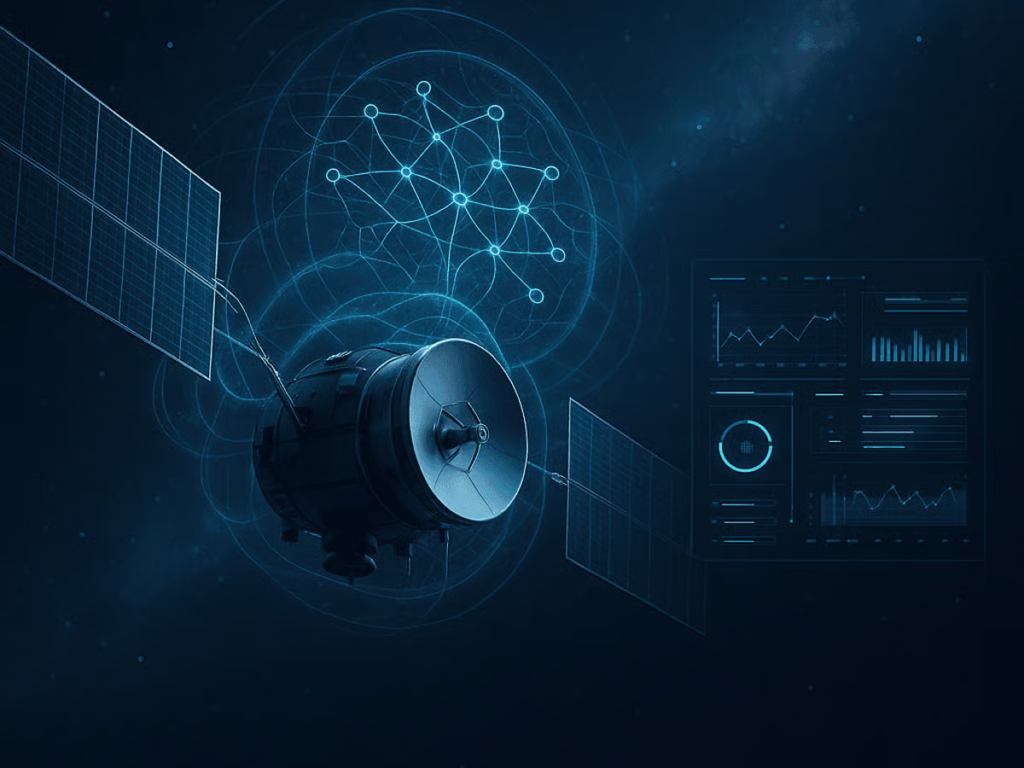
A spacecraft could soon operate through an entire mission without receiving a single command from Earth.
Asteroid-mining startup AstroForge says its upcoming Autonomy-1 mission will hand control of the spacecraft to an artificial intelligence system called Solo after it separates from its launch vehicle. The company plans to launch the mission in early 2027 aboard the first flight of Stoke Space’s Nova Pathfinder rocket.
AstroForge says Autonomy-1 will transmit telemetry and scientific data back to Earth, but the communication will be one-way. Ground controllers will be able to observe what the spacecraft is doing, but they will not send commands back to control it.
That would be a significant step toward spacecraft that can make operational decisions independently, particularly as missions venture farther from Earth and communication delays make real-time intervention impossible.
There is an important qualification, however: this is a planned demonstration, not a capability that has already been proven in space.
What is AstroForge’s Solo AI?
Solo is an in-house spacecraft intelligence system developed by AstroForge.
The company describes it as a transformer-based model that sits above its existing deterministic, physics-based flight software. Rather than replacing the traditional systems responsible for basic spacecraft control, Solo acts as a higher-level decision-making layer.
It monitors the spacecraft’s condition, looks for abnormal behavior and determines what actions should be taken.
AstroForge says Solo can coordinate different onboard systems in real time, allowing the spacecraft to respond to problems without waiting for instructions from a ground team.
The company has also trained the system using data from thousands of spacecraft sensors, giving it access to information about the spacecraft’s health that would normally have to be analyzed by operators on Earth.
How will Solo control the spacecraft?
The architecture is designed around three basic functions: sensing, deciding and acting.
First, Solo receives information from the spacecraft’s onboard systems and sensors.
It then assesses that information to determine whether the spacecraft is operating normally or whether a subsystem has entered an abnormal state.
Finally, it coordinates the appropriate response using the spacecraft’s existing control systems.
That means Solo is not intended to directly replace every piece of flight software. Instead, it would sit above the established control architecture and decide which actions should be taken while the underlying deterministic systems handle the physical execution.
This layered approach is important because spacecraft cannot rely entirely on a general-purpose AI model for basic safety-critical control.
What happens if the spacecraft develops a problem?
Anomaly handling is one of the main reasons AstroForge is developing Solo.
On a conventional mission, spacecraft send information to Earth, engineers examine the telemetry and then determine what commands should be transmitted back.
That process works well when communication is reliable and the delay is manageable.
In deep space, however, it can take minutes or longer for a signal to travel between Earth and a spacecraft. By the time a ground team identifies a problem and sends instructions, the spacecraft may already be in a different state.
Solo is intended to shorten that loop from minutes or hours to essentially real time.
For example, AstroForge has described a scenario in which the system detects that a spacecraft has lost its position estimate, connects the problem to a star-tracker issue and takes corrective action by managing the affected subsystem.
The objective is not simply to automate routine commands. It is to give the spacecraft enough onboard reasoning capability to respond when conditions do not match expectations.
When will Autonomy-1 launch?
AstroForge currently plans to launch Autonomy-1 in the first quarter of 2027.
The spacecraft is scheduled to fly on the first orbital flight of Stoke Space’s Nova Pathfinder launch vehicle from Cape Canaveral Space Force Station in Florida.
Stoke Space said in September 2026 that Nova Pathfinder’s first flight remains targeted for early 2027 and that AstroForge’s Autonomy-1 will be one of the customer payloads.
Because the rocket itself will be making its first orbital flight, the mission involves two technology demonstrations at once: Stoke will be testing a new launch vehicle, while AstroForge will be testing autonomous spacecraft operations.
Is this really the first spacecraft controlled entirely by AI?
That claim needs some careful wording.
AstroForge describes Autonomy-1 as the first space mission intended to complete its entire mission after separation without a single command from the ground.
That is different from saying it is the first spacecraft ever to use artificial intelligence.
NASA demonstrated significant onboard autonomy decades ago.
In 1999, NASA’s Deep Space 1 used an artificial-intelligence-based system called Remote Agent to plan and execute spacecraft activities with high-level goals provided from Earth. The system monitored spacecraft health and was capable of dealing with certain faults on its own.
Other missions have also performed important activities autonomously. NASA’s OSIRIS-REx, for example, used onboard navigation systems to autonomously guide its spacecraft during its approach to asteroid Bennu and its sample-collection operations.
The distinction is therefore between AI-assisted or phase-specific autonomy and AstroForge’s proposed end-to-end mission autonomy without ground commands after separation.
How is Solo different from NASA’s earlier autonomous systems?
NASA’s Remote Agent was an important milestone, but it operated within a mission architecture where human controllers remained responsible for the overall mission and could provide high-level goals.
Other spacecraft have also been capable of navigating or carrying out individual sequences autonomously while still remaining connected to ground teams.
AstroForge is proposing something more sweeping.
Once Autonomy-1 separates from its rocket, the company’s stated plan is not to send the spacecraft a command at all.
Ground teams will continue receiving telemetry and science data, but information would flow only from the spacecraft to Earth.
That creates a fundamentally different operational model. The humans become observers rather than active pilots.
What is DeepSpace-2 and why is it important?
AstroForge does not plan to jump directly from development to full operational autonomy.
Before Autonomy-1, the company says its DeepSpace-2 mission will carry Solo in shadow mode.
In that configuration, Solo will operate onboard and analyze real spacecraft data, but its decisions will not actually control the vehicle.
Engineers will instead compare what Solo wants to do with what human controllers and the existing flight systems determine should happen.
The shadow-mode phase is effectively a dress rehearsal. It allows AstroForge to expose the AI to real spacecraft behavior without immediately giving it authority over the vehicle.
That provides a valuable test of whether the system can correctly interpret unexpected situations before its decisions are allowed to affect the spacecraft.
Why does spacecraft autonomy matter?
The farther a spacecraft travels from Earth, the more difficult traditional mission control becomes.
Radio signals cannot travel instantly. Even at the speed of light, communication between Earth and a spacecraft separated by large distances introduces unavoidable delays.
Deep-space missions also rely on large ground antennas and specialized mission-control teams to analyze telemetry and generate commands.
AstroForge says those ground operations account for nearly one-third of its overall mission costs.
For a small startup, maintaining a large team of specialists and continuous access to expensive ground infrastructure can become a major limitation.
Autonomy could reduce that dependence by moving part of the decision-making process directly onto the spacecraft.
What does “zero commands from Earth” actually mean?
It does not mean Earth will lose all contact with the spacecraft.
AstroForge plans for Autonomy-1 to continue transmitting telemetry and science information back to Earth.
Engineers would therefore be able to monitor the spacecraft, analyze what Solo is doing and collect scientific data.
What changes is the direction of control.
Under the company’s stated mission plan, the spacecraft would not receive commands after separation. Earth would become a monitoring destination rather than a command center.
That distinction matters because the phrase “no commands” can otherwise give the impression that the spacecraft will become completely disconnected.
It will not. The proposed system simply removes the ground-to-space control link from the operational loop.
What scientific payload will the spacecraft carry?
Autonomy-1 will not be an empty technology demonstration.
AstroForge says the spacecraft will carry COMPASS, a heliophysics science payload from NASA Goddard Space Flight Center.
That raises the stakes for Solo because the AI will not only be responsible for keeping the spacecraft operating. It will also have to coordinate the systems supporting a real scientific instrument.
The mission therefore offers a simultaneous demonstration of autonomous spacecraft control and science operations.
A successful result would provide stronger evidence that autonomous decision-making can handle useful work rather than simply keeping an otherwise empty vehicle alive.
Why is AstroForge interested in autonomy?
The company’s ultimate business goal is asteroid mining.
Mining resources from asteroids would require spacecraft to travel large distances and potentially operate in environments where communication with Earth is limited.
An asteroid-mining fleet could become especially difficult to manage if every vehicle required a dedicated team of human operators constantly monitoring its systems.
AstroForge’s broader strategy is therefore to make its spacecraft increasingly self-reliant.
Solo is intended to address one of the biggest operational limitations of deep-space missions: the need to maintain a human decision-maker in the loop even when communication is slow and expensive.
What could an autonomous spacecraft do on its own?
A system such as Solo could potentially handle a variety of tasks that currently require human intervention.
These could include detecting subsystem failures, changing operating modes, responding to navigation problems and adjusting mission plans when conditions differ from expectations.
The advantage is not simply speed.
An AI onboard has access to the spacecraft’s data at the moment it is generated. A ground team must wait for some of that information to be transmitted, received and processed.
An autonomous system could therefore respond to certain problems before a human operator on Earth even knows they have occurred.
That could become increasingly important for missions operating far beyond Earth’s immediate neighborhood.
What are the risks of giving AI control?
The same feature that makes autonomous spacecraft attractive also creates the biggest risk.
A human controller can review an unexpected situation, consult other engineers and decide not to follow an automated recommendation.
An autonomous spacecraft does not have that option if there is no command path back from Earth.
A mistake by Solo could therefore become difficult or impossible to correct.
The risk is particularly important because transformer-based AI systems are fundamentally different from traditional deterministic flight-control software. Conventional control algorithms are designed around explicit rules and carefully bounded behavior. An AI decision layer can behave in more complex ways that are harder to predict in every possible circumstance.
AstroForge’s decision to use shadow mode before Autonomy-1 reflects that challenge.
Why keep the deterministic software underneath the AI?
The layered architecture provides a form of engineering redundancy.
Solo does not replace the traditional flight software responsible for fundamental spacecraft control.
Instead, the AI operates at a higher level and makes decisions while the underlying physics-based systems execute them.
This creates a separation between reasoning and basic control.
If successful, that could combine the flexibility of AI-based decision-making with the predictability of conventional spacecraft software.
It also means that the system is not simply handing every spacecraft function to a chatbot-like model.
The AI is being integrated into a conventional flight architecture rather than replacing the entire architecture.
Can AI really solve deep-space communication problems?
It cannot eliminate the physical delay imposed by the speed of light.
What it can do is reduce the need to wait for a human decision.
That distinction becomes increasingly important as missions move farther from Earth.
For a spacecraft near Earth, ground control can often respond quickly enough that onboard autonomy is primarily about convenience and efficiency.
For distant spacecraft, waiting for instructions can become a fundamental operational problem.
An autonomous system can act immediately because it does not have to wait for a round-trip communication cycle.
That is why the technology being tested by AstroForge could have applications far beyond asteroid mining.
Could this technology be used for future NASA missions?
Potentially, although NASA and other space agencies are already developing their own autonomous-navigation and onboard decision technologies.
NASA’s Deep Space 1 demonstrated AI-based onboard planning in the 1990s, and more recent spacecraft have increasingly relied on autonomous navigation for complex maneuvers.
NASA is also developing newer autonomous navigation technologies intended for future lunar and deep-space missions.
AstroForge’s work could nevertheless provide another real-world test of how more modern machine-learning systems can operate as part of spacecraft control architectures.
If the technology performs reliably, it could become relevant to future commercial and government missions where communication delays or operating costs make constant human intervention impractical.
What will scientists and engineers be watching?
Several milestones will determine whether AstroForge’s approach works.
The first is DeepSpace-2’s shadow-mode performance.
Engineers will want to know whether Solo’s decisions consistently agree with expected spacecraft behavior and whether it correctly identifies anomalies without generating unnecessary interventions.
The second is Autonomy-1’s launch and separation.
The mission must first survive the normal challenges of launch and deployment before the autonomy experiment even begins.
The third is what happens when Solo encounters something unexpected.
That will be the real test. Demonstrating autonomous behavior during normal conditions is useful, but the promise of the system rests largely on its ability to diagnose and respond to anomalies.
What happens if Autonomy-1 succeeds?
A successful mission would not mean that every spacecraft could immediately be handed over to AI.
Space missions require enormous amounts of validation, redundancy and testing before new control systems can be trusted.
But Autonomy-1 could demonstrate that an AI-based intelligence layer is capable of operating a spacecraft continuously without a ground command loop.
That would be a meaningful milestone for commercial spaceflight.
It could also make future spacecraft fleets easier to operate, particularly if companies deploy large numbers of vehicles that would otherwise require individual mission-control teams.
Why this mission is bigger than asteroid mining
AstroForge started developing Solo because autonomous spacecraft are important to its asteroid-mining ambitions.
But the underlying problem is much broader.
Every deep-space mission faces communication delays, limited ground-station availability and the need to make decisions when humans cannot respond immediately.
Moving some of that intelligence onto the spacecraft could allow missions to become more independent as they travel farther from Earth.
AstroForge’s experiment is therefore testing more than a piece of AI software.
It is testing a different philosophy of spaceflight in which Earth sends a spacecraft on its way and, after that point, trusts the vehicle to make many of its own decisions.
The next frontier may be spacecraft that think on their own
Autonomy has been part of space exploration for decades, but most missions have kept humans firmly in charge.
AstroForge’s Autonomy-1 is attempting to push that boundary further by removing the command link altogether after launch-vehicle separation.
The company still has to prove that its system can handle the messy reality of spacecraft operations. Sensors fail, hardware behaves unexpectedly and environments can differ from simulations.
That is why the upcoming shadow-mode test may be just as important as the headline-grabbing 2027 mission.
For now, Solo remains a promise on the ground.
But if AstroForge’s plan works, the next generation of spacecraft may spend less time waiting for Earth to tell them what to do and more time figuring it out for themselves.