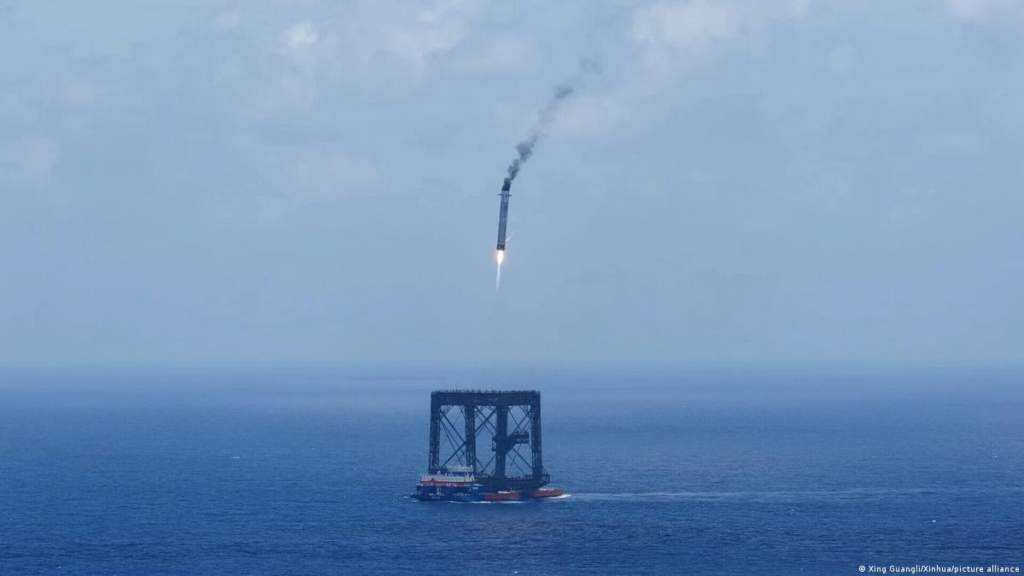
China has reached a major milestone in reusable Rocket, successfully recovering the first stage of its Long March 10B rocket during its maiden launch. The achievement makes China the second country to demonstrate the controlled recovery of an orbital-class rocket booster, joining the United States in a technology that is transforming the economics of space launches.
While the accomplishment has drawn comparisons with SpaceX’s pioneering Falcon 9 program, China’s recovery system takes a different engineering approach. Instead of landing vertically on deployable legs, the Long March 10B booster was captured using a sea-based net suspended from a recovery platform.
What happened during China’s Long March 10B launch?
On July 10, China successfully launched the Long March 10B carrier rocket and recovered its first-stage booster in a controlled operation.
According to Chinese officials, this marked the country’s first successful recovery of an orbital-class reusable rocket booster.
The milestone represents years of research into reusable launch technology aimed at lowering launch costs and increasing launch frequency.
China’s Foreign Ministry described the mission as “a historic day” for the nation’s space program.
Why is reusable rocket technology important?
Traditional rockets are discarded after a single launch, making space missions extremely expensive.
Reusable rockets allow expensive hardware to be recovered, refurbished, and flown again, significantly reducing launch costs.
The technology offers several advantages:
- Lower launch expenses.
- Faster turnaround between missions.
- Increased launch frequency.
- Greater commercial competitiveness.
- More sustainable access to space.
Reusable launch systems have become one of the biggest technological shifts in the global space industry over the past decade.
How does China’s recovery system work?
Unlike SpaceX’s Falcon 9, the Long March 10B does not land directly on its own legs.
Instead, the booster descends toward a sea-based recovery platform equipped with a suspended net.
Landing hooks attached to the booster engage with the net, allowing the rocket to be safely captured without touching the ocean.
This approach differs significantly from traditional vertical landing systems and may reduce some of the engineering challenges associated with deploying landing legs.
Consider adding an infographic comparing China’s net-based recovery system with SpaceX’s vertical landing approach.
How does it compare with SpaceX?
SpaceX became the first company to successfully recover an orbital-class rocket booster in December 2015 with the Falcon 9.
Its recovery process includes:
- Controlled reentry.
- Engine relight during descent.
- Autonomous navigation.
- Precision vertical landing.
- Touchdown on deployable landing legs.
Recovered boosters can often be refurbished and reused for future missions.
China’s Long March 10B follows the same overall objective—recovering the rocket—but uses a fundamentally different landing method.
| Feature | Long March 10B | Falcon 9 |
|---|---|---|
| Recovery method | Net capture | Vertical landing |
| Landing surface | Sea-based platform | Drone ship or landing pad |
| Landing legs | No | Yes |
| Controlled descent | Yes | Yes |
| Reusable booster | Yes | Yes |
Is China the second country to achieve this?
China is among the few nations to successfully demonstrate controlled recovery of an orbital-class rocket booster.
The United States pioneered operational reusable orbital rockets through SpaceX, while Blue Origin has also demonstrated reusable launch capabilities with its New Glenn rocket.
China’s success places it among the global leaders developing reusable launch systems capable of supporting frequent orbital missions.
Why has China spent years developing reusable rockets?
China has invested heavily in reusable launch technology as part of its broader ambitions in commercial spaceflight.
The country is expanding:
- Satellite deployment.
- Space station operations.
- Lunar exploration.
- Deep-space missions.
- Commercial launch services.
Reducing launch costs through reusable rockets could make these programs more economically sustainable.
Were there previous attempts?
Yes.
Chinese aerospace companies have conducted numerous technology demonstrations over the past decade.
These included:
- Hover tests.
- Controlled descents.
- Vertical landing experiments.
- Orbital recovery trials.
According to previous reports, two reusable rocket demonstrations conducted in late 2025 attempted Falcon 9-style vertical landings using landing legs and grid fins but were unsuccessful.
The Long March 10B mission marks the first successful controlled recovery of an orbital-class booster using China’s current recovery approach.
Why does reusable rocketry matter for the space industry?
Launch costs remain one of the biggest barriers to space exploration and commercial satellite deployment.
Reusable rockets have already transformed the industry by making launches significantly more affordable.
Lower costs can benefit:
- Communications satellites.
- Earth observation missions.
- Scientific research.
- Human spaceflight.
- Lunar and Mars exploration.
As more countries develop reusable launch vehicles, competition is expected to accelerate innovation while lowering costs across the global launch market.
What comes next?
China is expected to continue testing and refining the Long March 10B recovery system.
Future milestones will likely focus on:
- Reusing recovered boosters.
- Increasing launch cadence.
- Improving recovery reliability.
- Supporting crewed lunar missions.
- Expanding commercial launch services.
Successfully recovering a booster is only the first step. Demonstrating that the recovered hardware can be rapidly refurbished and flown again will determine how competitive the system ultimately becomes.
TL;DR
- China has successfully completed its first controlled recovery of an orbital-class reusable rocket booster.
- The Long March 10B uses a sea-based net capture system rather than SpaceX-style landing legs.
- The achievement marks a significant step toward lowering launch costs and expanding China’s reusable launch capabilities.
- China has spent nearly a decade developing reusable rocket technology through multiple experimental programs.
- Future testing will determine how effectively recovered boosters can be refurbished and reused.